
8 Cheapest Payment Gateways in Malaysia: Fees Compared
Finding the cheapest payment gateway in Malaysia sounds simple until you read the pricing pages. One provider quotes a flat fee per FPX transaction. Another charges a percentage on cards plus a fixed amount. A third adds setup, monthly, and settlement fees. Comparing them side by side takes time, and a low headline rate can hide costs that erode your margin.
Here is the short answer. For most Malaysian merchants, FPX is the cheapest rail, usually a small flat fee per transaction. Credit cards typically run around 2% to 3% plus fixed fees, and e-wallets sit in between. The best option for you depends on your payment mix and monthly volume, not on the lowest advertised number.
Below, we compare eight gateways on card, FPX, and e-wallet rates, plus the extra payment gateway charges in Malaysia that most lists skip. At CoinPay, we have supported merchants across Southeast and South Asia for five years, so we also flag what to check before you sign: settlement terms, verification requirements, and support quality.
How payment gateway charges work in Malaysia
Most gateways price by payment method, not with one blended rate. Once you understand the three common pricing patterns, comparing the cheapest payment gateway in Malaysia gets much easier.
Pricing by payment method
FPX, Malaysia's online bank transfer network, is almost always a flat fee per transaction. Cards use a percentage plus a small fixed amount. E-wallets such as Touch 'n Go eWallet, GrabPay, and ShopeePay usually charge a percentage only. The table shows typical market ranges, so confirm exact figures on each provider's current price sheet.
| Method | Typical structure | Typical range |
|---|---|---|
| FPX | Flat fee | RM0.50 to RM1.50 per transaction |
| Credit and debit cards | Percentage, sometimes plus a fixed fee | About 2% to 3% |
| E-wallets | Percentage | About 1.5% to 2.5% |
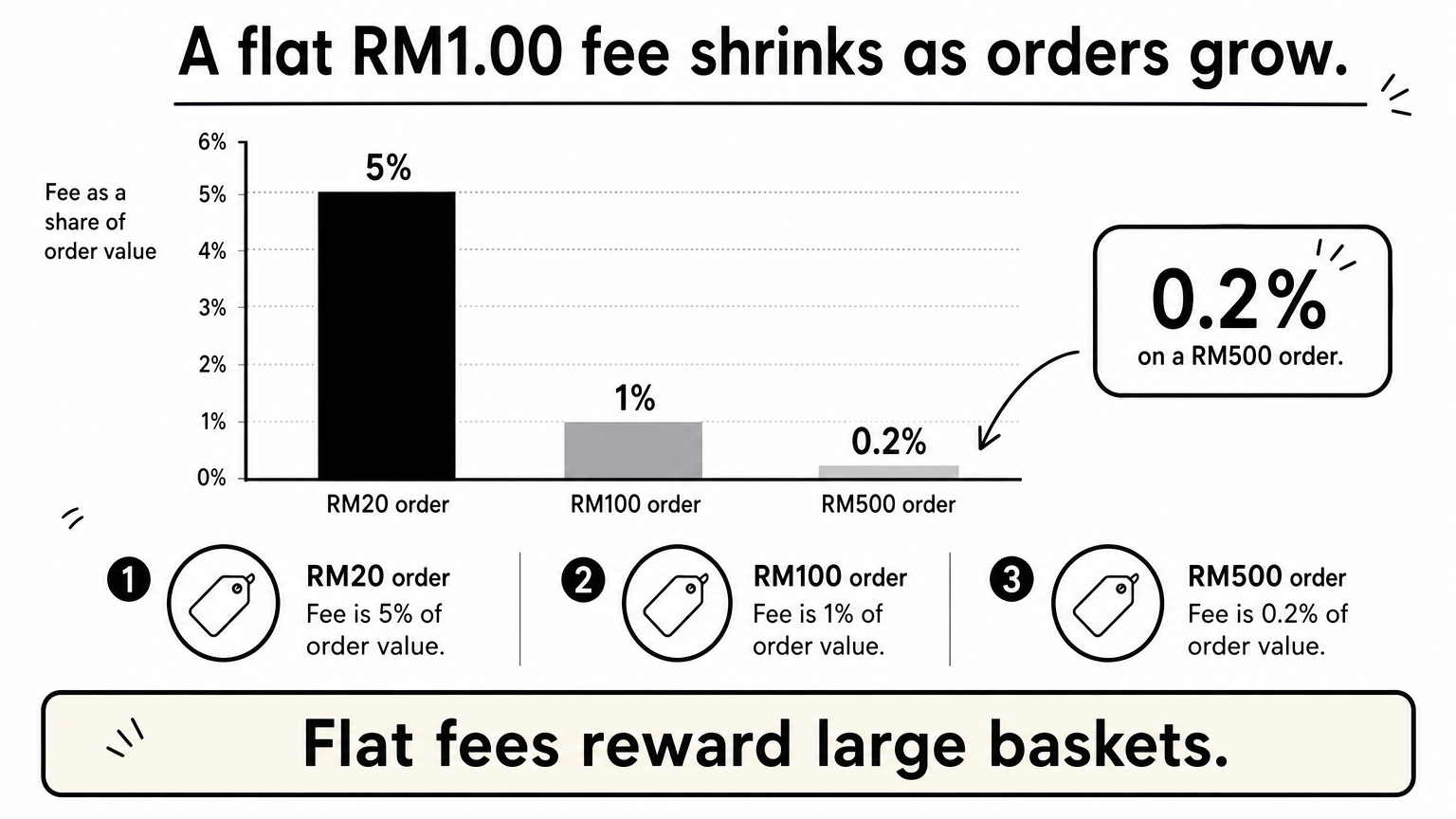
Because FPX is flat, it gets cheaper per ringgit as order value rises. A RM1.00 fee on a RM20 order is 5%. The same fee on a RM500 order is 0.2%. Percentage rates work the other way, so low-ticket sellers often pay less on an e-wallet than on FPX.
Flat fees reward large baskets, and percentage fees reward small ones.
Fees outside the transaction rate
Transaction rates are only part of your total payment gateway charges in Malaysia. Two providers with the same FPX fee can differ by hundreds of ringgit a month once these items are added, so ask for the full fee schedule before you compare:
- Setup or onboarding fees
- Monthly or minimum volume fees
- Settlement or payout fees
- Refund and chargeback fees
- Currency conversion margins on foreign cards
1. CoinPay
Fees and pricing model
CoinPay does not publish a one-size rate card. Pricing is quoted per merchant, based on your market, volume, and payment journey. That is less convenient than reading a number off a page, but the quote reflects your actual business.
The cheapest gateway is the one whose total cost holds up after approval, not the one with the lowest headline rate.
Ask for the full schedule covering FPX, cards, e-wallets, settlement, and refunds. Then you can compare it line by line with the other payment gateway charges in Malaysia on this list.
Payment methods supported
CoinPay organizes its Malaysia payment gateway by market, payment journey, and settlement need. Local payment methods are the focus, and you should confirm your exact Malaysian mix during scoping:
- Local rails per market, such as PromptPay with THB settlement in Thailand
- Coverage across Malaysia, Thailand, Vietnam, the Philippines, Bangladesh, India, and Indonesia
- A separate USDT payment service for crypto and stablecoin flows
Settlement and onboarding
Expect a real review. CoinPay rejects scams, money-games, and deceptive schemes, so approval is stricter than on self-signup gateways. The flow looks like this:
- Submit a structured application
- Pass KYC, due diligence, and compliance checks
- Integrate, then go live with ongoing support
Who it is best for
Business owners and finance leads running legitimate e-commerce, gaming, or fintech platforms will get the most from it, especially if you sell in several Asian markets and want one partner. You also get hands-on help improving deposit journeys and monitoring payment performance.
Skip it if you want instant self-serve signup or a public price list. If you want a long-term partner, talk to CoinPay about a quote built around your volume.
2. Billplz
Fees and pricing model
Billplz is known for a simple flat-fee structure. Its FPX pricing has long been about RM1.50 per successful transaction, with no monthly fee on the standard plan. Check the current price sheet, because rates and plan tiers change.
That model rewards bigger baskets. On a RM300 order, RM1.50 is 0.5%. On a RM15 order, it is 10%.
A flat FPX fee only counts as cheap when your average order is large enough to absorb it.
Payment methods supported
FPX online banking is the core of the product, and it suits Malaysian buyers who prefer paying from their bank account. Depending on your plan, look for:
- FPX for consumer and business accounts
- Selected cards and e-wallets, which you should confirm at signup
- Payment links and bills that work without a full website
Settlement and onboarding
Signup happens online and is lighter than a bank-style review. Expect to submit your SSM business registration and bank details, then wait for verification.
Payouts usually land within a few business days. Before you commit, get the settlement cycle in writing and ask whether withdrawals carry a fee, since that affects your total payment gateway charges in Malaysia.
Who it is best for
Small sellers, freelancers, schools, and clubs that collect mostly by FPX will find it a strong contender for the cheapest payment gateway in Malaysia, especially when invoices or payment links matter more than a custom checkout.
Merchants with many low-value card or e-wallet sales should compare percentage rates elsewhere. If you need multi-market coverage beyond Malaysia, you will outgrow it.
3. Bizappay
Fees and pricing model
Bizappay leans on a low flat fee for FPX, with entry pricing that has been advertised at roughly RM1 per successful transaction. Cards and e-wallets carry a separate percentage rate. Treat these numbers as a starting point, because plans and rates change.
The lowest FPX fee only wins if setup, monthly, and payout charges stay low too.
Ask whether a plan fee applies. At low volume, that line can outweigh the per-transaction saving in your total payment gateway charges in Malaysia.
Payment methods supported
Coverage matches what most Malaysian shoppers expect at checkout. Confirm what each plan actually includes before you sign:
- FPX for consumer and business accounts
- Credit and debit cards, priced separately
- E-wallets, depending on plan
- Payment links, invoices, and plugins for common store platforms
Settlement and onboarding
Signup runs online, and the review is lighter than a bank-style check. Prepare your SSM registration, bank account details, and a working website or sales channel.
Payout timing varies by plan and payment method, so request the settlement cycle in writing. Also ask about withdrawal fees and minimum payout amounts.
Who it is best for
Small online sellers and service businesses that collect mostly by FPX should shortlist it as a cheapest payment gateway in Malaysia candidate. Average orders above RM50 make the flat fee work harder for you.
If you sell across several countries or need hands-on compliance support, you will want a broader partner.
4. SenangPay
Fees and pricing model
SenangPay targets small merchants with low entry pricing. It has advertised a flat FPX fee of roughly RM1 per successful transaction, with cards and e-wallets on percentage rates. Plans change, so confirm the current price sheet before you commit.
Entry pricing is only a starting point, so price your own payment mix before you choose.
Run your numbers on a typical month. If most orders fall below RM30, a flat FPX fee can cost you more than an e-wallet percentage, and plan or payout fees can widen the gap.
Payment methods supported
Checkout coverage follows what Malaysian shoppers expect. Ask which items your plan actually includes:
- FPX online banking
- Credit and debit cards, priced separately
- Selected e-wallets, depending on plan
- Payment forms, links, and plugins for common store platforms
Settlement and onboarding
Signup happens online and is lighter than a bank-style review. Have your SSM registration, bank account details, and a live sales channel ready.
Payout timing depends on plan and payment method. Get the settlement cycle in writing, then ask about withdrawal fees and minimum payouts, since both feed into your total payment gateway charges in Malaysia.
Who it is best for
New online stores, hobby sellers, and service providers who collect mostly by FPX can fairly shortlist it as a cheapest payment gateway in Malaysia option. Average orders above RM50 let the flat fee work in your favor.
Outgrow it, and you will want more. Merchants selling across borders or needing hands-on compliance support should look at a broader partner.
5. HitPay
Fees and pricing model
HitPay uses pay-as-you-go pricing. It has advertised no monthly fee on its standard plan and no setup fee. You pay per transaction, with FPX as a flat amount and cards and e-wallets as a percentage. Rates change, so confirm the current Malaysia price sheet before you commit.
Pay-as-you-go pricing is cheapest when your volume is small or uneven.
A slow month costs you almost nothing in fixed fees. That makes it a real contender for the cheapest payment gateway in Malaysia if your sales swing by season.
Payment methods supported
Coverage is broad for a gateway aimed at small businesses. Check which methods are live for Malaysian accounts, because availability can differ by country and plan:
- FPX online banking
- Credit and debit cards
- E-wallets such as Touch 'n Go eWallet and GrabPay
- DuitNow QR
- Payment links, invoices, and an in-person POS
Settlement and onboarding
Signup happens online. You create an account, then submit business documents such as your SSM registration and bank details for verification.
Payouts go to your Malaysian bank account on a set schedule. Get that schedule in writing, and ask whether payouts carry a fee, since it adds to your total payment gateway charges in Malaysia.
Who it is best for
Start-ups and small shops that sell both online and in person get the most from it. One account covers your website, payment links, and counter.
Skip it if you need hands-on compliance support or one partner across several Asian markets. In that case, a merchant-focused provider will serve you better.
6. Stripe
Fees and pricing model
Stripe uses pay-as-you-go pricing with no monthly fee on its standard plan. Cards have been advertised at roughly 3% plus a fixed amount per charge, and international cards cost more. Rates change, so confirm the current Malaysia pricing before you commit.
A fixed fee on every card charge hits small baskets harder than a percentage alone.
On a RM20 order, an extra RM1.00 adds 5% on top of the percentage. Check how FPX is priced too, because it may not match the flat fee other gateways on this list quote. Stripe rarely wins on price alone, so it only competes for the cheapest payment gateway in Malaysia when your average order is large.
Payment methods supported
What Stripe offers is polished checkout tools, and availability varies by account. Confirm what is live for Malaysian businesses:
- Credit and debit cards, plus Apple Pay and Google Pay
- FPX online banking
- E-wallets such as GrabPay
- Subscriptions, invoices, and payment links
Settlement and onboarding
Signup is online and quick. Have your SSM registration, director details, and bank account ready. Payouts follow a rolling schedule to your Malaysian bank, and new accounts can face longer holds at first. Ask about payout timing and any reserve before you rely on the cash flow.
Who it is best for
SaaS companies, subscription sellers, and teams with developers get the most from it. You gain clean APIs and recurring billing that cheaper local gateways often lack.
Skip it if you sell mostly low-value orders by FPX. Merchants needing hands-on support or local compliance guidance will find a smaller, merchant-focused partner more useful.
7. ADAPTIS (iPay88 and eGHL)
Fees and pricing model
ADAPTIS brings two long-running Malaysian gateways, iPay88 and eGHL, under one group. Pricing is quoted per merchant, not posted on a public rate card, and it is built around volume.
Negotiated pricing only helps if you ask for every fee, not just the headline rate.
High-volume merchants can often secure lower per-transaction rates, which keeps ADAPTIS in the running for the cheapest payment gateway in Malaysia at scale. Ask about setup, monthly minimums, and settlement charges too.
Payment methods supported
Coverage is broad, and it suits merchants who want one contract for many methods. Confirm what your agreement includes:
- FPX online banking
- Credit and debit cards
- E-wallets and DuitNow QR
- Installment options, depending on the issuing bank
Settlement and onboarding
Onboarding feels closer to a bank-style review than a quick signup. Prepare your SSM registration, director details, bank account, and a working site. Your developers will also need time for integration and testing.
Settlement timing depends on your contract and payment method, so get the cycle in writing. Ask about reserves and payout fees as well.
Who it is best for
Mid-size and enterprise merchants with steady, high monthly volume get the most value, because negotiated rates improve as you grow. Retailers, travel sellers, and large e-commerce teams fit well.
Skip it if you are a new or tiny seller who wants instant signup and a public price list. Cheaper self-serve gateways will serve you better until your volume justifies a negotiated deal.
8. Fiuu (formerly Razer Merchant Services)
Fees and pricing model
Fiuu is the rebranded Razer Merchant Services, and it prices by payment channel and volume. Expect a quoted schedule rather than one posted rate, with FPX as a flat fee and cards and e-wallets as percentages. Rates change, so confirm the current schedule before you sign.
Compare fee schedules, not brand names, because the logo changes faster than the pricing.
Ask for setup, monthly, and settlement fees in writing. They shape your total payment gateway charges in Malaysia as much as the transaction rate does.
Payment methods supported
Channel variety is the draw here. Confirm which of these are live for your account, since availability depends on your agreement and business type:
- FPX online banking
- Credit and debit cards
- E-wallets and DuitNow QR
- Buy now, pay later and over-the-counter options, where enabled
Settlement and onboarding
Onboarding is a document-based review. Prepare your SSM registration, director details, bank account, and a working site. Your developers will need time for integration and testing.
Settlement timing depends on your channel and contract. Get the cycle in writing, and ask about reserves and payout fees before you plan your cash flow.
Who it is best for
Merchants that want many payment channels under one contract get the most from it. Gaming, digital goods, and mid-size e-commerce sellers fit well. It can become the cheapest payment gateway in Malaysia for you once your volume earns a negotiated rate.
Skip it if you are a tiny seller who wants a public price list and instant signup. Self-serve gateways will cost you less effort until your volume justifies a quote.
Fee comparison table: FPX, cards and e-wallets
Rates side by side
The table below pulls together the advertised pricing from the eight providers above. Figures are approximate and change often, so treat them as a screening tool and confirm current rates with each provider.
| Gateway | FPX | Cards | E-wallets | Pricing model |
|---|---|---|---|---|
| CoinPay | Quoted | Quoted | Quoted | Per merchant quote |
| Billplz | About RM1.50 flat | Confirm at signup | Confirm at signup | No monthly fee on standard plan |
| Bizappay | About RM1 flat | Percentage | Percentage | Check for a plan fee |
| SenangPay | About RM1 flat | Percentage | Percentage | Check for a plan fee |
| HitPay | Flat fee | Percentage | Percentage | Pay as you go, no monthly fee |
| Stripe | Confirm | About 3% plus fixed | Confirm | Pay as you go, no monthly fee |
| ADAPTIS | Quoted | Quoted | Quoted | Volume-based |
| Fiuu | Flat, quoted | Percentage, quoted | Percentage, quoted | Channel and volume |
How to read the numbers
Published rates favor small merchants. Billplz, Bizappay, SenangPay, and HitPay show entry pricing you can check today, which makes them easy to rank. The quoted gateways hide their numbers until you apply, but they can beat the posted rates at volume.
The cheapest payment gateway in Malaysia is the one that wins on your own payment mix, not on the table's lowest cell.
So take your last three months of sales and split them by FPX, cards, and e-wallets. Multiply each share by the rates above, add any fixed fees, and compare the totals. Two minutes with a spreadsheet will tell you more than any ranking.
Hidden costs that raise your real payment gateway charges
Headline rates tell only half the story. We listed the fee types earlier, so here is how they behave in a live month, and why a low rate can turn expensive once real sales, refunds, and payouts start.
Fixed fees weigh most on small volume
A RM50 monthly fee barely registers at RM100,000 in sales. At RM3,000 it eats 1.7% of revenue, which can exceed the card percentage you thought you were avoiding. Fixed fees punish small sellers hardest.

| Monthly sales | RM50 fee as a share of sales |
|---|---|
| RM3,000 | 1.7% |
| RM10,000 | 0.5% |
| RM100,000 | 0.05% |
Costs that surface after launch
Refunds deserve a close look. Some gateways keep the original transaction fee when you refund, so a 5% return rate quietly lifts your effective rate. Chargebacks can also add a flat fee per dispute, whether you win or lose.
Settlement terms matter as well. A rolling reserve holds back a share of your sales, and slow payouts tie up cash you need for stock. Ask about both before you sign.
Finally, calculate your effective rate for each shortlisted provider using your last three months of sales. That number, not the advertised one, shows the cheapest payment gateway in Malaysia for your business.
Divide your total monthly fees by your total sales, and you get the rate you actually pay.
How to pick the cheapest gateway for your business
Pick by profile first, then by price. The cheapest payment gateway in Malaysia for a hobby shop doing RM3,000 a month is not the same as it is for a retailer doing RM500,000.
Match your profile to a pricing model
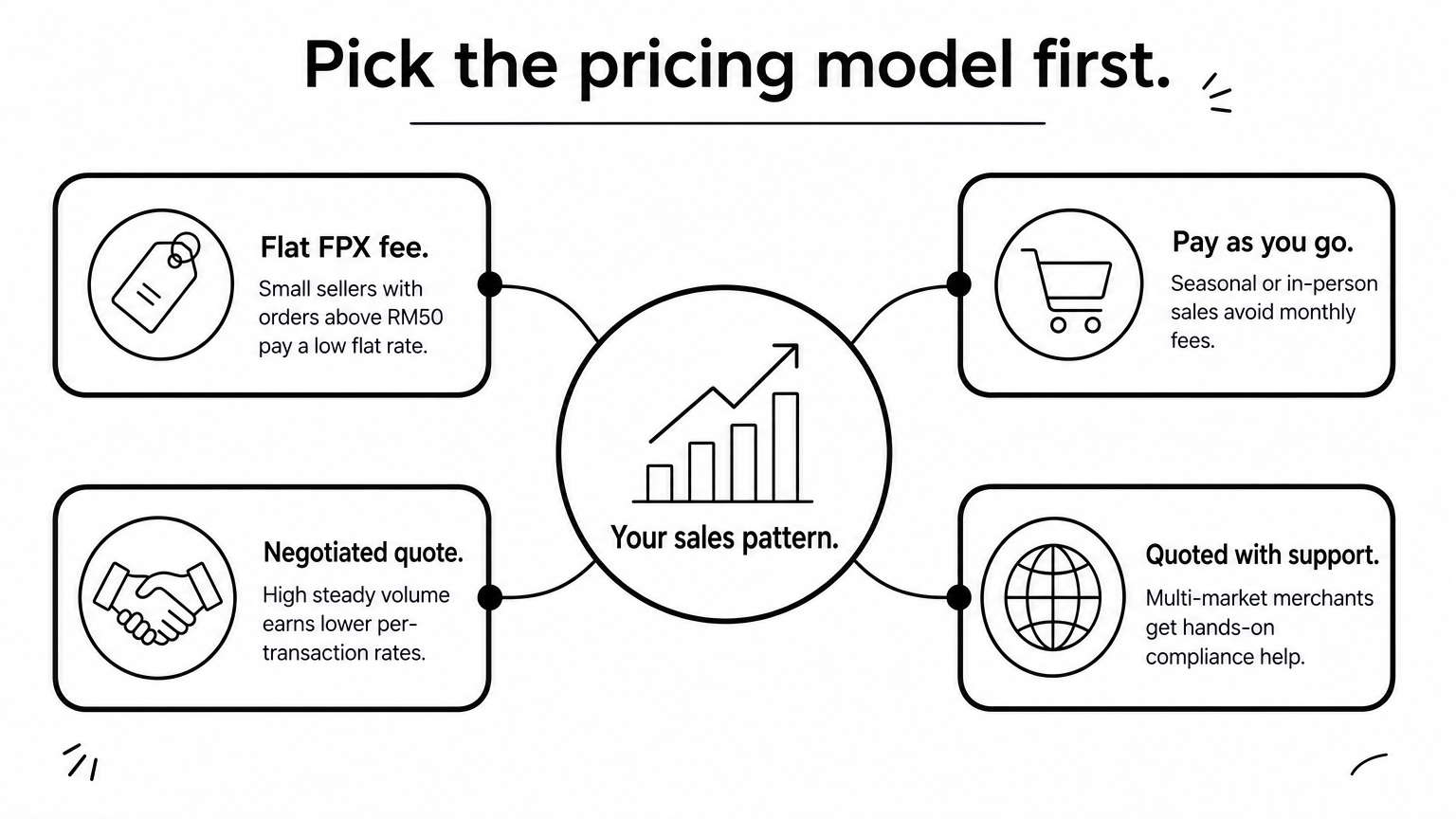
Your size and order value point to a pricing model before you compare a single rate. Once you know the model, the shortlist is only two or three names long.
| Your situation | Pricing model to favor | Shortlist |
|---|---|---|
| Small seller, mostly FPX, orders above RM50 | Flat FPX fee, no monthly fee | Billplz, Bizappay, SenangPay |
| Seasonal sales, online plus in-person | Pay as you go | HitPay |
| Subscriptions or developer-led product | Pay as you go with strong APIs | Stripe |
| High, steady volume across many channels | Negotiated quote | ADAPTIS, Fiuu |
| Several Asian markets or compliance needs | Quoted, with hands-on support | CoinPay |
Choose the pricing model that fits your sales pattern first, then compare rates inside it.
Verify before you sign
Before committing, request a written fee schedule from your top two or three picks. Then confirm these points:
- Settlement cycle, reserves, and payout fees
- Whether refunds return the original transaction fee
- Documents required and expected approval time
- Contract length and exit terms
Revisit your pricing once a year. Growth in volume often earns you a lower negotiated rate, and a gateway that was cheapest at RM10,000 a month may not be at RM200,000.
Picking the right fit for your fees
The cheapest payment gateway in Malaysia is the one that wins on your own numbers. FPX is usually the lowest-cost rail, cards cost more, and e-wallets sit between. Your payment mix and average order value decide which pricing model saves you money, and fixed fees, refunds, and reserves can erase a low headline rate.
Small sellers collecting by FPX will do well with Billplz, Bizappay, or SenangPay. HitPay suits uneven sales, Stripe suits subscription products, and ADAPTIS or Fiuu reward high volume. Whatever you shortlist, get the full fee schedule in writing and work out your effective rate from three months of sales.
If you sell across several Asian markets, or want a partner who stays involved after launch, get a free demo with CoinPay and we will walk you through a quote built around your volume.