
Crypto Payment Gateway: How It Works and 8 Best Providers
Accepting crypto sounds simple until you try it. You have to pick coins, handle volatile prices, confirm transactions on-chain, and still get paid in a currency your bank understands. A crypto payment gateway handles that work between your checkout and your settlement account.
Here is the short answer. A gateway generates a payment address or invoice, watches the blockchain for confirmation, locks in the exchange rate, and then settles to you in fiat or stablecoins like USDT. Good providers also give you an API, a hosted checkout page, and reporting. The best ones make a crypto to fiat payment gateway feel like any other card processor.
Below, we explain how the flow works step by step, then compare 8 providers. We judge each on supported coins, fees, settlement options, compliance standards, and support quality. At CoinPay, we run payment infrastructure for merchants across Southeast and South Asia, so we also flag what matters in those markets before you commit.
1. How a crypto payment gateway works
Before you compare crypto payment gateway providers, you need the mechanics. Every provider runs the same basic loop, and the real differences show up in rate locking, settlement, and custody.
The payment flow, step by step
Five steps cover every payment, whether you use a plugin, a hosted page, or an API. A multi coin crypto payment gateway simply lets the customer choose from more assets at step one.
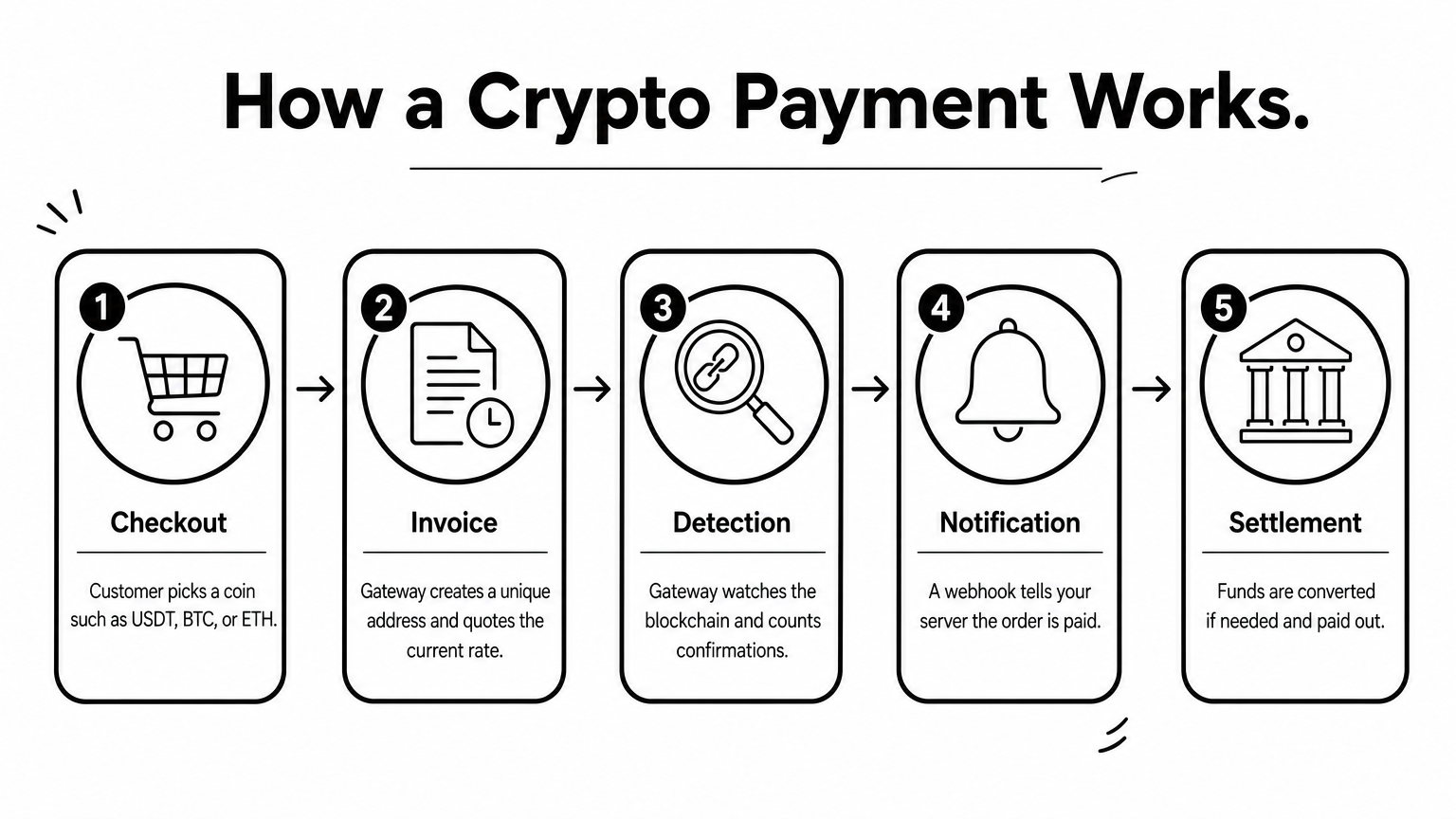
- Checkout: the customer picks a coin, such as USDT, BTC, or ETH.
- Invoice: the gateway creates a unique wallet address and quotes the amount at the current rate, usually valid for 10 to 20 minutes.
- Detection: the gateway watches the blockchain and counts confirmations.
- Notification: once the required confirmations arrive, a webhook tells your server the order is paid.
- Settlement: the gateway converts the funds if needed and pays you out.
Underpayments, overpayments, and late transfers are where gateways differ most. Ask how each case is handled, because partial payments and expired invoices create most of the support tickets.
Settlement, custody, and compliance
Settlement decides your real costs. A crypto to fiat payment gateway converts coins when the customer pays and sends local currency to your bank. Others pay out in stablecoins such as USDT, which avoids conversion spread but leaves you to handle the off-ramp.
A gateway is only as good as its settlement: checkout is the easy part, and the payout is where providers separate.
Custody is the second split. Custodial gateways hold your funds briefly before payout, which enables fiat settlement but adds counterparty risk. Non-custodial gateways route coins straight to your wallet, so you convert them yourself.
| Model | Where funds go | Best for |
|---|---|---|
| Custodial | Gateway, then your bank or wallet | Teams that want fiat in their account |
| Non-custodial | Directly to your wallet | Teams with treasury experience |
Compliance sits behind all of this. Reputable providers run merchant KYC and wallet screening, so expect a verification step before you go live.
2. CoinPay
How it works
CoinPay is a managed payment partner, not a bare connector. We organize operations by market, payment journey, and settlement need, so a Thai deposit flow is built differently from a Bangladeshi one.
After launch, we monitor payment performance and look for friction in your deposit journey. You also get a direct line to a team that answers, which matters when a payout runs late.
Supported coins and settlement
Coverage spans Thailand, Vietnam, the Philippines, Malaysia, Bangladesh, India, and Indonesia, including local methods like PromptPay with THB settlement in Thailand. Unlike many crypto payment gateway providers, CoinPay runs USDT payments as a separate service, so you choose the rail per use case.
CoinPay pairs local payment methods with a separate USDT service, so settlement follows your market.
Fees and onboarding
There is no public rate card. Pricing is quoted after review, based on your market, volume, and settlement needs. Onboarding runs in four stages:
- Submit a structured application
- Pass business verification and KYC
- Clear due diligence and compliance checks
- Integrate and go live
We reject scams, money-games, and deceptive schemes, so expect real questions. You can start an application with CoinPay.
Who it is for
CoinPay suits legitimate B2B merchants in e-commerce, gaming, fintech, and online platforms that need local currency settlement in the seven markets above.
Skip it if you want instant self-serve signup or run a high-risk model. Choose it if you want a long-term partner with five years of operating experience.
3. NOWPayments
How it works
NOWPayments is a self-serve gateway you can wire into a store in an afternoon. The customer picks a coin on a hosted payment page, and the funds move to you after confirmation. You connect through:
- Hosted invoices and payment links
- Plugins for platforms like WooCommerce
- A REST API with webhooks
Supported coins and settlement
The provider lists 300+ coins, which makes it a strong multi coin option. Payouts go to your own wallet, either in the coin received or auto-converted to a single asset such as USDT.
Fiat is the catch. Cash-out relies on third-party exchanges or partners, so check availability for your country before you commit.
NOWPayments gives you wide coin choice, but you still own the off-ramp to fiat.
Fees and onboarding
Pricing is public. Expect roughly 0.5% per transaction when you keep the coin the customer paid in, and about 1% when conversion is involved. Confirm current rates on the provider's site before you budget.
Signup is self-serve. You create an account, add a payout wallet, and generate an API key. Higher volumes may trigger extra verification.
Who it is for
Small and mid-size online shops, SaaS teams, and developers who want a crypto payment gateway for website checkout with low fees and fast setup.
Look elsewhere if you need local rails like PromptPay, fiat settlement in Asian markets, or hands-on support after launch.
4. CoinGate
How it works
CoinGate is a long-running European gateway, founded in 2014 and based in Lithuania. Customers pay on a hosted page, and you connect through:
- Plugins for WooCommerce, Shopify, Magento, and others
- A REST API with callbacks
- Invoices, payment buttons, and a point-of-sale app
Supported coins and settlement
The platform accepts 70+ cryptocurrencies, including Bitcoin, Ethereum, USDT, and Lightning payments. Its real edge is fiat settlement. You can take payouts to a EUR, GBP, or USD bank account, or keep the funds in crypto.
CoinGate pairs self-serve signup with direct bank payouts, which is rare in this category.
Bank payout coverage is strongest in Europe. Confirm that your country and currency are supported before you build around it.
Fees and onboarding
Pricing is simple: 1% per transaction, with no setup or monthly fees based on the published terms. Bank withdrawals can carry separate charges, so check the payout schedule on the provider's site. Onboarding looks like this:
- Create an account
- Complete business verification
- Add a payout method
- Install a plugin or generate an API key
Who it is for
European and international online merchants will find a top crypto payment gateway here if they want bank payouts without a sales process. Webshops, digital goods sellers, and small SaaS teams fit well.
Look elsewhere if you need local Asian payment rails such as PromptPay, THB or VND settlement, or a team that monitors your deposit journey after launch.
5. BitPay
How it works
BitPay launched in 2011 and is one of the oldest names in the category. Customers pay through a hosted invoice that shows the quoted amount and a countdown timer. You connect through:
- Plugins for Shopify, WooCommerce, and Magento
- A REST API with webhooks
- Email invoices and payment buttons
Supported coins and settlement
The coin list is focused rather than huge. It covers major assets like Bitcoin, Ethereum, XRP, Litecoin, Dogecoin, and several stablecoins. The draw is fiat settlement to a bank account in currencies such as USD, EUR, and GBP, or you can keep crypto.
BitPay trades coin variety for a payout process that finance teams already understand.
Bank coverage leans toward North America and Europe. Local Asian currencies are limited, so confirm your market first.
Fees and onboarding
Published pricing starts at about 1% per transaction, with volume terms for larger merchants. Network and withdrawal costs can apply on top, so check the current schedule before you budget.
Onboarding is a business verification process rather than instant signup:
- Create an account
- Submit company details and verification documents
- Add a settlement method
- Install a plugin or integrate the API
Who it is for
Mid-size and enterprise merchants in the US and Europe get the most from it, especially retailers and digital businesses that want a crypto payment gateway for business with predictable bank payouts. It also suits teams that value a long operating record.
Skip it if you need hundreds of coins, local rails like PromptPay, or hands-on regional support in Southeast and South Asia.
6. Triple-A
How it works
Triple-A is a Singapore-based gateway founded in 2017 and licensed by the Monetary Authority of Singapore as a major payment institution. Its crypto payment gateway solution shows customers a hosted checkout, then settles after confirmation. You connect through:
- Plugins for WooCommerce, Shopify, and Magento
- A REST API with webhooks
- Payment links and invoices
Supported coins and settlement
The coin list is mid-sized, covering Bitcoin, Ethereum, USDT, USDC, and other major assets. The draw is fiat settlement to bank accounts in several currencies, with stronger Asia-Pacific coverage than most Western rivals. Confirm that your currency and country are on the payout list.
Triple-A offers a regulated route from crypto checkout to a bank account in Asia-Pacific.
Fees and onboarding
Pricing is tiered and partly quoted. Published entry rates have sat around 1% per transaction, but volume, currency, and payout method change the final number, so get a written quote. Onboarding is a business verification process, and you should expect to provide:
- Company registration documents
- Ownership and director details
- A description of your business model
Who it is for
Growing e-commerce, travel, and digital-services merchants in Asia-Pacific will find a best payment gateway for crypto candidate here, especially if a licensed provider matters to your bank or auditors.
Look elsewhere if you need local rails like PromptPay, a separate USDT service, or a team that monitors your deposit journey after launch.
7. BVNK
How it works

BVNK is a stablecoin payments platform built for companies, not small webshops. It is based in London and was founded in 2021. You get API-led infrastructure rather than a plugin-first checkout, covering:
- Pay-ins from customers in crypto or stablecoins
- Payouts to suppliers, partners, or users
- Wallets that hold balances in several currencies
Supported coins and settlement
The focus is stablecoins like USDT and USDC, plus a few major assets, not hundreds of altcoins. Settlement is the strength. You can hold balances in stablecoins or convert to fiat and withdraw to bank accounts in currencies such as USD, EUR, and GBP.
BVNK is built to move stablecoin value at scale, not to accept every coin.
Payout corridors vary by country, so confirm yours before you build. Local Asian methods like PromptPay are not the core offer.
Fees and onboarding
Pricing is custom and quoted. Do not expect a public rate card, because fees depend on volume, currencies, and the flows you run. Onboarding is sales-led and slower than self-serve signup. Expect:
- An intro call and scoping of your use case
- Business verification (KYB) with ownership documents
- Technical integration with their team
Who it is for
Fintechs, payout platforms, marketplaces, and enterprises will find the crypto payment gateway services they need for treasury and cross-border flows. It fits teams with developers and meaningful volume.
Skip it if you want a plugin live in an afternoon, or if you need local Asian rails and hands-on regional support after launch.
8. Stripe with Bridge
How it works
Stripe acquired Bridge, a stablecoin infrastructure company, in 2025. The result is stablecoin acceptance inside the Stripe checkout you may already use. The customer pays in a stablecoin, and Stripe converts it to fiat for your balance. You connect through:
- Checkout and Payment Links
- Payment Element and the Stripe API
- Bridge APIs for wallets, transfers, and stablecoin issuance
Supported coins and settlement
Coin choice is narrow by design. Stripe supports USDC on networks such as Ethereum, Solana, Polygon, and Base. Funds settle as fiat in your Stripe balance and pay out on your normal schedule, like a card sale. This is a payment gateway for crypto only in the stablecoin sense, so expect no Bitcoin or altcoins.
Stripe with Bridge turns stablecoin payments into ordinary Stripe revenue, but only for a handful of coins.
Fees and onboarding
Stripe has listed stablecoin payments at about 1.5% per transaction, with no separate contract. Confirm the current rate and your eligibility in the Dashboard, since availability depends on country and business type. Onboarding looks like this:
- Use or open a Stripe account
- Request stablecoin payments in the Dashboard
- Pass Stripe's review
- Add it to Checkout or your API integration
Who it is for
Businesses already on Stripe get the most value, especially US-based SaaS companies, marketplaces, and online sellers that want a crypto to fiat payment gateway without adding a vendor. Your finance team keeps one dashboard and one payout flow.
Skip it if you need many coins, local rails like PromptPay, or settlement in Southeast and South Asian currencies. Also skip it if you expect hands-on regional support after launch.
9. Coinremitter
How it works
Coinremitter is an India-based, wallet-first gateway. You create a wallet per coin in its dashboard, and each invoice gets its own payment address. Customers pay on a hosted page, and the platform confirms the transfer. You connect through:
- Plugins for WooCommerce, OpenCart, and similar platforms
- A REST API with webhooks
- Hosted invoices and payment links
Supported coins and settlement
The list is small and focused. It covers Bitcoin, Ethereum, Litecoin, Dogecoin, BNB, TRON, and USDT on several networks. There is no fiat settlement. Balances stay in crypto until you withdraw to your own wallet.
Coinremitter gets coins into a wallet cheaply, but turning them into fiat is your job.
That matters if you want a crypto payment gateway India merchants can use for rupees. You will still need an exchange or off-ramp partner.
Fees and onboarding
Pricing is among the lowest in this list. Published rates have sat near 0.23% per transaction, with a free starting plan and paid tiers for extra features. Confirm current numbers on the provider's site, and budget for network fees on withdrawals.
Signup is self-serve. Register, create coin wallets, and generate an API key. Verification is light compared with licensed providers, so check what your own bank or auditor expects.
Who it is for
Small online shops, hobby projects, and developers who want a crypto gateway payment option at minimal cost will like it. It also suits teams comfortable managing their own treasury.
Skip it if you need fiat payouts, local rails like PromptPay, or a compliance-heavy partner with hands-on support after launch.
10. How to choose the right provider
Start with settlement, not coin count. The best crypto payment gateway for you pays out in the currency your business actually spends, in your country. Coin lists look impressive, but your payout method and custody model decide your real cost.
Choose the gateway by how you get paid, not by how many coins it lists.
Match the provider to your main priority
Next, name your biggest constraint. Most buyers fit one of the rows below, and a shortlist of two or three is enough to start.
| Your priority | Shortlist |
|---|---|
| Local Asian rails, THB settlement, managed support | CoinPay |
| Widest coin choice, fast self-serve setup | NOWPayments |
| Bank payouts in Europe or the US | CoinGate, BitPay |
| Licensed fiat settlement in Asia-Pacific | Triple-A |
| Stablecoin treasury at scale | BVNK |
| Already on Stripe, stablecoins only | Stripe with Bridge |
| Lowest fees, self-managed treasury | Coinremitter |
Questions to ask before you sign
Before you commit to any provider, get written answers to these questions. Vague replies on the first two are a red flag.
- Is the gateway custodial, and how long do funds sit before payout?
- Which countries and currencies does fiat settlement cover?
- How are underpayments, overpayments, and expired invoices handled?
- What are the total fees, including network, conversion, and withdrawal costs?
Finally, run a small live payment before you scale. Time the payout, check the reporting, and see how fast support replies. That test costs little and shows you more than any sales page.
Picking the right fit for your business
A crypto payment gateway earns its fee at settlement, not at checkout. Coin count, plugins, and headline rates matter less than how you get paid and who holds your funds along the way.
For most buyers the choice is simple. Pick a self-serve provider like NOWPayments, CoinGate, or Coinremitter if you want speed and low cost. Go with BitPay, Triple-A, BVNK, or Stripe with Bridge if you need bank payouts, a license, or stablecoin scale. If you sell in Southeast or South Asia and want local rails plus hands-on support, CoinPay is built for that case. Shortlist two providers, then run a small live payment before you commit.
If you want to see how this would work for your market and payment flow, talk to CoinPay about a free demo and walk through it with our team. We will tell you plainly whether we are the right fit.