
6 Best Dropshipping Payment Gateway Options in Bangladesh
The best dropshipping payment gateway in Bangladesh is the one that matches where your customers live and which legal entity receives the money. If you sell to buyers inside Bangladesh, a local gateway such as SSLCOMMERZ or AamarPay, or a managed provider like CoinPay, handles BDT bank and wallet payments. If you sell to US or European shoppers on Shopify, the practical route is Stripe through a foreign company, with Payoneer as the account where the money lands. 2Checkout sits in between as a card option you apply for.
The problem is that the gateways every Shopify tutorial recommends are not open to you. Stripe and Shopify Payments need a business in a supported country, and Bangladesh is not one. PayPal has long limited what Bangladeshi accounts can do. New dropshippers lose weeks on these dead ends before they find something that works.
This article covers six options, with how each works, who it suits, and what it costs, then walks you through setup and a side-by-side comparison. CoinPay is our own service, so it comes first, and we say plainly where it fits and where it does not.
Why Stripe, PayPal and Shopify Payments fall short
What is blocked and why
Stripe and Shopify Payments are closed to Bangladeshi businesses because both require you to be registered, and to bank, in a supported country. Bangladesh is on neither list. You can still open a Shopify store from Bangladesh and pay its subscription with an international card, so the store is not the obstacle. The payment provider is.
PayPal is a different case. Accounts exist, but receiving payments has been restricted for Bangladeshi users for years. Confirm the current rules on PayPal's own site before you build a store around it.
The store is never the problem. The payment provider's country list is.
The two routes that work
Every working setup falls into one of two routes, and the right one depends on where your buyers live.
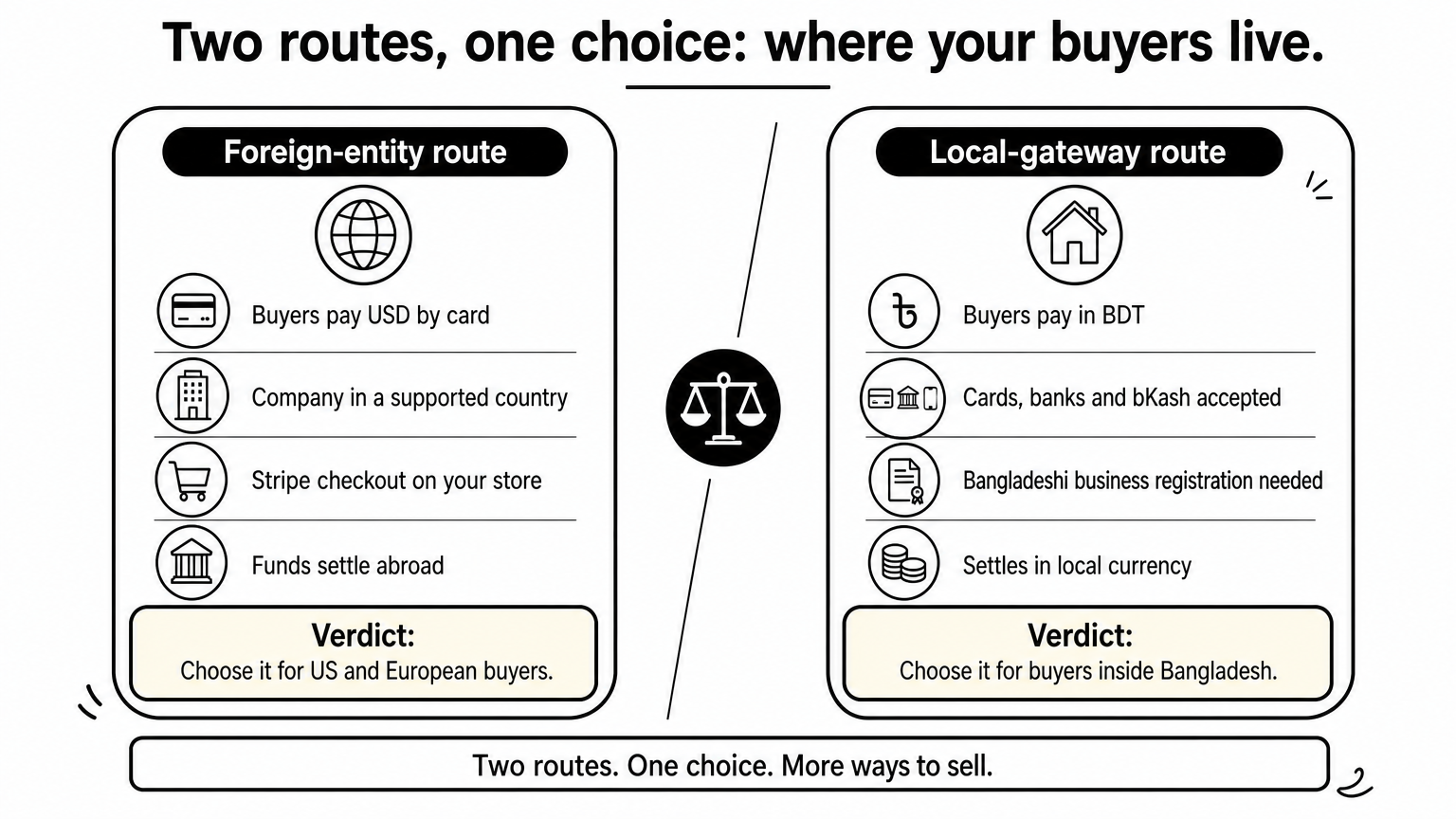
- Foreign-entity route: A company in a supported country gets a gateway like Stripe. Buyers pay by card in USD, and you bring the money home through a receiving account.
- Local-gateway route: A gateway licensed for Bangladesh collects BDT through cards, banks and wallets such as bKash. Buyers are mostly local.
Choose the route before the provider. Comparing Stripe with AamarPay makes little sense, because they serve different buyers.
1. CoinPay
How it works
CoinPay is a managed payment gateway for merchants in Southeast and South Asia, Bangladesh included. For BDT, customers pick a supported bank and pay using the bank details shown in the gateway, or choose a supported e-wallet and finish through the wallet flow. Merchants who want it can also take and send USDT through the same gateway.
Access starts with an application and business verification. The review can cover company information, ownership details, identity checks and business activity. Approved merchants then get the information needed for integration and testing before any processing begins. CoinPay has five years of experience running this for merchants.
CoinPay is a screened partnership, not a self-service sign-up.
Who it suits
CoinPay fits dropshippers who sell to customers inside Bangladesh, or who accept USDT, and who run a legitimate business with steady order volume. It does not replace Stripe for US card checkout, so do not expect it to take Visa payments from American shoppers.
- Good fit: BDT bank and wallet payments, USDT deposits and payouts, merchants who want hands-on support.
- Poor fit: scams, money-games or misleading investment models. CoinPay does not accept these.
Costs and limits
To ask about pricing, contact sales@coinpay.world or follow up with the team through Telegram. Approval is the main limit, because the review is strict. Once live, CoinPay produces monthly success-rate monitoring for its merchants. The service figures below come from its own offerings.
- Bangladesh bank transfer payout: average 1 to 3 minutes
- USDT deposit: from 1 USDT, about 9.35 seconds from submit to deposit complete, 15.25 seconds for the whole process
- USDT payout: from 1 USDT, average 1 to 3 minutes
2. Stripe through a US or UK company
How it works
Stripe cannot be opened with a Bangladeshi business, so you form a company in a supported country, such as a Delaware company through Stripe Atlas. You open a business bank account for it, apply to Stripe with that entity, and connect Stripe to your store. Buyers pay by card, Apple Pay or Google Pay.
Funds settle to the foreign bank account, and you move them home from there. Stripe also reviews what you sell. Dropshipping with long shipping times raises disputes, so publish clear shipping and refund policies before you apply.
Stripe works for you only if the company behind it is foreign.
Who it suits
This route suits sellers aiming at US and European buyers who expect a familiar card checkout. It asks for more effort than the other options. You need to manage a foreign company, its filings and its bank account.
Skip it while you are still testing one product. Come back when ad spend and orders justify the overhead.
Costs and limits
The standard US rate is 2.9% plus $0.30 per card payment, and international cards or currency conversion may add more. On a $30 order, the fee is $0.87 plus $0.30, which is $1.17, so you keep $28.83. Add company formation, annual filings and registered agent costs. Check Bangladesh tax and foreign exchange rules with an accountant before you move money.
3. Payoneer
How it works
Payoneer is the receiving leg, not a checkout gateway. It gives you receiving account details in currencies such as USD, EUR and GBP. Money from a foreign gateway, a marketplace or a client arrives there, and you withdraw it to your Bangladeshi bank in BDT.
Do not assume every gateway pays out to a Payoneer receiving account. Confirm that your payout destination accepts it before you rely on it.
Payoneer moves the money home. It does not take the customer's card.
Who it suits
Payoneer suits dropshippers who earn in foreign currency from several places, such as a foreign gateway payout, marketplace sales or overseas clients. It is a poor choice as your only payment tool, because a store needs a checkout provider that charges customers. Pair it with a gateway from this list.
Costs and limits
Fees apply when you withdraw and when you convert currency. Check Payoneer's current fee page rather than trusting a figure from a comparison. Ask these questions before you commit:
- What does a withdrawal to a Bangladeshi bank cost?
- What exchange rate spread applies to the BDT conversion?
- Does my gateway pay out to the receiving account I plan to use?
The conversion spread often costs more than the headline fee.
4. 2Checkout (Verifone)
How it works
2Checkout, now sold under the Verifone name, is a card checkout provider built around localization. It supports several languages and currencies, and published comparisons list Visa, Mastercard, JCB, PayPal and bank transfer as buyer options. The same comparisons put onboarding at 24 to 48 hours.
Not every platform supports every gateway. Check that your store platform lists 2Checkout before you apply, and confirm during the application that your business and country qualify.
2Checkout is worth an application, but approval is not guaranteed.
Who it suits
It suits dropshippers who cannot or will not form a foreign company and still want to take international card payments. It also helps when your buyers want to pay in their own currency. Approval depends on your business, so apply with a working store, clear policies and a real product catalog.
Costs and limits
Setup is free in published comparisons. Rates differ by source and plan. One lists 3.5% plus $0.30, another lists 3.9% plus $0.45 with a 1.5% cross-border fee. Plan with the higher figure. On a $30 order, 3.9% is $1.17, plus $0.45, plus a 1.5% cross-border fee of $0.45. That is $2.07 in total, and you keep $27.93. Confirm your real rate in the application.
5. SSLCOMMERZ
How it works
SSLCOMMERZ is a Bangladeshi gateway that accepts Visa, Mastercard, DBBL Nexus cards, internet banking and bKash. Published comparisons say it settles in BDT, EUR, GBP, AUD, USD and CAD, onboards in 1 to 2 days, and settles the same day. It offers developer kits for PHP, Node.js, Python, Laravel and others, and the comparison source describes it as a licensed Payment Systems Operator.
Shopify lists only certain third-party gateways. A local gateway often means a WooCommerce store or a custom checkout, so check plugin support first.
SSLCOMMERZ gives you local rails plus a few foreign currencies.
Who it suits
It suits registered Bangladeshi businesses selling to local customers, with some foreign-currency orders on the side. Expect to provide business documents and bank details, typically a trade license. A store with no legal registration will struggle here.
Costs and limits
Figures below come from a published comparison of payment gateway prices in Bangladesh, so confirm them with the provider before you apply.
- Setup fee: BDT 15,000, no annual fee
- Visa and Mastercard: 2.5%
- Internet banking and other cards: 2% to 4%
- Refunds: no extra charge
On a BDT 2,000 card order, the fee is BDT 50.
6. AamarPay
How it works
AamarPay is a BDT-only gateway that takes cards, bKash, Rocket, SureCash, UnionPay and Amex. A published comparison puts onboarding at about 24 hours and settlement at one week. It also supports payouts and has developer kits for Laravel and Android.
Because it settles in BDT only, foreign buyers cannot pay you in USD through it. It is a local-market tool.
AamarPay is the wallet-friendly option for Bangladeshi buyers, not for foreign ones.
Who it suits
It fits dropshippers selling inside Bangladesh to customers who prefer mobile wallets over cards. If your ads target Facebook audiences in Dhaka or Chattogram, wallet payments matter more than cards. If you sell abroad, pick another option.
Costs and limits
Figures come from a published comparison and may have changed, so verify them before you apply.
- Setup fee: BDT 4,000 to 15,000, depending on plan, no annual fee
- Cards: 2.55% to 3.25%
- bKash, Rocket and SureCash: 1.85% to 2.1%
- Refunds: no extra charge
On a BDT 2,000 order, a card payment costs BDT 51 to 65, and a wallet payment costs BDT 37 to 42.
How to set up a gateway and compare your options
Setup steps
Most gateways ask for the same things in roughly the same order. Follow these steps and you avoid most rejections.
- Decide where your buyers live and in which currency they will pay.
- Choose the route, foreign entity or local gateway, and shortlist two providers.
- Prepare your documents: ID, business registration, a bank account, and a working store with a domain.
- Add policy pages for shipping, refunds and contact details before you apply, because reviewers check them.
- Apply, then wait for review. Answer follow-up questions about your products and suppliers.
- Connect the gateway by plugin or API keys, and test in sandbox mode first.
- Run one small live order and one refund, then watch your success rate and disputes weekly.
Shopify also adds a third-party transaction fee when you do not use Shopify Payments. Check your plan's rate, because it comes on top of the gateway fee.
Side-by-side comparison
Use this table to match each option to your buyers.
| Option | Buyers pay in | Foreign company needed | Best for |
|---|---|---|---|
| CoinPay | BDT by bank or e-wallet, USDT | No | Local and USDT buyers, screened merchants |
| Stripe via foreign company | USD and other currencies by card | Yes | International card buyers |
| Payoneer | Not a checkout, receives USD, EUR, GBP | No | Receiving foreign payouts |
| 2Checkout | Multiple currencies, cards, PayPal | Confirm at application | International cards without a foreign company |
| SSLCOMMERZ | BDT plus USD, EUR, GBP, AUD, CAD | No | Local buyers, some foreign orders |
| AamarPay | BDT only | No | Wallet-heavy local buyers |
If your buyers pay in USD, take the Stripe route. If they pay in BDT, take a local gateway.
Pick the route first, then the gateway
Stripe, PayPal and Shopify Payments are not open to Bangladeshi businesses, but you still have working options. International card buyers point you to Stripe through a foreign company, with Payoneer as the receiving account, or to 2Checkout if approved. Buyers inside Bangladesh point you to a local gateway, such as SSLCOMMERZ or AamarPay, or to a managed provider with bank, wallet and USDT coverage.
Start with one buyer market and one gateway, test a live order, and only then add a second option. Verify every fee with the provider, because published rates change.
If you sell to Bangladeshi customers or accept USDT and want a payment partner that screens merchants and supports you after integration, talk to CoinPay's team in a free demo call.