
7 Best Fiat to Crypto Payment Gateways for 2026
If you're running an online business in Thailand, Vietnam, Indonesia, or anywhere across South and Southeast Asia, you already know local customers want to pay with local rails, and a growing share want to pay in crypto. Finding a fiat to crypto payment gateway that actually settles in your merchant account, without freezing your funds or ghosting your support tickets, is harder than it sounds. Most "global" providers treat this region as an afterthought.
This list answers a specific question: which gateways can you plug into your checkout right now and trust to convert USDT or other stablecoins into local currency reliably. We looked at settlement speed, KYC and compliance standards, and how each provider handles a crypto payment gateway Indonesia merchants can rely on alongside markets like the Philippines, Malaysia, and Bangladesh, and you can compare the top payment gateways in Indonesia separately too.
We built this guide from five years of watching merchant deposit journeys break down at the worst possible moment. Below you'll find seven providers worth evaluating, what separates a solid fiat-to-crypto payment gateway from a risky one, and where hands-on merchant support, not just an API, ends up mattering most.
1. CoinPay: best for merchants in Southeast and South Asia
CoinPay was built specifically for merchants who need a fiat to crypto payment gateway that understands regional banking rails, not a generic API bolted onto a Western checkout stack. Rather than treating Southeast and South Asia as a secondary market, CoinPay operates from the ground up in these regions, pairing USDT settlement with local currency payout so merchants never have to explain to their finance team why funds are stuck in a wallet instead of a bank account.

How it works
Onboarding starts with a structured merchant application that includes business verification, KYC, and due diligence checks before any integration work begins. This isn't a rubber-stamp process. CoinPay explicitly screens out scam operations and money-game schemes, which means legitimate merchants get a cleaner risk profile and fewer downstream account freezes. Once approved, merchants connect through CoinPay's payment infrastructure, which routes customer deposits (crypto or local method) into settlement in local currency, with ongoing support monitoring the deposit journey rather than leaving merchants to troubleshoot failed transactions alone.
A payment gateway is only as good as what happens after a transaction fails, and that's where most providers disappear.
Supported countries and payment methods
CoinPay covers seven markets with local-method depth that few global gateways match:
| Country | Local settlement | Example local method |
|---|---|---|
| Thailand | THB | PromptPay |
| Vietnam | VND | Bank transfer / e-wallets |
| Philippines | PHP | GCash, bank rails |
| Malaysia | MYR | Local bank transfer |
| Bangladesh | BDT | Mobile financial services |
| India | INR | UPI / bank transfer |
| Indonesia | IDR | Local bank & e-wallet rails |
For a merchant running a crypto payment gateway Indonesia operation, that means USDT deposits convert to IDR settlement through QRIS and local bank rails without routing through a third country's compliance framework, cutting delays and reducing the chance of a flagged transaction. USDT and other stablecoin rails run as a distinct service layer, so merchants who only need crypto settlement aren't forced into unnecessary fiat infrastructure.
Pricing and fees
CoinPay doesn't publish a flat-rate card, because fees depend on market, payment method, and settlement currency, factors that genuinely change the cost structure between, say, PromptPay deposits with THB settlement and UPI in India. Merchants get a quote after the application review, which lets CoinPay price based on actual risk and volume rather than a one-size-fits-all rate that overcharges low-risk merchants and undercharges high-risk ones. If you want exact numbers, start with CoinPay's merchant application rather than guessing from a generic pricing page that won't reflect your market anyway.
Best for
Merchants operating in e-commerce, gaming, or fintech across Southeast and South Asia who need both local currency settlement and USDT payment options, and who value a provider that reviews merchants carefully rather than onboarding anyone with a business name. If your priority is a payment partner who answers support tickets and helps diagnose deposit friction, not just a technical connector, CoinPay is built for exactly that role.
2. BVNK: best for enterprise-scale global stablecoin payments
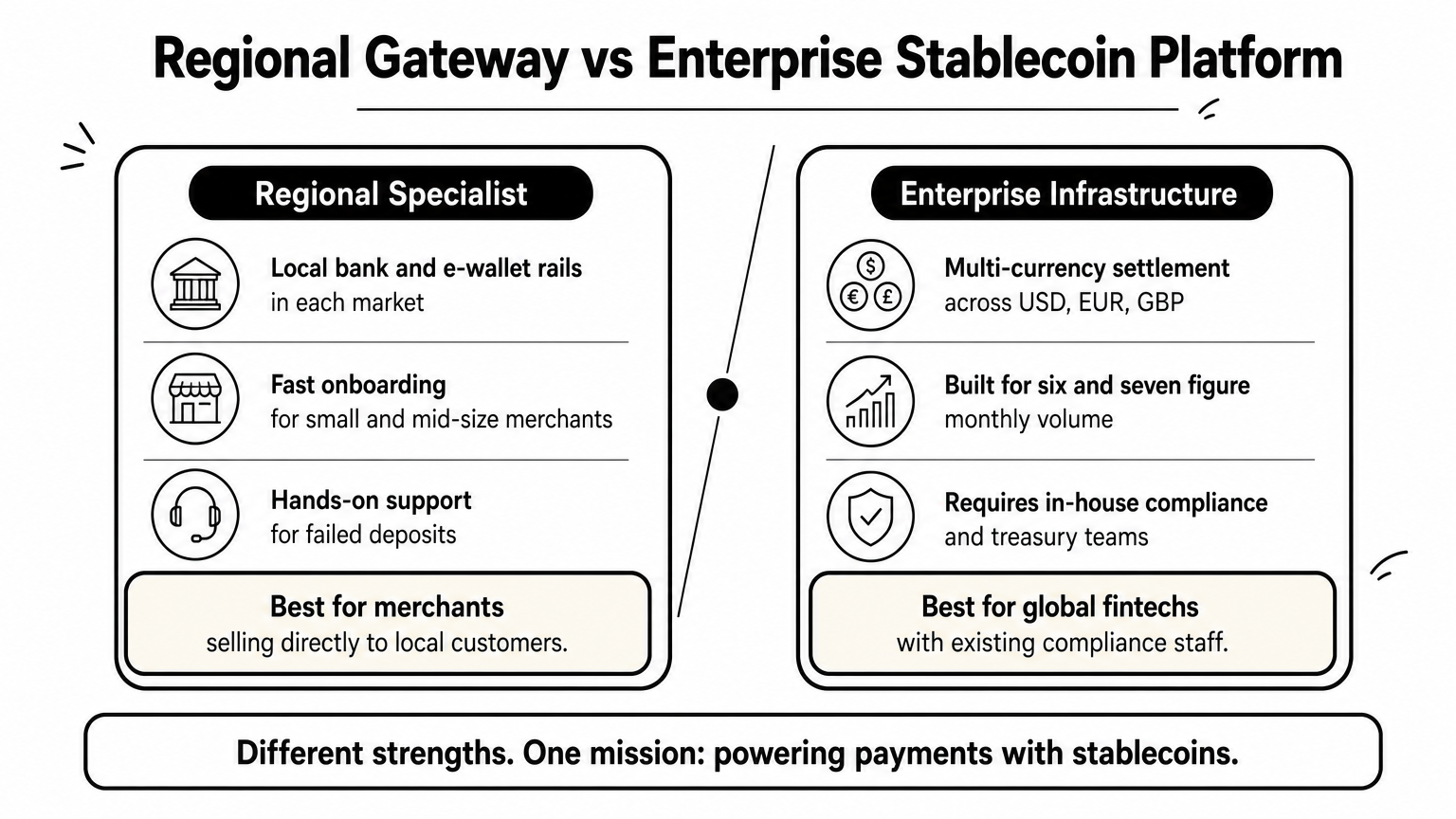
BVNK built its reputation processing stablecoin volume for enterprise fintechs and payment platforms that move real money at scale, not hobby projects testing a wallet integration. If your business already has compliance staff and a treasury team, BVNK gives you the infrastructure to settle USDC and USDT into fiat accounts across multiple currencies without building that stack yourself.
How it works
Companies connect through BVNK's API to accept stablecoin payments and route them into fiat settlement across supported banking partners. The platform handles custody, conversion, and treasury management in one system, so a merchant collecting USDT from customers in one region can settle in USD, EUR, or GBP without manually bridging currencies. BVNK positions itself as regulated infrastructure rather than a simple fiat to crypto payment gateway plug-in, which matters if your compliance team needs documented licensing behind every transaction.
Enterprise-grade stablecoin infrastructure only pays off once your transaction volume justifies the onboarding lift.
Supported countries and payment methods
BVNK focuses on global coverage rather than deep regional specialization, supporting major stablecoins (USDT, USDC) alongside settlement in USD, GBP, and EUR through licensed banking partners. Coverage skews toward Europe, the UK, and North American corridors, with less depth in Southeast Asian local payment methods like PromptPay or GCash than a regionally focused gateway would offer.
Pricing and fees
Pricing isn't published publicly and runs through custom enterprise agreements based on volume, currency pairs, and settlement speed. Smaller merchants processing modest monthly volume will find the onboarding process heavier than the payoff justifies, since BVNK's sales and compliance review is built for six and seven figure monthly flows.
Best for
Enterprise fintechs, payment platforms, and treasury teams that need regulated multi-currency stablecoin settlement at scale, and that already have the internal compliance resources to match BVNK's onboarding requirements. It's not the right fit for a smaller merchant in Indonesia or a Bangladesh merchant taking bKash and Nagad deposits looking for a lighter-touch, regionally specialized partner.
3. Mercuryo: best for B2B on-ramp and off-ramp integrations
Mercuryo built its business around embedding buy and sell crypto flows directly into other companies' apps and platforms, rather than running its own consumer-facing checkout. Wallets, exchanges, and neobanks license Mercuryo's infrastructure as a white-label layer, which makes it a common choice for companies that want a fiat to crypto payment gateway they can brand as their own rather than send users to a third-party page.
How it works
Partners integrate Mercuryo through a widget or API that handles card and bank payment processing on one side and crypto settlement on the other. The platform manages the licensing, KYC checks, and liquidity sourcing behind the scenes, so a wallet app can offer "buy crypto with card" without building its own compliance stack. Off-ramp works the same way in reverse, converting crypto back to fiat and pushing it to a linked bank account or card.
An embedded on-ramp only works if the partner behind it holds real licensing, not just an API key.
Supported countries and payment methods
Mercuryo supports card payments, SEPA transfers, and a growing list of local methods across Europe, Latin America, and parts of Asia, with over 30 fiat currencies on the books. Coverage in Southeast Asia exists but runs shallower than a regionally dedicated gateway, particularly for local rails like PromptPay or the bank transfer and e-wallet networks specific to Vietnam or the Philippines.
Pricing and fees
Fees typically fall between 1.5% and 3.5% depending on payment method and region, with volume-based discounts negotiated for larger B2B partners. Card transactions usually cost more than bank transfer settlement, and exact rates depend on the specific integration agreement rather than a public rate card.
Best for
Wallets, exchanges, and fintech apps that need a licensed, white-label on-ramp and off-ramp to embed inside their own product, rather than a standalone merchant checkout. It suits companies building their own front-end experience more than merchants simply accepting payments for goods or services.
4. Transak: best for emerging market payment rails
Transak built its name connecting Web3 apps to local payment rails in markets that bigger providers often skip, including India, Nigeria, and several Southeast Asian corridors. Developers embed Transak's widget to let users buy crypto with a debit card, bank transfer, or local method, without Transak ever taking custody of customer funds directly. That focus on emerging market coverage makes it a genuinely different fiat to crypto payment gateway than providers built around US and European card rails.
How it works
Apps integrate Transak through an SDK or hosted widget that presents payment options based on the user's detected location. The platform partners with regional liquidity providers and banking rails to process the fiat leg, then delivers crypto directly to the user's connected wallet address. Off-ramp works similarly, letting users sell crypto and receive a local payout without the app handling settlement itself.
Coverage in markets that other gateways ignore is worth more than a longer stablecoin list.
Supported countries and payment methods
Transak lists over 150 supported countries and accepts cards, bank transfers, and select local methods like UPI and net banking in India. Depth varies sharply by country though, and Southeast Asian local rails such as PromptPay or GCash and Maya in the Philippines aren't guaranteed at the same level of reliability you'd get from a regionally dedicated crypto payment gateway Indonesia merchants use for daily settlement.
Pricing and fees
Fees generally range from 0.5% to 5.5% depending on payment method, country, and transaction size, with card payments sitting at the higher end. Transak publishes a general fee structure but actual rates shift based on the liquidity partner routing a given transaction, so quoted numbers can vary by market.
Best for
Developers and Web3 apps that need broad geographic reach and don't require deep local payment method support in any single country. It's a strong pick for teams prioritizing coverage breadth over the kind of hands-on regional support a dedicated merchant partner provides.
5. MoonPay: best for consumer-facing Web3 checkout
MoonPay built its name as the on-ramp NFT marketplaces and wallet apps reach for first, largely because its checkout looks and feels like something a mainstream shopper trusts. Where other providers optimize for developer flexibility, MoonPay optimizes for conversion at the point of purchase, which is why you'll spot its widget inside OpenSea, MetaMask, and dozens of consumer crypto apps.
How it works
Apps embed MoonPay through a hosted widget or SDK that walks the end user through identity verification and payment in a single flow, then delivers crypto to a connected wallet within minutes. The platform handles KYC, fraud screening, and liquidity sourcing on the backend, so the integrating app never touches raw payment data. Sell-side works the same way, converting crypto back to fiat and pushing payout to a linked card or bank account.
A checkout that looks trustworthy to a first-time crypto buyer converts better than one that just moves faster.
Supported countries and payment methods
MoonPay operates in over 160 countries and supports Apple Pay, Google Pay, debit and credit cards, and bank transfers in select regions, though not the DuitNow and FPX rails Malaysian merchants use. Coverage across Southeast Asia exists, but it leans on card rails rather than the local bank transfer and e-wallet methods that a fiat-to-crypto payment gateway built for the region, like a dedicated Thai or Indonesian provider, would prioritize.
Pricing and fees
Fees typically run between 1% and 4.5% depending on payment method, with card transactions costing more than bank transfer. MoonPay publishes a general rate card, though actual costs shift by region and volume tier, and enterprise partners can negotiate lower rates through direct agreements.
Best for
NFT platforms, wallet apps, and Web3 products that need a polished, consumer-trusted checkout widget rather than deep regional payment rail integration. It's a strong fit if your users are already comfortable paying by card and you value brand recognition over local method depth.
6. Ramp Network: best for DeFi and multi-chain platforms
Ramp Network built its reputation inside the DeFi ecosystem, embedding directly into wallets, dApps, and multi-chain protocols that need users to fund a wallet without leaving the app. Instead of chasing merchant checkout volume, Ramp focused on becoming the on-ramp developers reach for when they're building on Ethereum, Solana, or a dozen other chains at once, which makes it a favorite among protocol teams rather than e-commerce merchants.
How it works
Developers drop in Ramp's SDK or hosted widget, and it detects the user's wallet, chain, and region automatically before presenting local payment options. Behind the interface, Ramp handles KYC verification and liquidity routing across multiple blockchain networks simultaneously, so a single integration can serve a user buying ETH one day and a stablecoin on Polygon the next. Off-ramp support lets users cash out directly to a bank account, closing the loop without routing through a separate exchange.
A gateway that only supports one chain forces every new integration to start from scratch.
Supported countries and payment methods
Ramp covers roughly 150 countries and accepts cards, Apple Pay, Google Pay, and SEPA bank transfers in supported European markets. Southeast Asian coverage exists but stays shallow compared to a dedicated fiat to crypto payment gateway built around regional rails, since Ramp's engineering priority has always been chain support over local payment depth.
Pricing and fees
Fees generally land between 1% and 3% depending on payment method and transaction size, with card payments costing more than bank transfers. Ramp doesn't publish enterprise pricing publicly, and larger protocol partners typically negotiate volume-based rates directly with the sales team.
Best for
DeFi protocols, multi-chain wallets, and Web3 apps that need broad blockchain support baked into the on-ramp itself, rather than a single-chain or fiat-only solution. It's less suited to merchants running a straightforward e-commerce or gaming checkout who need deep local payment method coverage in a specific country.
7. Onramper: best for aggregated on-ramp coverage
Onramper doesn't process payments itself. It aggregates dozens of other providers, including Mercuryo, Transak, and MoonPay, behind a single API, then routes each transaction to whichever partner offers the best rate or coverage for that user's country and payment method. If you've read this far and thought about integrating three or four separate gateways to cover different regions, Onramper is the shortcut that saves you from maintaining all those connections yourself.
How it works
Developers integrate one SDK, and Onramper's routing logic checks the user's location, preferred payment method, and requested currency pair before selecting a partner on-ramp behind the scenes. The platform compares live rates across providers in real time, so the same widget might route a Vietnamese user through one partner and an Indian user through another, all without the integrating app managing multiple contracts. Off-ramp works through the same aggregation model, pulling from whichever connected partner supports cash-out in the user's region.
Aggregation trades deep regional expertise for broad, one-integration coverage.
Supported countries and payment methods
Coverage depends entirely on which underlying partners Onramper has connected, but combined reach spans over 100 countries and includes cards, bank transfers, Apple Pay, and select local methods depending on the region. A merchant targeting a crypto payment gateway Indonesia setup gets whatever local depth the underlying partner provides that day, not a dedicated regional integration built specifically for Indonesian bank rails.
Pricing and fees
Onramper adds a small aggregation fee on top of whatever the underlying partner charges, typically pushing total fees slightly higher than going direct to a single provider. Exact costs vary transaction by transaction since the routing engine picks partners dynamically, which makes predicting fees ahead of time harder than working with one fixed-rate gateway.
Best for
Developers who want broad geographic coverage through one integration and don't need deep support for any single market's local payment rails. It suits early-stage apps testing demand across regions more than merchants who already know their core market and need a dedicated fiat to crypto payment gateway partner there.
Finding the right fit for your business
Global aggregators and enterprise stablecoin platforms each solve a real problem, but none of them were built around the specific banking rails, KYC expectations, and support needs of merchants operating in Thailand, Vietnam, Indonesia, or Bangladesh. Picking a fiat to crypto payment gateway based on a feature list alone misses the part that actually determines whether your business survives a failed settlement at 2am on a Friday.
Match the provider to your actual operating market first, then worry about chain support or checkout polish. If you're running a legitimate e-commerce, gaming, or fintech operation across Southeast or South Asia and want local currency settlement paired with USDT options and a team that answers when a deposit journey breaks, that's the exact gap CoinPay was built to close. Rather than guessing which gateway fits your market, talk to CoinPay about your merchant account and get a straight answer on what settlement would actually look like in your country.