
High-Risk Merchant Services: 5 Providers Worth Comparing
The best high risk merchant services provider is the one that already underwrites your industry, puts fees and reserve terms in writing, and helps you manage chargebacks after approval. If your customers are in Southeast or South Asia, CoinPay is the first pick. If you run a card-based online business that mainstream processors turned down, CCBill, SoarPay, AllayPay and PayDiverse are the specialists to compare.
You probably know the problem already. A standard processor declined your application, froze your funds, or closed your account without warning. High-risk providers exist to fill that gap, but they differ a lot in who they approve, what they charge, and how much help you get once you are live.
This article explains what counts as high risk and what it costs, with a worked example. Then it covers five providers using the same three checks: what each offers, who it suits, and what to confirm on cost and approval. No provider can promise approval before underwriting, so treat "instant approval" claims as the start of a review, not the end.
What counts as high risk and what it costs
What makes a merchant high risk
A merchant is high risk when card networks, banks or processors expect more chargebacks, fraud or regulatory trouble than usual. Two things drive the label: what you sell and how you sell it. Industries that often land here include adult content, gambling, CBD and cannabis, tobacco and vaping, travel, supplements, cryptocurrency, subscriptions, and some e-commerce such as electronics and jewelry.
Your numbers can put you there even in a normal industry. Watch for these triggers:
- A chargeback ratio above 1%
- No processing history, as with a new business
- High ticket sizes or sudden volume spikes
- Many sales to customers outside the processor's core markets
- Recurring billing where customers forget to cancel
- A past account termination, which can put you on the MATCH list, Mastercard's database of terminated merchants
You can be high risk because of your industry, your numbers, or both.
What high-risk processing costs
Expect higher rates, extra fees and held funds. The usual premium is about 1.5 percentage points above a standard rate, and a rolling reserve can hold up to 5% of each transaction for a set period.
| Cost item | What to expect |
|---|---|
| Processing rate | About 1.5 points above standard |
| Rolling reserve | Up to 5% of each transaction, held for a set period |
| Other fees | Setup, monthly and chargeback fees |
| Settlement | Often slower than standard accounts |
| Contract | Longer terms and cancellation penalties are common |
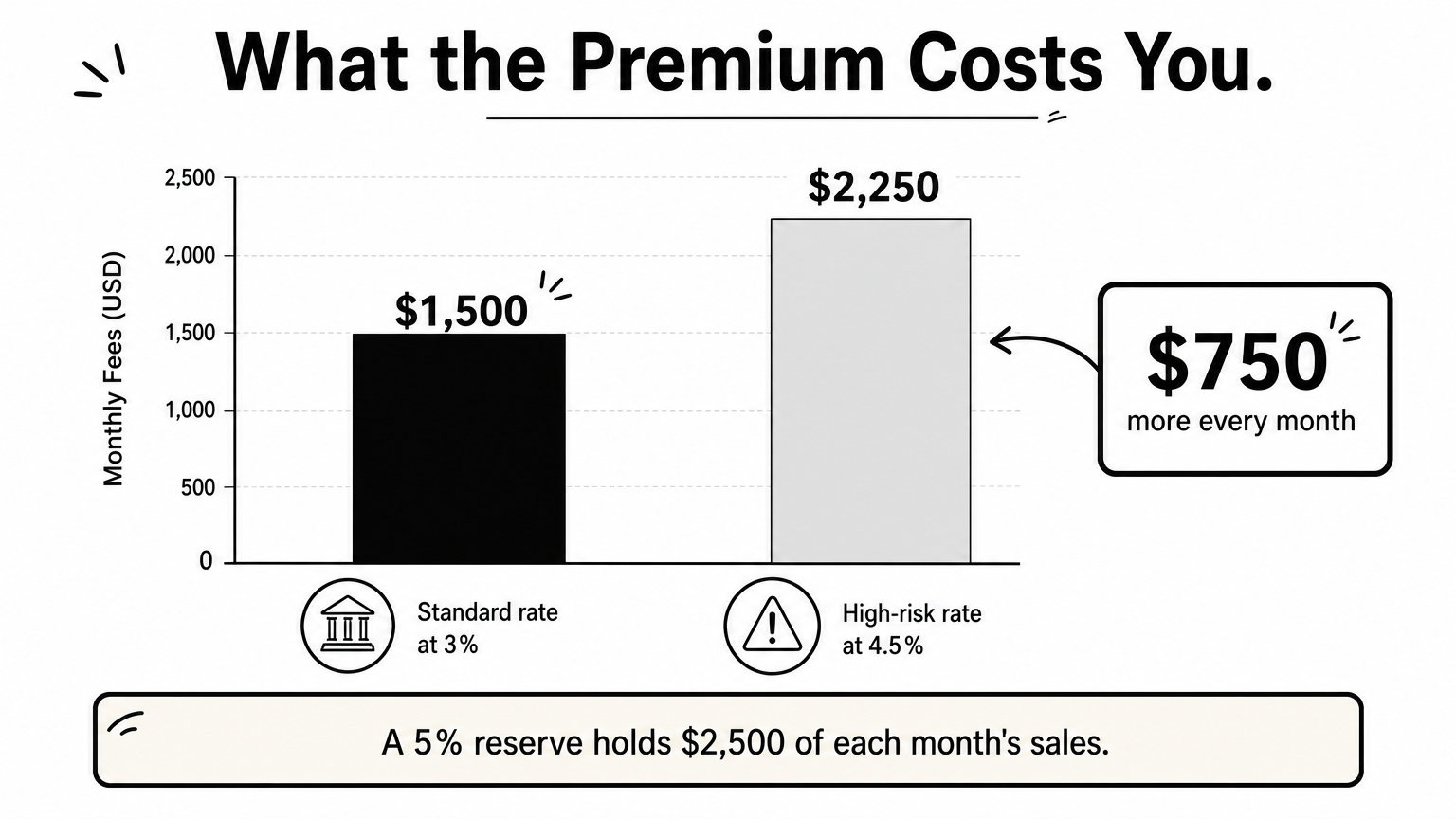
Here is a worked example. Say you process $50,000 a month and a standard rate would be 3%, which is $1,500 in fees. At 4.5%, you pay $2,250, or $750 more every month. A 5% reserve holds $2,500 of each month's sales. If the contract holds it for 180 days, about $15,000 of your money sits with the processor at any time. Plan your cash flow around that number, not just the rate.
1. CoinPay
What it offers
CoinPay is a payment gateway provider for merchants in Thailand, Vietnam, the Philippines, Malaysia, Bangladesh, India and Indonesia. It covers onboarding, verification, setup and ongoing operations, using local currencies and local payment methods such as PromptPay with THB settlement in Thailand. Its USDT services run separately from the local rails.
- USDT deposits start from 1 USDT, with 9.35 seconds from submit to deposit complete and 15.25 seconds for the whole process
- USDT payouts start from 1 USDT and average 1 to 3 minutes
- Approved merchants get integration information and testing support
- Monthly success-rate monitoring for the merchants it works with
Who it suits
CoinPay suits e-commerce, gaming, fintech and other online merchants that sell to customers in those seven markets and can pass a real review. The review may cover company information, ownership, identity checks and business activity, and you must apply customer and age checks where required. It does not take fraudulent or deceptive businesses, pyramid or money-game models, or misleading investment schemes.
That makes it a poor fit for "anything goes" processing. It is a good fit if you want a partner with five years of operating experience that stays involved after go-live.
CoinPay screens hard up front, then stays involved after go-live.
Cost and approval
Approval follows a clear sequence: application, business verification, service setup, then integration and testing before processing begins. Ask for pricing, settlement terms and any holds in writing on a demo call. You can also reach the team at sales@coinpay.world or on Telegram.
2. CCBill
What it offers
CCBill describes itself as a high-risk payment processor with fast approval, easy onboarding, no minimum or maximum volumes, and support for nearly all business types. It also cites more than 24 years of experience with high-risk merchants. Those are its own claims, so test them in the application.
- Quick onboarding for most business types
- No stated volume floor or ceiling
- Long history with high-risk merchants
Who it suits
Small and new merchants benefit most from a provider that states no volume minimum. Businesses that mainstream processors rejected for their category also fit, as do merchants whose volume swings month to month. A fixed volume floor would punish that pattern.
No volume limits matter most when your sales are uneven.
Cost and approval
Fast onboarding does not remove underwriting. Ask what documents it wants and how it handles disputes, since your chargeback ratio decides how long you keep the account. Get the fee schedule, reserve terms and cancellation terms before you sign.
3. SoarPay
What it offers

Soar Payments positions itself as a high risk merchant account provider for hard-to-place and non-traditional businesses. It offers credit card processing for merchants that standard banks avoid. Other high-risk guides also name it among the specialists.
- Credit card processing for high-risk categories
- Focus on businesses other processors will not place
Who it suits
SoarPay suits merchants with an unusual model that gets declined elsewhere, such as a niche product, a thin processing history or a mixed business profile. Come ready with the paperwork: business licenses, bank statements and any processing history. A complete file shortens the review.
Hard-to-place merchants win approval with complete paperwork, not with speed.
Cost and approval
Ask which acquiring bank would hold your account and under which category code. Request the rate, reserve percentage and holding period in one written quote. A low headline rate with a large reserve can cost more than a higher rate with none.
4. AllayPay
What it offers

AllayPay provides high risk payment processing for complex industries. It highlights global card acceptance and advanced fraud protection, which matters if you sell across borders and see more fraud attempts.
- High-risk processing for complex industries
- Card acceptance for customers in many countries
- Fraud protection built into the offer
Who it suits
AllayPay fits merchants with international customers and a real fraud exposure, such as online platforms taking cards from many countries. If you only sell domestically, the global focus may add nothing for you.
Cross-border sellers should buy fraud tools first and a low rate second.
Cost and approval
Ask exactly which fraud tools are included in the base price and which cost extra, including 3D Secure support. Also ask about multi-currency settlement and fees. International sales often add currency conversion costs on top of the premium rate.
5. PayDiverse
What it offers
PayDiverse says it places high risk merchant accounts with banks that want your business. Its services include payment gateways and credit card processing. The placement model means it works as a go-between with acquiring banks rather than only as a single processor.
- Account placement with banks open to high-risk merchants
- Payment gateway and credit card processing
Who it suits
PayDiverse suits merchants who were declined by one or two processors and want a broker to find the right bank for their category. It works best when you can explain your business model, refund policy and chargeback history clearly.
A placement service is only as good as the bank it picks for you.
Cost and approval
Ask which bank will hold the account and whether the merchant ID is in your name. Confirm who holds any reserve and who handles chargebacks. Because several parties may take a cut, ask for the total cost, not just the processor's rate.
Choosing a provider that will stay with you
Pick the provider that fits your category, your customers and your cash flow. Compare written quotes for the rate, reserve, settlement time and contract length, not headline rates alone. Bring clean documents, a refund policy and a chargeback plan, because approval depends on them.
Use a specialist while your history is thin, then work to lower your chargeback ratio so you have better options later. If your customers are in Thailand, Vietnam, the Philippines, Malaysia, Bangladesh, India or Indonesia, you can arrange a free demo with CoinPay's team to see whether your business fits its review and how local payment methods and USDT would work for you.