
9 Payment Gateway Companies in India: Full 2026 List
India has more payment gateway providers than most founders can name off the top of their head, and that's the problem. You need a list of payment gateway companies in india that actually helps you compare settlement speed, local method coverage, and pricing, not another homepage full of buzzwords. Dozens of providers claim to serve Indian merchants, but only a handful handle UPI, cards, and net banking with the reliability a growing business needs.
This article gives you exactly that comparison. Whether you searched for a payment gateway india list or wanted to know how many payment gateway in india actually operate at scale, you'll find nine providers worth evaluating, along with what sets each one apart for different business models.
We built this list with cross border and regional merchants in mind, since that's where CoinPay works daily across South and Southeast Asia. You'll see local payment method support and settlement reliability weighed alongside compliance standards, because a gateway that can't clear KYC properly will cost you more than the transaction fees ever could. By the end, you'll have a shortlist matched to your industry, transaction volume, and whether you need crypto or USDT settlement alongside traditional rails.
1. CoinPay
How it works
CoinPay works differently from most gateways on this list of payment gateway companies in india because it treats onboarding as a relationship, not a checkbox. You submit a structured application, and the team runs full KYC and due diligence before you ever see an API key. That review process actively rejects scam operations, money-game platforms, and deceptive schemes, which means the merchants who make it through tend to sit in a cleaner, more stable pool. Once approved, integration follows a standard path: sandbox testing, credential issuance, and go-live, backed by a support team that stays engaged after launch rather than disappearing once the contract is signed.

A payment gateway is only as reliable as the merchant screening that happens before the first transaction.
Key features and supported payment methods
Here's what CoinPay brings to merchants operating across India and the wider South and Southeast Asian region:
- Local payment method coverage tailored per market, including UPI, net banking, and INR settlement rails relevant to Indian consumers
- USDT and stablecoin settlement as a separate, dedicated crypto payment service with 1-3 minute payouts for merchants who need it
- Case study driven optimization, where the team analyzes deposit journeys and flags friction points before they cost you conversions
- Ongoing payment performance monitoring, with success rate reported back per payment service, not just a dashboard you check yourself
- Cross-border settlement expertise across Thailand, Vietnam, the Philippines, Malaysia, Bangladesh, India, and Indonesia
That regional breadth matters if your business isn't confined to a single country, since you get one partner instead of juggling six local providers.
Pricing and fees
CoinPay doesn't publish a flat rate card, and that's intentional. Pricing depends on your industry risk profile, transaction volume, and whether you need crypto settlement alongside traditional rails. You'll get a quote after the application and verification stage, which lets CoinPay price fairly instead of forcing every merchant into one bracket. If you're comparing a payment gateway in india list purely on advertised percentages, it helps to understand how payment gateway costs in India break down across MDR, GST and hidden fees; this approach requires a bit more patience upfront, but it usually means fewer surprise holds or account freezes later.
Best for
Merchants who need more than a plug-and-play integration fit CoinPay best. If you're running an e-commerce, gaming, or fintech platform expanding across multiple Asian markets, and you want a partner that vets its merchant base seriously while offering both local currency and USDT settlement, CoinPay is worth a direct conversation before you commit to a single-country provider.
2. Razorpay
How it works
Razorpay built its reputation as one of the fastest-growing names on any list of payment gateway providers in india, and the onboarding reflects that speed. You sign up online, submit business documents, and get a test API key within hours in most cases, with full activation following a KYC review that's largely automated. Developers get a clean dashboard, well-documented SDKs, and prebuilt checkout flows, so a small technical team can go live in days rather than weeks. That speed comes from Razorpay's scale: it processes payments for hundreds of thousands of Indian businesses, from solo founders to large enterprises.
Fast onboarding only pays off if the settlement behind it stays just as fast.
Key features and supported payment methods
Razorpay covers nearly every domestic rail a business would need:
- UPI, cards, net banking, and wallets in a single unified checkout
- Payment links and invoices for businesses without a full website
- Subscription billing and payment routes for marketplaces splitting funds across vendors
- Razorpay Capital, offering working capital loans to qualifying merchants
Pricing and fees
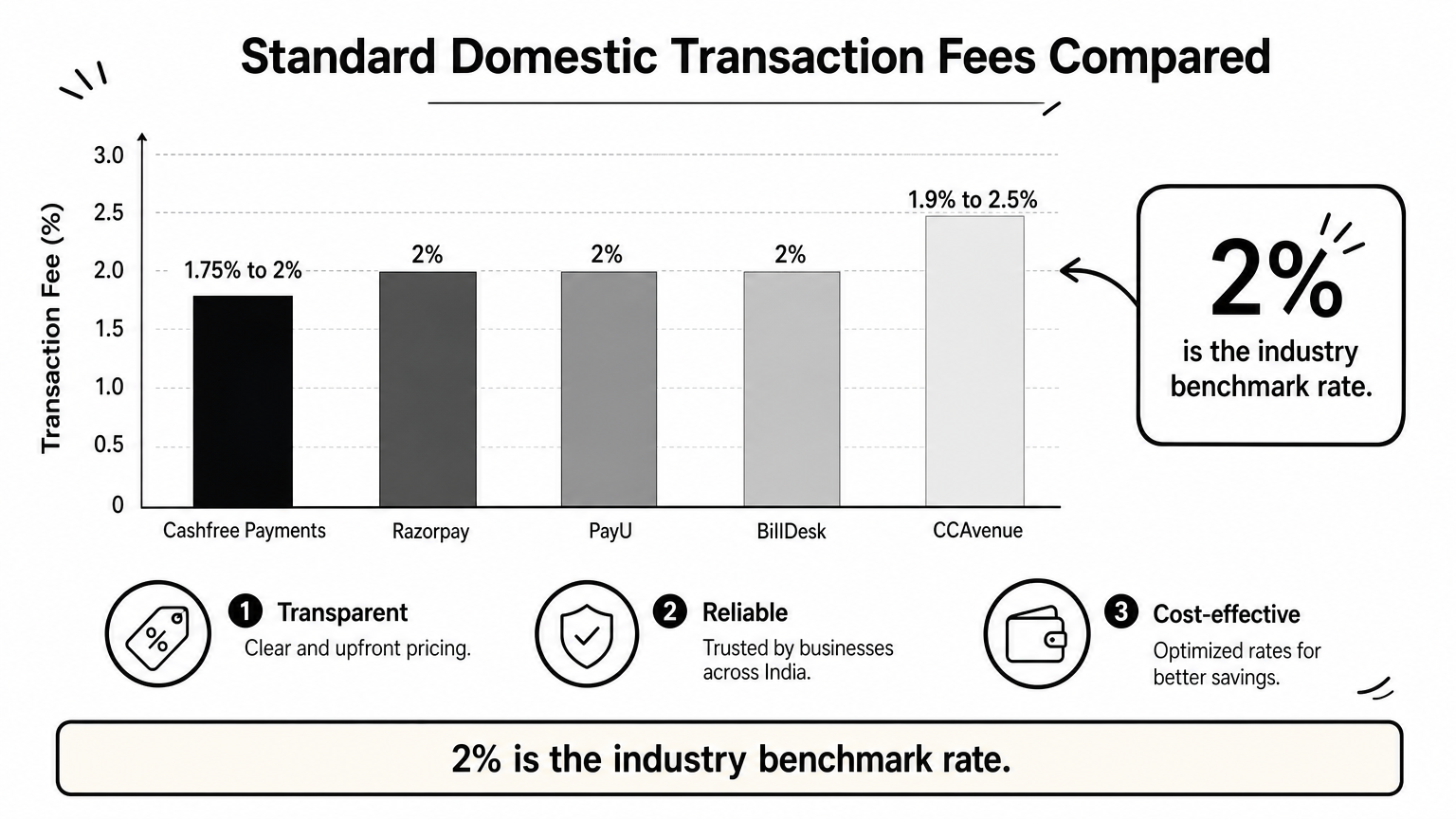
Standard transaction fees run around 2% per transaction for domestic cards and UPI, with international cards and enterprise plans priced separately after a sales conversation. There's no setup fee for the standard plan, though larger merchants often negotiate custom rates.
Best for
Razorpay suits Indian-first startups and SMEs that want fast integration and a broad domestic feature set without needing cross-border or crypto settlement.
3. PayU
How it works
PayU has operated in India longer than most challengers on this list of payment gateway companies in india, built originally on a global fintech backbone before carving out a strong domestic presence. Merchants apply through a documented onboarding flow, and PayU's team reviews business KYC alongside your website or app before issuing live credentials. Larger enterprises often get a dedicated account manager, which sets PayU apart from the pure self-service model some newer gateways use. Integration supports both hosted checkout pages and API-based custom flows, so the setup effort depends heavily on how much control your dev team wants over the payment experience.
A gateway with two decades of settlement history has already survived the failures that sink newer providers.
Key features and supported payment methods
PayU's method coverage reflects its enterprise focus:
- UPI, credit and debit cards, net banking, and wallets across all major Indian banks
- EMI options at checkout for higher-ticket purchases
- Fraud and risk scoring tools built into the transaction flow
- Recurring billing for subscription and SaaS merchants
Pricing and fees
Rates typically sit near 2% for standard domestic transactions, though PayU negotiates custom pricing for high-volume merchants and offers separate international card rates. Setup involves no upfront fee on standard plans, but enterprise integrations often include a commercial discussion before go-live.
Best for
Established mid-size and enterprise businesses that want a proven track record and dedicated account support will find PayU a solid fit, particularly if EMI and recurring billing matter more than crypto settlement options.
4. Cashfree Payments
How it works
Cashfree Payments earned its spot on this list of payment gateway providers in india by focusing heavily on speed and API-first design. Merchants sign up through an online portal, upload KYC documents, and often receive test credentials the same day, with full activation following a compliance check. Developers appreciate the modular API structure, which lets you pick individual services like payouts or subscriptions without bundling everything into one contract.
Modular pricing means you only pay for the payment infrastructure you actually use.
Key features and supported payment methods
Cashfree's method coverage reads like a checklist for growing Indian businesses:
- UPI, cards, net banking, and wallets, plus international cards for cross-border sellers
- Instant refunds and payouts, useful for marketplaces needing rapid vendor settlement
- Subscription billing for recurring revenue businesses
- API-first architecture letting you integrate specific services independently rather than adopting one bundled package
Pricing and fees
Fees hover around 1.75% to 2% for standard domestic transactions, with payouts and other add-on services priced separately based on volume. Cashfree doesn't charge setup fees on its standard plan, though enterprise merchants negotiate custom rates tied to transaction volume and risk profile.
Best for
Marketplace operators and developers who want granular control over which payment services they use, rather than a single bundled package, will find Cashfree Payments a strong match. It suits teams that value instant payouts and prefer building their own checkout logic over a fully hosted, one-size-fits-all solution.
5. CCAvenue
How it works
CCAvenue has been processing Indian transactions since the early 2000s, making it one of the oldest names on any list of payment gateway companies in india. Merchants apply through a documented onboarding process, submitting business and banking KYC before CCAvenue issues a merchant ID and test credentials. The platform leans on a hosted checkout model by default, meaning your customers get redirected to a CCAvenue-branded payment page, though API integration is available for teams that want the transaction to stay within their own site design.
Longevity in payments usually means a provider has already worked through the compliance issues newer gateways are still discovering.
Key features and supported payment methods
CCAvenue's method list reflects decades of bank relationships across India:
- Cards, net banking, UPI, and wallets spanning over 200 payment options and 27 currencies
- EMI and Buy Now Pay Later options at checkout
- Recurring billing for subscription merchants
- Multi-currency settlement for businesses selling internationally alongside domestic customers
Pricing and fees
Standard domestic transaction fees generally fall between 1.9% and 2.5%, depending on your industry and volume, with international card transactions priced higher. CCAvenue doesn't publish a universal rate card publicly, so most merchants negotiate pricing directly with a sales representative once they submit an application.
Best for
Businesses that value a long operating history and broad currency support over a modern developer experience will find CCAvenue dependable. It suits merchants selling internationally who need multi-currency settlement without switching to a separate cross-border provider, even if the checkout interface feels less polished than newer competitors.
6. Instamojo
How it works
Instamojo built its name serving small merchants and solo sellers who needed a payment link, not a full developer integration. Signing up takes minutes: you create an account, complete basic KYC, and get a payment link generator immediately, with fuller API access unlocking after document verification clears. Solo founders and small shop owners without a dedicated dev team often start here precisely because you don't need to write code to accept your first payment. That low barrier to entry explains why Instamojo shows up on nearly every list of payment gateway in india aimed at small businesses.
A payment gateway that a non-technical founder can set up alone removes the biggest barrier to getting paid online.
Key features and supported payment methods
Instamojo keeps its feature set focused on simplicity rather than enterprise scale:
- UPI, cards, net banking, and wallets through hosted payment links
- Storefront and invoicing tools bundled alongside the payment gateway
- QR code payments for offline-to-online collection
- Instant settlement options for an added fee
Pricing and fees
Standard transaction fees sit around 2% to 3.5% depending on the plan tier, with instant settlement carrying an extra charge on top of the base rate. Instamojo also offers subscription plans bundling the gateway with storefront and invoicing tools, which can work out cheaper than paying transaction fees alone at higher volumes.
Best for
Solo entrepreneurs, small shop owners, and side-hustle sellers who need a payment link today, without a development team, will find Instamojo the fastest path to accepting money online.
7. BillDesk
How it works
BillDesk processes a huge share of India's online bill payments and utility transactions, making it one of the most established names on any list of payment gateway providers in india. Merchants apply through a formal onboarding process involving bank-grade KYC, since BillDesk built much of its business around banks, government portals, and insurance companies before expanding to general e-commerce. Getting approved takes longer than newer gateways, often weeks rather than days, but the tradeoff is access to a settlement network with deep bank integrations. Once live, most merchants use hosted checkout pages rather than heavily customized API flows.

Deep bank integrations built over two decades handle payment volume that newer API-first gateways haven't been tested against yet.
Key features and supported payment methods
BillDesk's strength lies in bank-grade reliability rather than developer convenience:
- UPI, net banking, cards, and wallets with direct bank-level integrations
- Bill payment and recurring collection tools originally built for utility companies
- High-volume transaction handling proven at national scale
- Government and institutional payment support, a niche few competitors cover
Pricing and fees
Charges typically run close to 2% for standard domestic cards and UPI, though BillDesk negotiates most pricing directly with merchants based on volume and sector. Expect a longer sales cycle before you see actual numbers, since pricing isn't published on a self-serve rate card.
Best for
Institutions, utility companies, and high-volume enterprises that need proven bank connectivity over flashy developer tools will find BillDesk a dependable, if less agile, choice.
8. Paytm Payment Gateway
How it works
Paytm built its payment gateway on top of one of India's most recognized consumer wallets, which gives it a distinct edge on any list of payment gateway companies in india. Merchants apply online, submit KYC documents, and go through a verification process that typically takes a few business days before test credentials arrive. Because Paytm already handles wallet, UPI, and QR transactions for hundreds of millions of consumers, the checkout flow feels familiar to shoppers who already use the Paytm app daily, which can lift conversion for merchants targeting price-sensitive, mobile-first buyers.
A gateway backed by an existing consumer wallet base can shorten the trust gap at checkout before a shopper types a single card number.
Key features and supported payment methods
Paytm's feature set leans into its wallet and mobile-first roots:
- Paytm Wallet, UPI, cards, and net banking in one checkout
- QR code payments for offline and in-store collection
- Postpaid and EMI options through Paytm's lending arm
- Soundbox integration linking online and offline payment confirmations
Pricing and fees
Transaction fees generally run close to 2% for domestic cards and UPI, with wallet transactions sometimes priced slightly differently depending on merchant category. Paytm doesn't publish a single universal rate card, so most businesses get final pricing after submitting an application and discussing volume with a sales representative.
Best for
Merchants targeting everyday Indian consumers, especially in retail, food, and mobile-first commerce, will benefit most from Paytm's existing wallet reach and familiar checkout experience.
Picking the right fit for your business
Nine providers, one decision: match the gateway to how your business actually operates, not to whichever name shows up first in a search. Local method coverage decides whether your customers complete checkout or abandon it, and settlement reliability decides whether that revenue actually lands in your account on schedule. A solo seller needs Instamojo's simplicity, an enterprise with bank-grade volume leans toward BillDesk, and a startup wanting speed picks Razorpay or Cashfree.
But if you're operating across India and neighboring Asian markets, or you need both local currency and USDT settlement without stitching together separate providers, the calculation changes. Compliance and merchant screening matter as much as checkout speed once you're handling real volume. That's the gap CoinPay was built to close, and the fastest way to see if it fits your business is a direct conversation. Book a free demo with CoinPay and get a pricing quote built around your actual transaction profile, not a generic rate card.