
Merchant Services: What They Are and How to Choose One
Merchant services are the accounts, software, and hardware that let a business accept card payments and receive the money in its bank account. When a customer taps, swipes, or types in a card number, your merchant services authorize the payment, route it through the card networks, and settle the funds to you. If you sell by card at all, you already use them or need them, whether they come from a bank, a processor, or a payments company.
This guide explains why small businesses need them, how credit card processing works step by step, what it costs with a worked example, and how to choose a merchant service provider you can trust. It also covers what to do when a "merchant services" salesperson calls you unprompted.
CoinPay is a payment gateway provider for merchants in Southeast and South Asia, with five years of hands-on operating experience. The advice below comes from the operator side of payments, where provider choice shows up in approval rates, settlement timing, and support quality.
Why merchant services matter for your small business
Merchant services matter because a business that cannot take cards turns away customers who do not carry cash. For a small business the case rests on three things: more ways to sell, steadier cash flow, and safer handling of card data.

Sales you lose without card acceptance
Card acceptance widens the set of customers you can serve. A customer without cash, a buyer ordering from another city, and a client paying a large invoice by phone cannot buy from a cash-only business. A merchant services setup lets you take payment in person, online, over the phone, and in the field with a mobile reader. That matters most to small businesses that sell through more than one channel.
A business that takes cards can sell wherever its customers are, not only where cash changes hands.
Cash flow, security, and records
Merchant services also make cash flow more predictable. Card sales settle on a schedule, commonly within one to three business days, so you can plan payroll and supplier payments around known deposit dates.
Security is the other benefit. Your provider encrypts card details in transit and helps you meet PCI DSS, the card industry's data security standard, so card numbers never sit in your own files. Every transaction also lands in a report, which makes bookkeeping and refunds far easier than tracking cash.
How merchant services and credit card processing work
A merchant services setup has four working parts, and a card payment passes through them in a fixed order within seconds. Once you know the parts and the order, provider quotes become much easier to read.
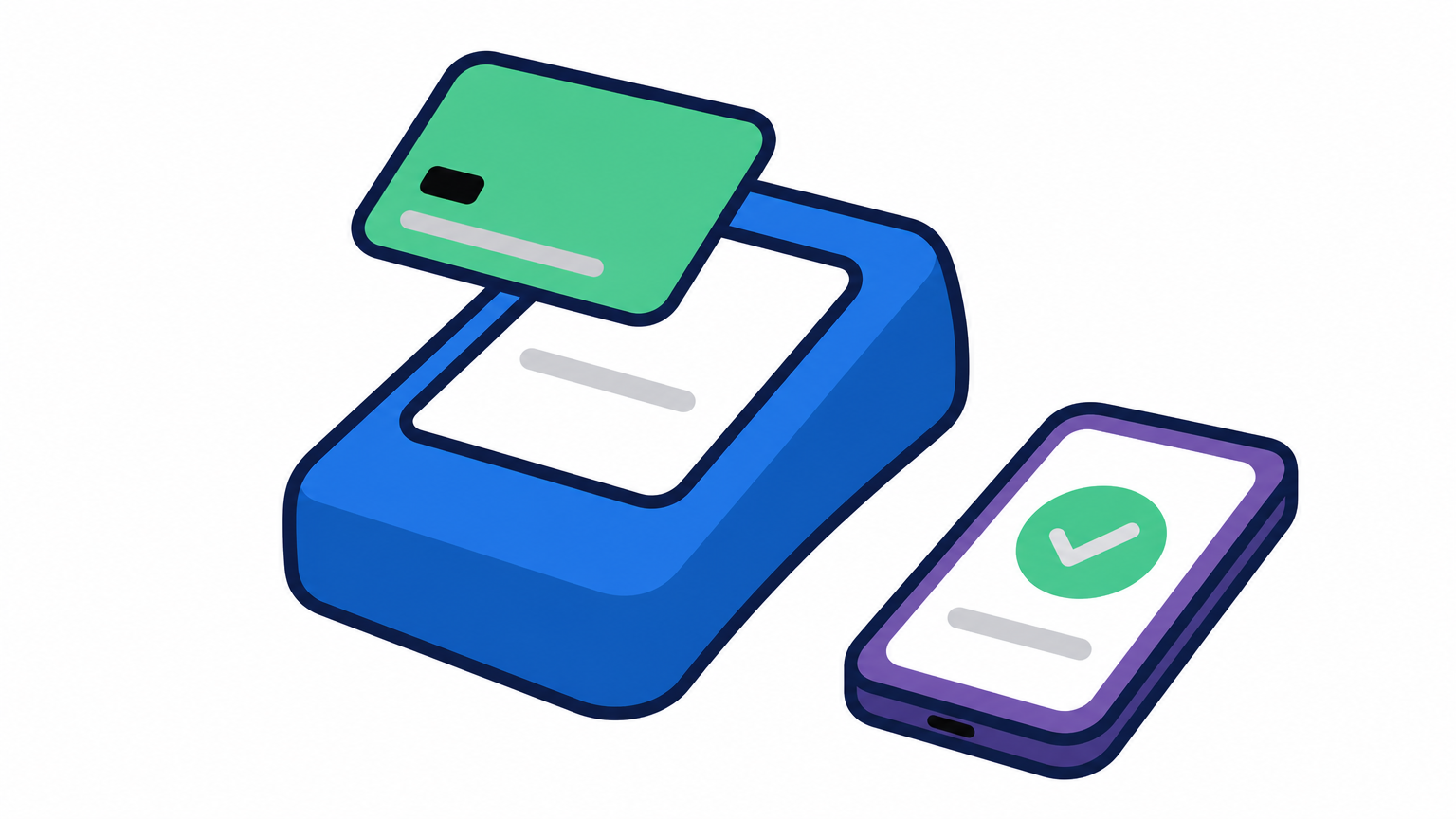
The four parts of a setup
You will not need every part. A shop with a counter needs a POS, while an online store needs a gateway. Both need a merchant account somewhere in the chain.
| Part | What it does | Who needs it |
|---|---|---|
| Merchant account | Receives approved card proceeds and passes them to your business bank account | Every business that accepts cards |
| Payment gateway | Securely sends card details from your website or app for authorization | Online sellers |
| POS system | Card reader or terminal plus software for in-person sales, often with inventory and sales reports | Shops, restaurants, market stalls |
| Virtual terminal | Web page where you key in card details yourself | Phone and mail orders, invoicing |
How a card payment moves from tap to deposit
Credit card processing has two phases. Authorization checks that the card is valid and the funds exist. Settlement moves the money. Here is the sequence:
- The customer pays by tap, swipe, or online checkout.
- The terminal or gateway encrypts the details and sends them to your processor.
- The processor passes the request to the card network, which forwards it to the customer's issuing bank.
- The issuer approves or declines, and the answer travels back the same way, usually in seconds.
- Approved sales are grouped into a batch and submitted for settlement.
- Funds reach your bank account, commonly within one to three business days.
Authorization takes seconds, but settlement is what puts money in your account, so ask every provider how long it takes.
What merchant services cost
Merchant services cost a percentage of each sale plus a small fixed fee, with monthly and occasional charges on top. Two providers can quote different headline rates and still cost the same, so compare the full statement, not one number.
The fees you will see on a statement
| Fee | What it is |
|---|---|
| Interchange | Set by the card networks and issuing banks, and passed through to you |
| Provider markup | The processor's own percentage or per-transaction charge |
| Monthly fee | A flat charge for the account, gateway, or support |
| Equipment | Purchase or rental of readers and terminals |
| Setup | A one-time onboarding charge, if any |
| Chargeback fee | Charged when a cardholder disputes a payment and it is reversed |
Pricing usually comes in two shapes. Flat-rate pricing bundles everything into one percentage and is simple to predict. Interchange-plus pricing shows the pass-through cost and the provider's markup separately, which makes it easier to audit.
A worked example for a small shop
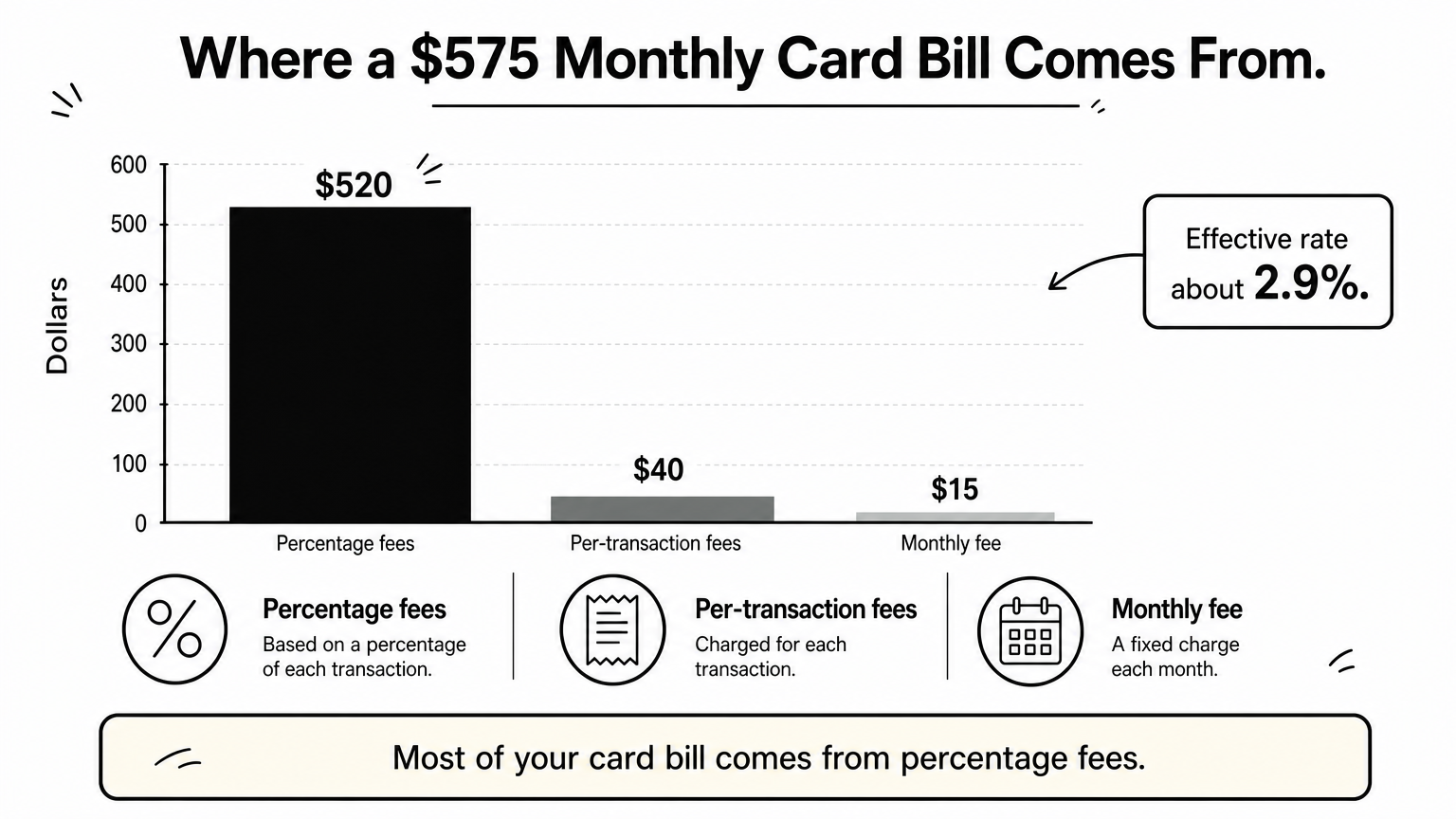
The numbers below are made up for illustration and are not a quote. Say your shop takes $20,000 a month in card sales across 400 transactions, an average ticket of $50. Your provider charges 2.6% plus $0.10 per transaction and a $15 monthly fee.
- Percentage fees: $20,000 × 2.6% = $520
- Per-transaction fees: 400 × $0.10 = $40
- Monthly fee: $15
- Total: $575, an effective rate of about 2.9%
Always calculate the effective rate this way. It is the number that compares fairly across providers.
Divide total monthly fees by total card sales to get your effective rate, and compare providers on that number.
How to choose a merchant service provider
Choose a merchant service provider by matching its type, pricing clarity, settlement speed, and support to how and where you sell. A merchant service provider is the company that supplies your merchant account, gateway, or equipment and handles processing on your behalf.
Types of providers
Providers fall into three broad groups. Banks bundle merchant accounts with business banking. Processors and sales organizations offer dedicated merchant accounts, with underwriting for each business. Payment facilitators onboard many merchants under one master account, which makes signup fast but can mean less flexibility and tighter limits on how funds are handled. None is best for everyone. Pick based on your volume, your risk profile, and how much support you need.
Questions to ask before you sign
- What is the full fee schedule, including monthly, equipment, and chargeback fees?
- How long is the contract, and what does early cancellation cost?
- How many days until funds reach my bank account?
- Does it connect to my accounting or e-commerce software?
- Who answers when a payment fails, and through which channels?
Unsolicited calls and vetting a provider
If a "merchant services" rep calls you unprompted, treat it as a sales pitch, not a notice about your account. Never share account numbers or statements on an inbound call. Ask for the company's legal name, check it independently, and request pricing in writing. A reputable provider also vets you in return. Expect questions about your business and ownership, and a review before processing starts.
If you sell in Southeast or South Asia
Cards are not the only way customers pay in many markets. In Thailand, for example, PromptPay is a common local method, so a provider needs to cover the methods and currencies your buyers use. CoinPay serves merchants in Thailand, Vietnam, the Philippines, Malaysia, Bangladesh, India, and Indonesia. Approved merchants receive the information needed for integration and testing, and CoinPay produces success-rate monitoring every month for them.
The right provider covers the way your customers actually pay, not just the way you would like them to.
Where to go from here
Merchant services are the accounts, gateways, and terminals that turn a customer's payment into money in your bank. You need them to sell beyond cash. Compare providers by effective rate, settlement time, contract terms, and support, and walk away from anyone who will not put pricing in writing.
If you run a business that sells in Southeast or South Asia and want payments built around local methods and a careful merchant review, book a free demo call with CoinPay's team. You can talk through your markets and payment flow with the team before you commit to anything.