
National Payment Gateway India: What NPCI Is and Does
The national payment gateway India relies on is not a single website or app. It is the National Payments Corporation of India (NPCI), a not-for-profit company that runs the country's retail payment rails. NPCI operates UPI, IMPS, RuPay, NACH, FASTag toll payments, Bharat BillPay and several other systems that move money between banks, apps, merchants and consumers.
The Reserve Bank of India (RBI) and the Indian Banks' Association (IBA) set up NPCI in 2008 under the Payment and Settlement Systems Act, 2007. It was created as a Section 8 company, so it exists to build shared infrastructure rather than to earn profit for its owners. Banks own it, and RBI oversees it.
This article explains why NPCI matters to anyone who sells or pays in India, how a merchant actually uses its rails, and what each system does. It also covers who owns and governs NPCI, and how UPI works abroad. At CoinPay we help merchants accept local payments across South and Southeast Asia, including India's UPI and bank rails. Knowing where NPCI ends and a gateway begins is the first thing we explain to new merchants.
Why NPCI matters for payments in India
NPCI matters because it turned a fragmented banking system into one interoperable network. Before it, a payment between customers of two different banks often meant different networks, different fees and slow settlement. Today a customer of any participating bank can pay a merchant at any other bank in seconds.
One set of rails instead of many closed networks
NPCI's biggest contribution is interoperability. UPI, launched in 2016, lets a customer use any UPI app to pay any merchant QR code, no matter which banks sit on either side. IMPS made instant transfers available around the clock, and RuPay gave India a domestic card network.

The scale shows the result. UPI has handled more than 10 billion transactions a month since 2024, and it is now the default way many Indian consumers pay for everything from groceries to rent. A national payment gateway India's businesses can plug into, in effect, turned digital payments into a public utility.
NPCI matters because it made every bank account in India reachable from every other bank account.
What it means for merchants
If you sell to Indian customers, you cannot ignore these rails. Shoppers expect to pay the way they pay everywhere else, which usually means a UPI app.
- Higher conversion. Customers abandon checkouts that lack their preferred method.
- Lower cost to collect. UPI merchant payments have carried zero merchant discount rate under government policy since 2020. Policy on fees has shifted over time, so confirm current terms with your provider.
- Faster money. Instant rails shorten the gap between a customer paying and you seeing the funds.
- Recurring billing. NACH and UPI mandates automate subscriptions, EMIs and bill collection.
NPCI is not a payment gateway
Many searchers use "national payment gateway" loosely, so the distinction deserves a clear statement. NPCI is the infrastructure operator. It does not onboard your online store, host your checkout page or handle your support tickets. A payment gateway or aggregator sits between your business and NPCI's rails, handling integration, verification, reconciliation and settlement. You connect to the gateway, and the gateway connects to the rails.
How to accept payments on NPCI rails
You accept payments on NPCI rails by working through a licensed bank or payment provider, not by contacting NPCI directly. NPCI certifies banks and payment service providers as participants, and those participants serve merchants. Your job is to choose the right provider and complete verification properly.
Five steps from decision to first payment
This is the sequence we see work for merchants entering India.
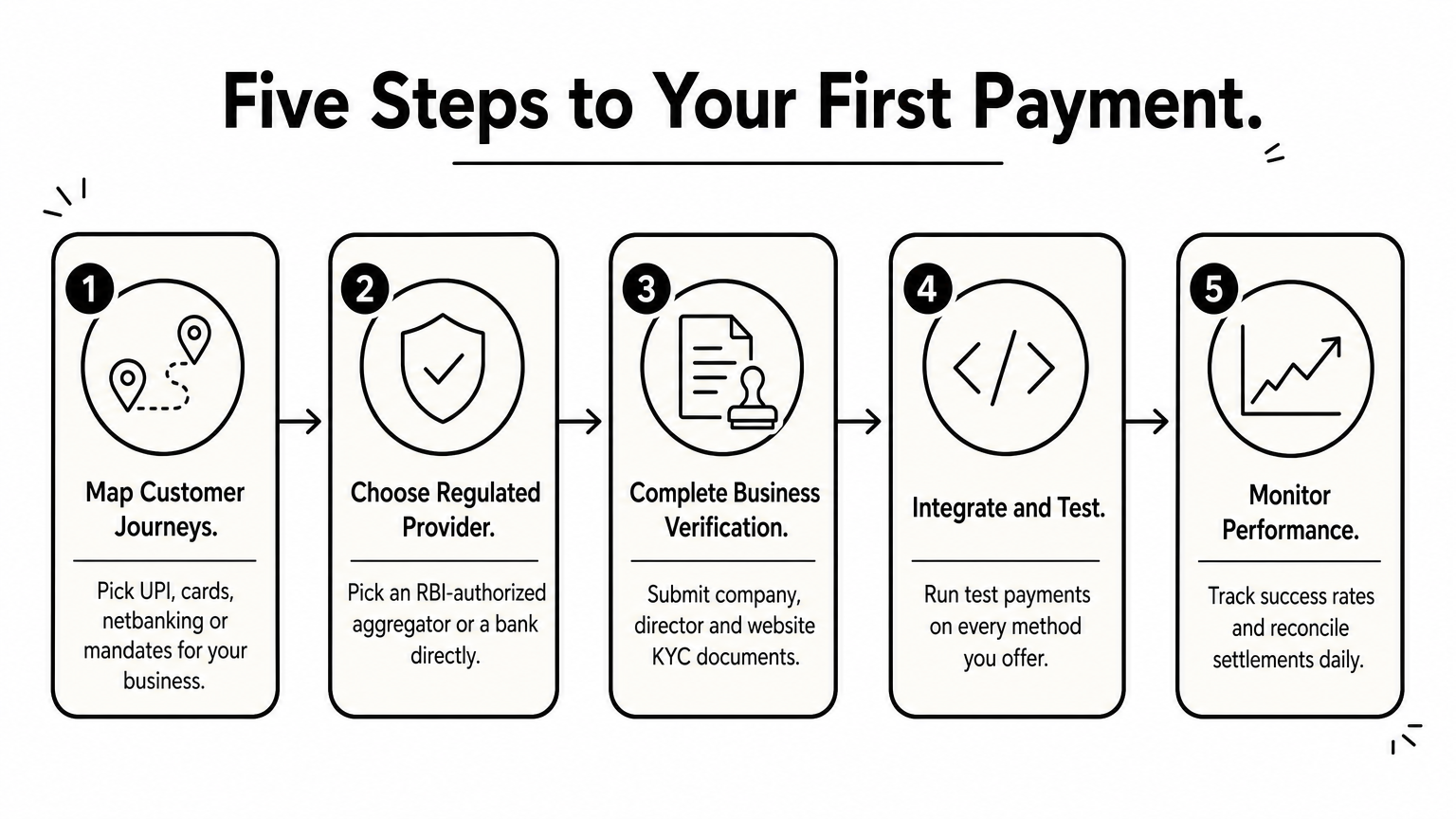
- Map your customer journeys. Decide whether you need UPI collect and QR flows, RuPay and other cards, netbanking, or recurring mandates. A subscription business needs different rails than a one-off retailer.
- Choose a regulated provider. Online merchants should work with a payment aggregator that holds RBI authorization, or with a bank directly. Ask who holds the funds and how settlement works.
- Complete business verification. Expect KYC on your company, directors and website, plus due diligence on what you sell. Have incorporation documents, bank details and a working site ready.
- Integrate and test. Connect through the provider's API or plugin, then run test payments through every method you plan to offer, including failed and pending cases.
- Monitor performance. Track success rates by method and bank, watch for drop-offs in the deposit journey, and reconcile settlements daily.
Merchants never plug into NPCI itself, they plug into a regulated provider that is certified on NPCI's rails.
What to check before you sign
Once you have a shortlist, compare providers on the details that decide day-to-day results. Marketing pages rarely cover them, so ask directly.
- Method coverage: UPI, RuPay and other cards, netbanking, wallets and mandates.
- Settlement timing: how fast funds reach your account, and in which currency.
- Review standards: a provider that screens merchants carefully protects you from a shared reputation with bad actors.
- Support after launch: who answers when success rates drop or a bank has an outage.
This is where CoinPay focuses. We handle merchant verification and onboarding, then stay involved on payment operations and performance once you are live.
The systems NPCI runs
NPCI runs about a dozen systems, and each handles a different payment job. UPI gets the attention, but the others carry large volumes in their own niches, from highway tolls to bulk salary and loan collections.
Core retail systems at a glance
| System | What it does | Typical use |
|---|---|---|
| UPI (Unified Payments Interface) | Real-time account-to-account payments through any UPI app, using a UPI ID, phone number or QR code | Shop payments, peer transfers, bills, subscriptions |
| IMPS (Immediate Payment Service) | Instant interbank transfers, available 24x7 | Urgent transfers, bank-app payments |
| RuPay | Domestic debit, credit and prepaid card network | Card payments at terminals, ATMs and online |
| NACH (National Automated Clearing House) | Bulk push and pull payments, including recurring debits | Loan EMIs, salaries, dividends, subscriptions |
| NETC FASTag | Electronic toll payment linked to a bank account or prepaid balance | Highway tolls |
| BBPS (Bharat Bill Payment System) | Single interoperable platform for bill payments | Electricity, insurance, utilities |
| AePS (Aadhaar Enabled Payment System) | Banking transactions authenticated with Aadhaar biometrics | Cash withdrawal and balance checks in underbanked areas |
| NFS (National Financial Switch) | Shared network connecting bank ATMs | Cash withdrawal at any participating ATM |
| CTS (Cheque Truncation System) | Image-based cheque clearing | Faster cheque processing |
Newer and specialized products
Beyond the core list, NPCI keeps adding formats built on the same rails. UPI Lite speeds up small-value payments by simplifying authentication. UPI AutoPay lets customers approve recurring payments once and have them collected on schedule. e-RUPI is a voucher that can be redeemed for a specific purpose without a card or app.
For people without smartphones or data, *99# offers USSD-based banking through a basic mobile phone. BHIM is NPCI's own UPI app, though most users pay through third-party apps that run on the same network.
Think of NPCI as one organization running many specialized lanes, and UPI is simply its busiest lane.
Who owns NPCI and how it is governed
NPCI is owned by banks, regulated by RBI, and run as a company with its own board and management. This setup keeps the infrastructure neutral. No single bank or fintech controls the rails that all of them depend on.
Ownership and structure
At founding, ten promoter banks held the company: State Bank of India, Punjab National Bank, Canara Bank, Bank of Baroda, Union Bank of India, Bank of India, ICICI Bank, HDFC Bank, Citibank and HSBC. Shareholding has since widened to include more public sector, private, foreign, cooperative and regional rural banks, so the national payment gateway India uses today has a far broader owner base than at the start.

The company is not-for-profit, so surplus goes back into infrastructure and operations rather than to dividends. A board that includes independent directors and an RBI nominee oversees management.
Regulation and oversight
RBI regulates payment systems in India under the Payment and Settlement Systems Act, 2007, and NPCI operates its systems with RBI's authorization. RBI also sets the rules for the providers that sit on top, including payment aggregators.
For you as a merchant, this layered oversight matters in practice. Participants must meet security, fraud monitoring and compliance standards, and disputes follow defined processes. If a UPI payment goes wrong, you first raise it with your provider or the customer's bank. NPCI also runs complaint channels for UPI and its other products.
UPI abroad and how it compares with Zelle
UPI is no longer only a domestic system. NPCI's international arm, NPCI International Payments Limited (NIPL), signs agreements with foreign payment operators so UPI QR payments and RuPay cards work overseas, mainly for Indian travelers and the diaspora.
Which countries have UPI
The markets most often cited as live or in pilot are Singapore, the UAE, France, Bhutan, Nepal, Sri Lanka and Mauritius. The list keeps changing as new agreements go live, and some links cover only specific use cases such as QR payments at merchants. Check NPCI's announcements for the current status before you plan around a specific country.
Can foreigners use UPI in India
Foreign visitors generally cannot link a foreign bank account to a UPI app, because UPI is built on Indian bank accounts and Indian mobile numbers. Non-resident Indians with eligible Indian accounts can often use it, and some banks support international numbers. NPCI has also tested programs aimed at tourists, but availability varies by app and bank.
Is UPI similar to Zelle
Both move money between bank accounts in seconds, but their scope differs. The table sets out the main contrasts.
| Feature | UPI | Zelle |
|---|---|---|
| Operator | NPCI, owned by banks | Early Warning Services, owned by large US banks |
| Main use | Person-to-person and merchant payments, bills, mandates | Mostly person-to-person transfers |
| Access | Many third-party apps plus bank apps | Mostly through bank apps |
| Merchant QR payments | Core feature | Limited |
UPI works like Zelle with a merchant checkout, bill payments and recurring billing built into the same network.
Where NPCI fits in your payment plan
NPCI is the neutral, bank-owned operator behind India's retail payments. It runs UPI, IMPS, RuPay, NACH, FASTag, BBPS and other rails that make every bank account reachable from every other. You do not connect to it directly. You reach it through a regulated provider that handles verification, integration and settlement.
If you plan to sell in India, choose that provider as carefully as you would choose a bank. Look at method coverage, settlement terms, review standards and the quality of support after launch. CoinPay has five years of operating experience across seven Asian markets, including India, and we screen merchants strictly so legitimate businesses share a clean ecosystem. To see how that would work for your business, get a free demo from the CoinPay team.