
Payment Gateway Cost in India: Fees, Charges & Comparison
If you're trying to pin down payment gateway cost in india, you already know the pricing pages don't make it easy. Every provider quotes transaction fees differently, some bundle in setup costs, others hide settlement delays behind "zero MDR" claims that only apply to specific card types or transaction volumes. You end up comparing apples to oranges across five open browser tabs.
This article breaks down exactly what you'll pay, and to whom, when you set up a payment gateway for a website or app in India. We cover the real charges for payment gateway in india across major providers like Razorpay, Cashfree, Paytm, and PhonePe, including transaction percentages, fixed fees, GST, refund charges, and the settlement terms that affect your actual cash flow. You'll also get a straight payment gateway charges comparison india table so you can see the numbers side by side instead of digging through terms pages.
If your business processes payments across Southeast and South Asian markets, not just India, that comparison matters even more. CoinPay works with merchants navigating exactly this kind of multi-market payment complexity, so we've built this guide around what actually shows up on your settlement statement, not marketing copy.
Why payment gateway costs matter for your business
Every rupee a payment gateway takes off the top comes straight out of your margin, not your customer's pocket. If you're running an e-commerce store or SaaS product on thin margins, a difference of even 0.5% in your transaction fee rate can mean the difference between a profitable quarter and a break-even one. Understanding the payment gateway cost in india before you sign a contract isn't an accounting exercise, it's a decision that shapes how much room you have to price competitively, run promotions, or absorb refunds without panicking.
Small percentages, big numbers at scale
Two percent sounds small until you run real volume through it. A merchant processing ₹50 lakh a month at a 2% blended rate pays ₹1 lakh in gateway fees every single month, before GST. Drop that to 1.5% and you keep an extra ₹25,000 a month, money that could cover a hire, a marketing budget, or just better margins. This is why serious finance teams don't just glance at the headline rate on a pricing page, they model it against their actual transaction mix, because a gateway that looks cheap for UPI can turn expensive fast once credit cards or international cards enter the picture.
A 0.5% difference in gateway fees on ₹50 lakh in monthly volume is ₹25,000 a month you're leaving on the table.
The costs that don't show up on the pricing page
Transaction fees are only part of the picture. Settlement timing, refund processing charges, and chargeback fees all add friction that doesn't show up when you're comparing headline payment gateway charges comparison india tables. A gateway that settles funds in T+3 days instead of T+1 forces you to hold more working capital just to keep operations running smoothly, and that has a real cost even if it never appears as a line item on your invoice. Refund charges are another blind spot: some providers don't refund the transaction fee itself when you process a refund, which means a customer return costs you twice, once on the original sale and again on the reversal.
Failed transactions cost you even when nothing settles
Payment failures are the part most merchants underestimate. A gateway with a weak success rate on a specific bank or card network doesn't just cost you the failed transaction, it costs you the customer who abandons checkout after the second failed attempt. If you're running a business where deposit journeys matter, gaming platforms, subscription services, or any high-frequency payment flow, a 3% improvement in transaction success rate can move your revenue more than a 0.3% cut in fees ever will. This is exactly the kind of friction CoinPay's merchant support work focuses on: identifying where deposit journeys break down and fixing it before it shows up as lost revenue, as in this rebuild of a cluttered deposit screen into a four-step flow.
Why this matters more if you operate beyond India
Businesses running payments across multiple Asian markets feel gateway costs differently than a single-market Indian merchant does. You're not just comparing the cost of payment gateway for website in india against one competitor, you're weighing that against settlement terms in Vietnam, PromptPay costs and THB settlement in Thailand, or USDT settlement options if your business handles crypto-adjacent payment flows. A gateway that's cheap in India but slow to settle or poorly supported for GCash, Maya and PHP settlement in the Philippines or Bangladesh can quietly cost you more in operational overhead than the fee difference ever saves you. This is the exact problem CoinPay was built to solve, treating gateway selection as a market-by-market decision rather than a single blanket contract.
The real question isn't just "how much" but "how predictable"
Predictability matters as much as the raw percentage. A provider that surprises you with a chargeback fee, a currency conversion markup, or a sudden change in settlement cycle costs you more in operational headaches than a slightly higher but transparent fee structure ever would. Before you lock into any provider, ask for the full fee schedule in writing, not just the number quoted on a sales call, because the gap between advertised and actual charges is where most merchants get burned. Getting this right at the outset saves you from renegotiating contracts or migrating gateways mid-year, both of which carry their own hidden costs.
What makes up payment gateway charges in India
A single line item labeled "gateway fees" on your invoice actually bundles several separate charges, each calculated differently and each worth understanding on its own. Knowing the individual pieces of payment gateway india charges is what lets you actually negotiate, because a provider quoting a low headline rate might be making it up elsewhere with fixed fees or refund penalties.
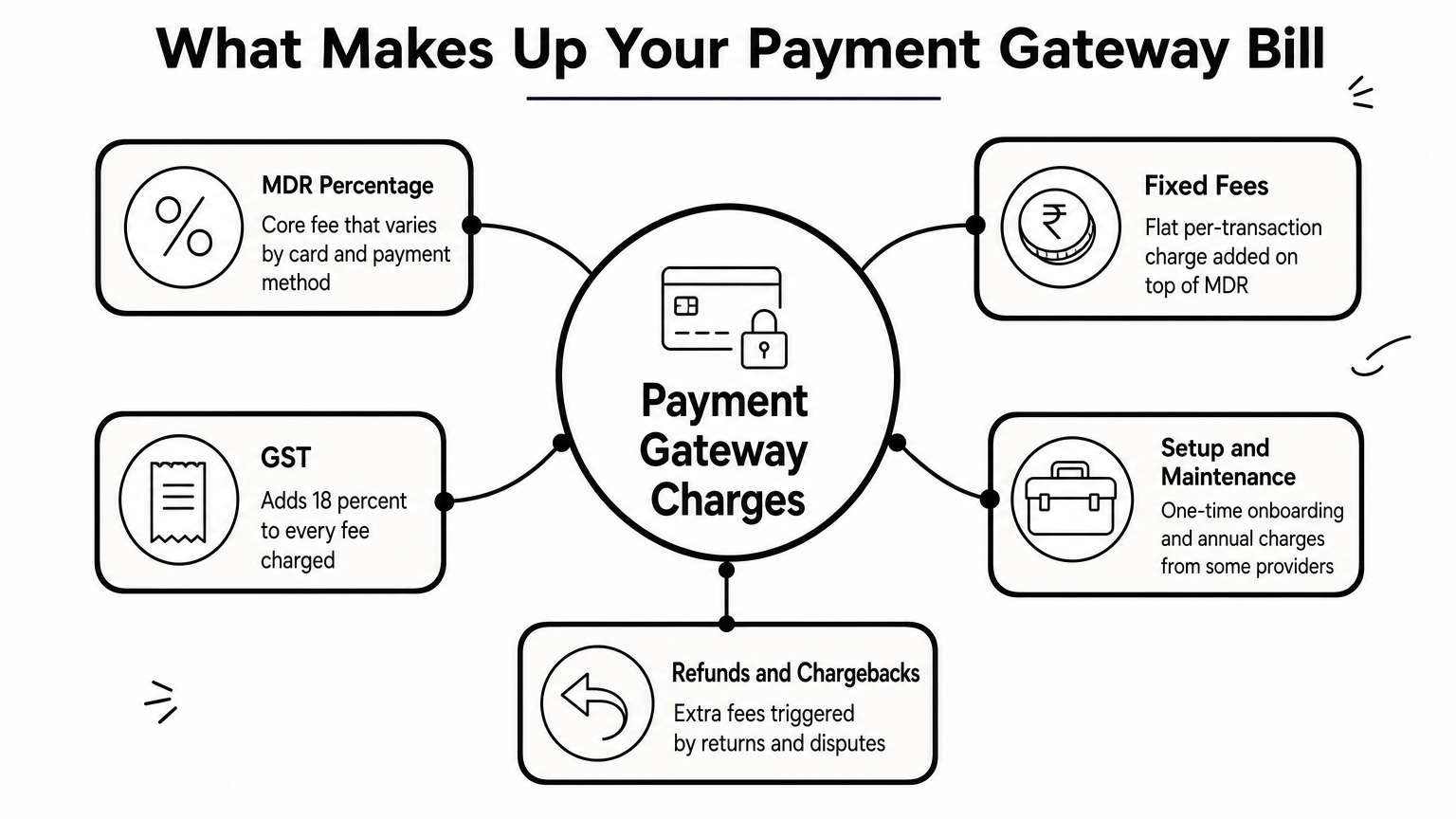
MDR is the core fee, but it varies by payment method
Most of what you pay is the Merchant Discount Rate (MDR), a percentage of each transaction value that the gateway and card network split between them. This rate isn't flat. UPI transactions in India currently carry zero MDR for merchants under a regulatory mandate, while credit cards typically run 1.5% to 2%, debit cards sit lower around 0.4% to 0.9%, and net banking or wallet payments fall somewhere in between depending on the provider.
The MDR you pay depends entirely on how your customers choose to pay, not on a single number a provider quotes you.
Fixed fees stack on top of the percentage
Beyond the percentage cut, many providers add a flat fee per transaction, often a few rupees, particularly on UPI or low-value transactions where a pure percentage wouldn't generate meaningful revenue for the gateway. This flat fee matters disproportionately if your average order value is small, since a ₹2 fixed charge on a ₹100 transaction functions like an extra 2% MDR that doesn't show up when you compare headline percentage rates.
GST adds 18% to every fee you pay
Government tax applies on top of whatever the gateway charges, not instead of it. Every MDR percentage, fixed fee, and refund charge carries an additional 18% GST, and this is the single most common reason merchants underestimate their actual cost after signing a contract. A 2% quoted rate is really 2.36% once GST lands on your statement.
Setup, onboarding, and maintenance charges
Some providers charge a one-time setup fee for onboarding and KYC processing, and a smaller group still charge annual maintenance fees regardless of transaction volume. These are increasingly rare among larger Indian gateways competing for volume, but they show up more often with niche or specialized providers, so ask directly rather than assume they're waived.
Refund, chargeback, and cross-border fees
Refunds and disputes are where costs quietly multiply. Here's what typically applies beyond the standard MDR:
| Charge type | Typical range | Notes |
|---|---|---|
| Refund processing fee | 0% to 2% of refunded amount | Some providers don't return the original MDR |
| Chargeback fee | ₹250 to ₹750 per dispute | Charged regardless of dispute outcome at many providers |
| International card MDR | 3% to 3.5% | Higher than domestic cards, plus currency conversion markup |
| Settlement delay fee | Varies | Faster settlement (T+0 or T+1) often costs extra |
International cards and cross-border transactions carry the steepest markup of the entire fee structure, since currency conversion adds its own spread on top of the elevated MDR. If your business processes payments from customers outside India, or you're comparing this against multi-market operations elsewhere in Asia, this line item deserves as much scrutiny as the domestic rate you'll see advertised most prominently.
How to calculate the real cost of a payment gateway
Headline MDR numbers on a pricing page tell you almost nothing until you run them against your own transaction mix. The real cost of a payment gateway depends on how your customers actually pay, how often they ask for refunds, and how many transactions fail before completing. Skipping this calculation is how merchants end up locked into a contract that looked cheap on paper but bleeds margin every month.

Start with your payment method mix
Grab your last three months of transaction data and break it down by payment method: UPI, debit card, credit card, net banking, wallets. Each carries a different MDR, so a blended rate only makes sense once you know the proportion of volume flowing through each channel. A business doing 70% UPI and 30% credit cards pays a very different effective rate than one doing the reverse, even under the identical payment gateway price list in india from the same provider.
Add the fixed fees and GST layer
Once you have your blended percentage, add any flat per-transaction fee, then apply 18% GST on top of the combined total, not just the MDR portion. This is where most back-of-envelope estimates go wrong, since GST compounds on every fee line, not a single flat number.
If you're not adding GST to your fee estimate, you're underestimating your real cost by roughly a fifth.
Factor in refunds and failed transactions
Refund charges and failed-transaction friction rarely show up in a simple MDR calculation, but they belong in it. Estimate your refund rate as a percentage of total transactions, then apply the provider's refund fee schedule against that volume. Do the same with your checkout failure rate, since every failed attempt that doesn't recover is lost revenue, not just a cost line.
A worked example
Here's how the math looks for a merchant processing ₹40 lakh a month with a mix of UPI and cards:
Monthly volume: ₹40,00,000
UPI (60%): ₹24,00,000 x 0% MDR = ₹0
Credit card (30%): ₹12,00,000 x 1.8% = ₹21,600
Debit card (10%): ₹4,00,000 x 0.6% = ₹2,400
Subtotal MDR: ₹24,000
GST (18%): ₹4,320
Fixed fees (₹2 x 8,000 transactions): ₹16,000
Refund fees (2% refund rate, 1% refund charge): ~₹800
Total monthly cost: ₹45,120
Effective rate on volume: 1.13%
Notice how the fixed fees and refund charges nearly double the pure MDR cost in this example. That gap is exactly why comparing headline percentages alone gives you a misleading picture of the cost of payment gateway for website in india.
Build this into a recurring check, not a one-time exercise
Your payment mix shifts as your customer base grows, and a gateway that was cheapest at ₹10 lakh a month might not stay cheapest at ₹1 crore. Revisit this calculation quarterly, especially after any pricing change from your provider or a shift in how customers pay. Merchants who treat this as a living number, rather than a decision made once at signup, consistently catch fee creep before it eats into a full quarter's margin.
Payment gateway charges comparison across top India providers
Numbers change constantly as providers compete for volume, but the structure of what you pay stays remarkably consistent across the big names. Below is a payment gateway charges comparison india snapshot built from publicly listed rates as of late 2025, so treat the exact figures as a starting point for your own quote request rather than gospel, since enterprise merchants routinely negotiate lower than the standard payment gateway price list in india shown to smaller businesses.
Razorpay, Cashfree, Paytm, and PhonePe side by side
Here's how the four providers most Indian merchants shortlist compare on the fees that actually hit your settlement statement:
| Provider | UPI MDR | Debit card MDR | Credit card MDR | Settlement | Setup fee |
|---|---|---|---|---|---|
| Razorpay | 0% | 0.4%-0.9% | 1.7%-2% | T+2 (T+0 paid add-on) | None on standard plans |
| Cashfree | 0% | 0.4%-0.75% | 1.75%-1.95% | T+1 default | None on standard plans |
| Paytm | 0% | 0.4%-0.9% | 1.8%-2.1% | T+1 to T+2 | Varies by KYC tier |
| PhonePe | 0% | 0.4%-0.85% | 1.7%-2% | T+1 to T+3 | None on standard plans |
All four charge 18% GST on top of every fee shown, and all four charge extra for international cards, typically landing between 3% and 3.5% once currency conversion is factored in.
On paper, these four providers look nearly identical, the real gap only shows up once you compare refund policy and settlement speed, not the headline MDR.
Why the near-identical rates still produce different bills
What separates these providers in practice isn't the percentage on the pricing page, it's the fine print around refunds, chargebacks, and how fast you get paid. Cashfree and Razorpay generally offer faster default settlement than PhonePe's standard tier, which matters if you're running tight on working capital. Paytm's setup fee structure varies more by merchant category and KYC tier than the other three, so a gaming or fintech merchant might see a different quote than an e-commerce store even under the same published rate card. None of this shows up in a simple side-by-side of charges for payment gateway in india, which is exactly why you need the full fee schedule in writing before signing.
International and niche providers change the math further
If your business takes payments outside the standard UPI-and-cards mix, the comparison gets more complicated fast. Stripe and international-first gateways typically charge higher blended rates in India but offer stronger tooling for cross-border merchants, while USDT deposits and merchant payouts sit entirely outside this comparison table since they run on a different fee model tied to network and conversion spreads rather than card-network MDR. This is where a single-market comparison stops being useful if you're also processing payments in Thailand, Vietnam, or the Philippines, since the cheapest Indian gateway on this table might not even operate in those markets, and the best payment gateway providers in Thailand make up an entirely separate shortlist. CoinPay's India payment gateway with UPI, net banking and INR settlement is built around exactly this gap, giving merchants operating across multiple Asian markets one point of comparison instead of five separate rate cards to reconcile.
How to reduce payment gateway charges without losing customers
Cutting your payment gateway india charges doesn't mean forcing customers through a clunky checkout to save half a percent. The merchants who actually lower their effective rate do it by negotiating smarter, steering payment mix toward cheaper rails, and fixing the friction that causes refunds and failures in the first place, not by picking the single cheapest number on a rate card.
Negotiate before you sign, not after
Most published MDR rates are starting points, not fixed prices. Once you're processing meaningful volume, usually above ₹10-15 lakh a month, providers will negotiate lower rates, waive setup fees, or offer faster settlement at no extra cost just to win your business away from a competitor. Get quotes from at least three providers before renewing any contract, and use the lowest one as leverage even with your preferred gateway.
The best time to negotiate your rate is right before you sign, not a year into the contract when switching feels expensive.
Steer customers toward UPI where it makes sense
Since UPI carries zero MDR under current regulation, every transaction you shift from credit card to UPI is pure margin recovered. Set UPI as the default payment option at checkout, offer a small discount or cashback for UPI payments if your margins allow it, and only show credit card as a secondary option. This single change often does more for your cost of payment gateway for website in india than any rate negotiation.
Reduce refunds and chargebacks at the source
Every refund you avoid is a fee you never pay. A few practical fixes:
- Write clearer product descriptions and sizing guides to cut return-driven refunds
- Respond to disputes quickly, since unanswered chargebacks convert to fees automatically at most providers
- Offer store credit instead of cash refunds where your business model allows it, since some providers charge lower fees on credit issuance
- Flag high-refund customer segments and tighten fraud checks specifically there
Don't sacrifice success rate to save on fees
Switching to a marginally cheaper gateway that has a weaker success rate on a specific bank or card network is a false economy. A 2% saving on MDR means nothing if 5% more transactions fail and those customers don't come back. Before switching providers purely on price, ask for success rate reported per payment service on your specific customer bank mix, not just an industry average.
Consolidate volume instead of splitting it thin
Running multiple gateways to hedge against downtime is smart, but splitting volume evenly across three providers means you never hit the transaction thresholds that unlock better negotiated rates with any of them. Route the bulk of your volume through one primary gateway and keep a secondary one for failover, rather than spreading it evenly.
Look at settlement speed as a cost, not just a convenience
Faster settlement often costs extra as a percentage, but it can still save you money overall if it reduces how much working capital you need to borrow to cover the gap. Run the math on your cost of capital against the settlement fee before assuming slower and cheaper is automatically the better deal. This is the kind of tradeoff CoinPay works through with merchants directly, weighing fee reduction against the operational cost of holding cash longer, especially for businesses juggling settlement cycles across more than one Asian market at once.
Choosing the right payment gateway for your website or business
Picking a provider based on the lowest MDR alone is how merchants end up switching gateways twice in one year. The right choice weighs payment gateway cost in india against your actual business model: transaction volume, average order value, customer payment habits, and how much you need hands-on support versus a purely self-service dashboard. A gaming platform with high-frequency micro-deposits has different priorities than a B2B SaaS business invoicing a handful of large clients monthly, even if both are comparing the same rate card.

Match the gateway to your transaction profile
Before requesting a quote, write down your average order value, your top three payment methods by volume, and your monthly transaction count. Providers price differently depending on whether you're running thousands of small UPI transactions or a smaller number of high-value credit card payments, and a gateway optimized for one profile often underperforms on the other. Ask any shortlisted provider for a quote based on your actual numbers, not their published rate card, since the headline payment gateway price list in india rarely reflects what a real merchant with your volume ends up paying.
Weigh support quality against pure price
Cheap becomes expensive fast when something breaks and nobody answers the phone. Look past the fee schedule and ask how disputes get resolved, how quickly onboarding actually happens, and whether you get a dedicated contact once you're live or just a support ticket queue.
A gateway that saves you 0.3% but leaves you stuck for three days during a payment outage costs more than the fee difference ever recovers.
This matters even more if your business operates in regulated or high-risk categories, where a provider's willingness to actually support you through compliance questions counts for more than a marginally better rate.
Run through a practical checklist before signing
Use this as a working checklist against any shortlist of providers:
- Get the full fee schedule in writing, including refund and chargeback charges, not just the MDR
- Confirm settlement timing and whether faster settlement costs extra
- Ask for success rate data specific to your customer bank and card mix
- Check whether pricing scales down as your volume grows, and at what thresholds
- Verify support responsiveness before you're live, not after something breaks
- Confirm coverage and settlement terms in every market you operate in, not just India
Consider whether you need a single-market or multi-market partner
Businesses selling only to Indian customers can reasonably shortlist based on the domestic comparison table earlier in this guide. But if you're processing payments and VND settlement across Vietnam, Thailand, the Philippines, or Bangladesh alongside India, a single-market gateway forces you to manage separate contracts, separate support relationships, and separate reconciliation processes for every country you touch. Reconciling five different rate cards and five different settlement calendars every month is its own hidden cost, one that rarely shows up until you're three markets deep. This is precisely why CoinPay works with merchants as a payment gateway partner across Southeast and South Asian markets rather than a single-country vendor, with merchant onboarding, KYC and post-launch support treating each market's charges, settlement rules, and compliance requirements as part of one coordinated relationship instead of five separate headaches.
Frequently asked questions about payment gateway costs in India
Merchants ask the same handful of questions once they start comparing quotes, so here are direct answers instead of another rate table.
What is the average payment gateway cost in India?
Most merchants land somewhere between 1% and 2% blended, once you factor in a realistic mix of UPI, debit, and credit card volume, plus 18% GST on top. A business leaning heavily on UPI can see an effective rate closer to 0.3% to 0.5% after GST, since UPI itself carries zero MDR under current regulation. Businesses taking a larger share of credit cards or international payments will sit closer to 2.5% once currency conversion and cross-border fees are added in.
Is there a payment gateway with truly no charges?
No provider processes payments for free, no matter what the marketing headline says. "Zero MDR" offers almost always apply only to UPI or RuPay debit cards under a specific transaction value, while credit cards, net banking, and international payments still carry standard fees. Read the fine print on any zero-cost claim before you build a pricing model around it, since the gap between the advertised offer and your actual mix is usually where merchants get caught out.
Do payment gateway charges include GST?
No, GST is added on top of whatever MDR and fixed fees the provider quotes, not baked into the headline number. A gateway advertising a 2% rate actually costs you 2.36% once 18% GST lands on your statement, and this applies to refund fees and chargeback fees too, not just the core transaction charge.
If a quote doesn't mention GST, assume it's missing from the number and add 18% before you compare it to anything else.
Which payment gateway is cheapest for a small website in India?
Cheapest depends entirely on your payment mix and monthly volume, not a single provider that wins across the board. For a small website doing mostly UPI transactions, Razorpay, Cashfree, and PhonePe all land close to zero MDR, so the deciding factor becomes setup speed and support quality rather than fees. Once you introduce credit cards or scale past ₹10-15 lakh a month, it's worth requesting fresh quotes, since negotiated rates at that volume rarely match the published payment gateway price list in india.
How do refund charges affect the total cost of a payment gateway?
Refunds add a real cost that most merchants only notice after processing several returns. Many providers don't refund the original MDR when you reverse a transaction, so a customer return can cost you the fee twice, once on the sale and again on the refund itself. Businesses with high return rates, particularly in fashion e-commerce, should weigh this refund policy as heavily as the headline transaction rate when comparing providers.
Do payment gateway costs differ for websites versus mobile apps?
The MDR itself usually stays the same across web and app checkout, but integration and maintenance costs can differ. Mobile SDKs sometimes carry higher setup complexity, and a few providers price app-specific features like saved cards or one-tap checkout differently from browser-based flows, so confirm this directly if most of your transaction volume comes through a mobile app rather than a desktop browser.
Putting payment gateway costs into perspective
Getting the payment gateway cost in india right isn't about chasing the lowest MDR on a rate card. It's about knowing your actual payment mix, adding GST honestly, and pricing in refunds, failures, and settlement speed before you sign anything. The merchants who protect their margins are the ones who treat this as an ongoing calculation, not a one-time decision made under sales pressure.
If your business only ever touches Indian customers, the comparison table earlier in this guide gets you most of the way there. But once you're settling payments across Vietnam, Thailand, the Philippines, or Bangladesh alongside India, a single-market view stops being enough, and reconciling five separate rate cards becomes its own cost.
That's the exact problem CoinPay was built to solve. If you want a clearer picture of what your real costs look like across markets, book a free demo call with our team and we'll walk through it with your actual numbers.