
8 Best Payment Gateways for Freelancers in India Compared
The best payment gateway for freelancers in India is the one that matches where your clients pay from. For Indian clients paying by UPI, cards, or netbanking, Razorpay and Cashfree are the strongest all-rounders, while Paytm and Instamojo are the easiest to start with. For overseas clients, look at Payoneer for marketplace payouts, Skydo or Wise Business for direct invoices, and PayPal only when a client insists. A good pick has low all-in fees, quick activation, fast settlement, and paperwork that keeps you compliant.
Most freelancers lose money in two places. One is a gateway that takes weeks to approve your account. The other is an international payment that quietly loses 7% to 9% to fees and exchange-rate markups. This article compares eight options on cost, activation, settlement, and fit, so you can choose without opening ten more tabs.
CoinPay builds payment gateway infrastructure for merchants in India and six other Asian markets. We see every day what approval, KYC, and settlement look like from the provider's side. That perspective shapes the checks below.
What to check before you pick a gateway
Domestic gateway or international receiving account
A domestic gateway collects UPI, card, and netbanking payments from Indian payers and settles in rupees. An international receiving account gives you foreign bank details, so a client in the US or UK pays you like a local transfer. They solve different problems, and many freelancers end up using one of each.
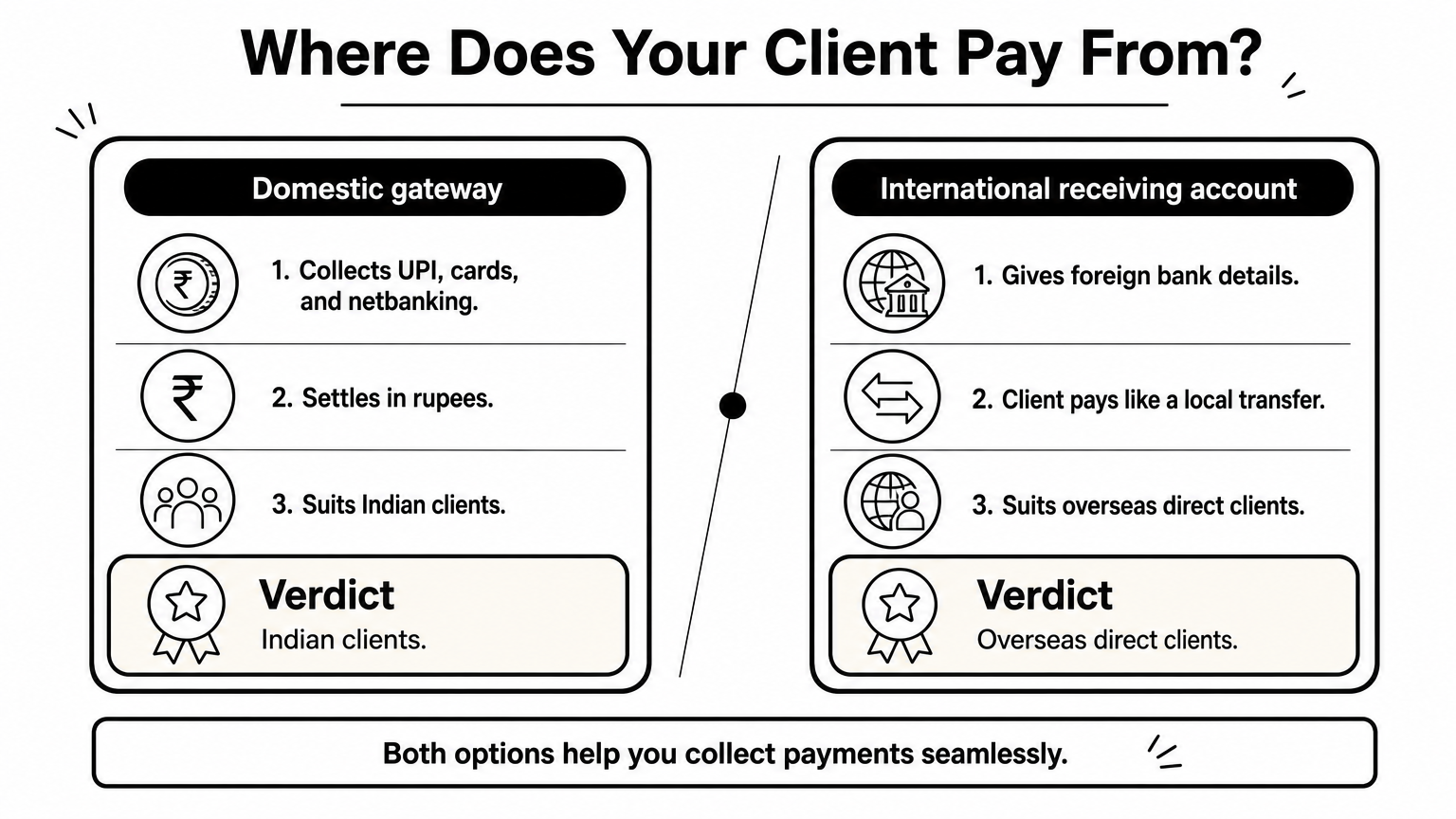
Gateways such as Razorpay can also accept international card payments, but that costs more than a receiving account and needs extra approval. Use this rule as a starting point:
- Indian clients: a domestic payment gateway.
- Overseas direct clients: a receiving account.
- Marketplace income: the marketplace's payout partner.
- One-off foreign payment: PayPal or a bank wire.
The right tool depends on where your client pays from, not on which brand is biggest.
Fees that decide what you keep
Judge the total cost, not the headline rate, and see what payment gateway charges add up to in India. Add the platform fee, any exchange-rate markup, and 18% GST on the fees. On a $2,000 invoice, 2% costs $40 while 8% costs $160. If you invoice monthly, that $120 gap becomes $1,440 a year for the same work.
UPI deserves its own look. Indian policy has long kept merchant fees on UPI at or near zero for most merchants. Ask every gateway what it charges on UPI today, because that is usually your cheapest domestic method.
Activation, settlement, and compliance
Activation is where freelancers lose weeks. Expect to submit PAN, bank details, ID, and a website or profile page. Reviewers look hardest at services such as consulting and advertising, and at requests to switch on international payments. Domestic settlement is commonly T+2 working days unless you pay for faster payouts.
Foreign income adds paperwork. You need a Foreign Inward Remittance Advice (FIRA) as proof the money came from abroad, plus the correct purpose code. Export of services can be zero-rated for GST when conditions are met, so confirm the rules with a chartered accountant. Before signing up, check three things:
- Does the provider hold RBI authorisation for the payments it handles, including cross-border where relevant?
- Does it issue a FIRA automatically, or only on request?
- How many days pass before money reaches your bank?
1. Razorpay
How it works
Razorpay is an RBI-authorised payment aggregator. You collect UPI, cards, netbanking, and wallets through payment links, payment pages, and invoices, and you do not need a website. Yes, freelancers can use Razorpay, as individuals or sole proprietors, once KYC clears.
It also offers international card acceptance, and Razorpay says it supports more than 130 currencies. That feature needs separate approval, and it is the step where freelancers most often stall.
Razorpay is the safest default payment gateway for freelancers in India, provided your activation goes through.
Fees, activation, and settlement
Domestic pricing is typically around 2% plus GST, but confirm the current rate card before you commit. International cards cost more. Here are the numbers to expect:
- Domestic methods: about 2% plus GST.
- International cards: around 3% plus GST, with currency conversion costs on top.
- Settlement: T+2 working days by default, instant settlement for an extra fee.
- Activation: PAN, bank proof, and business details, with extra review for international.
Who it suits
Razorpay suits freelancers who bill mostly Indian clients and want polished links, invoices, and APIs. It also fits a developer who wants to embed checkout in their own site.
Weigh these trade-offs:
- Activation can be slow for consulting, advertising, and other service profiles.
- Foreign payments cost more than a receiving account.
- Business-style onboarding can feel heavy for a solo freelancer.
2. Cashfree
How it works
Cashfree Payments is an Indian gateway that accepts cards, UPI, and netbanking across 80+ banks, plus buy-now-pay-later options. You can send payment links or add a checkout form to a site. Freelancers who only need a link can start without building anything.
For overseas clients, Cashfree also offers international collection products. These include foreign account details for wire payments alongside card checkout. Availability depends on your business profile, so ask before you rely on it.
Cashfree fits best when one account has to serve both Indian and overseas clients.
Fees, activation, and settlement
Domestic fees are a percentage per transaction, in the same low single-digit range as other gateways. International card payments start at roughly 3%. Pricing for international collections is often quoted on request rather than listed publicly.
- Domestic methods: percentage-based, plus GST.
- International: card rates near 3%, collection pricing on request.
- Settlement: next business day on many plans, with instant settlement as an option.
- Activation: business documents, with extra requests common for unregistered freelancers.
Who it suits
Cashfree works for freelancers and small agencies who bill Indian and foreign clients from one dashboard. It also suits anyone planning to grow into a registered business.
Keep these trade-offs in mind:
- International pricing is harder to compare before you talk to sales.
- Document requests can slow activation for solo freelancers.
- A pure receiving account may cost less on large overseas invoices.
3. Paytm Payment Gateway
How it works
Paytm's payment gateway accepts UPI, cards, netbanking, and wallets through payment links, QR codes, and checkout pages. Paytm positions its freelancer offering as something you can use without a website or technical knowledge. You create a link, send it, and get paid.
Brand familiarity helps. Most Indian clients already have the Paytm app or a UPI app, so paying takes seconds. Less friction at checkout means fewer excuses for late payment.
Paytm is the quickest route to getting paid by Indian clients, and it is not built for overseas receipts.
Fees, activation, and settlement
Paytm advertises minimal fees and quick settlement, but rates vary by plan and payment method. UPI is usually the cheapest method, and cards cost more. Check the live pricing page rather than trusting any old figure.
- Fees: percentage-based on cards and netbanking, lower on UPI.
- Settlement: quick on many plans, so confirm the cycle before you sign up.
- Activation: simple KYC for small merchants.
- International: limited, so plan another tool for foreign clients.
Who it suits
Paytm suits tutors, designers, consultants, and coaches whose clients are in India and pay in small to mid-sized amounts. It is a sensible first gateway if you want to start collecting this week.
Watch for these limits:
- No strong answer for FIRA or foreign-currency receipts.
- Less useful once you want custom API workflows.
- International clients need a second tool alongside it.
4. Instamojo
How it works
Instamojo is built for small sellers and solo professionals. You create a payment link or a simple page, share it, and the client pays by card, wallet, netbanking, or UPI. No coding is needed.
It also supports selling digital products through a basic online store. That suits freelancers who sell templates, courses, or fixed-price packages alongside client work.
Instamojo trades depth for simplicity, which is what most new freelancers want first.
Fees, activation, and settlement
Instamojo has changed its plans over the years, so read the current table before you commit. Entry plans have typically combined a percentage with a small fixed fee per transaction. That fixed fee matters on low-value invoices.
- Fees: percentage plus a fixed amount per transaction on entry plans.
- Settlement: usually a few working days to your bank.
- Activation: light KYC, often among the easier ones for individuals.
- International: limited compared with a receiving account.
Who it suits
Instamojo fits new freelancers with small domestic invoices who want a free-to-start tool and a quick setup. It also works for a side business selling downloadable products.
Consider these trade-offs:
- Fixed per-transaction fees hurt very small invoices.
- Fewer advanced features than Razorpay or Cashfree.
- It is not the right payment gateway for freelancers in India whose income is mostly foreign.
5. PayPal
How it works
PayPal lets an overseas client pay with a card or a PayPal balance, and you withdraw the money to your Indian bank account in rupees. In India it works for receiving cross-border payments for exports, not for domestic collections. You pick an export purpose code during withdrawal.
The appeal is client trust. Most foreign clients already have an account and need no setup, which removes a common reason for late payment.
PayPal sells convenience at a price that often lands between 7% and 9% of every invoice.
Fees, activation, and settlement
PayPal charges about 4.4% plus a fixed fee per cross-border payment. It adds a currency conversion markup of roughly 3% to 4%, and GST applies to the fees. Together these commonly reach 7% to 9% of the invoice.
- Fees: about 4.4% plus a fixed amount, then conversion markup, then GST.
- Settlement: withdrawals take a few business days to reach your bank.
- FIRA: available on request rather than automatic.
- Activation: quick online signup, and a business account is the better fit.
Who it suits
PayPal suits freelancers whose client refuses any other method and whose relationship is worth the fee. Use it for occasional payments, not for regular monthly income.
Accept these trade-offs:
- The highest all-in cost on this list.
- Holds and disputes tend to lean toward the buyer.
- No domestic collections at all.
6. Payoneer
How it works
Payoneer is a global payments platform connected to marketplaces such as Upwork and Fiverr. Earnings land in your Payoneer balance, and you withdraw to your Indian bank in rupees. It also issues local receiving accounts in several currencies, including USD, EUR, and GBP, so direct clients can pay by bank transfer.
Marketplace freelancers often have no choice here. The platform pays out through Payoneer, and the payout route is chosen for you.
If your income comes from marketplaces, Payoneer is usually the default, so focus on minimizing its costs.
Fees, activation, and settlement
Marketplace payouts are typically free to receive. The cost sits in the conversion, where a markup of around 2% has been reported. Card-funded client payments cost more, and an annual fee can apply on low-volume accounts.
- Fees: free on most marketplace payouts, conversion markup on withdrawal.
- Card payments: noticeably pricier, up to around 3%.
- Settlement: withdrawals reach your bank in a couple of days.
- Activation: online, with ID and business verification.
Who it suits
Payoneer suits freelancers who earn mainly through Upwork, Fiverr, or similar sites. It also works for agencies that take payments in several currencies.
Here are the trade-offs to plan for:
- The markup is not shown as a line-item fee.
- Account reviews can freeze funds for a while.
- It does nothing for Indian clients paying by UPI.
7. Skydo
How it works
Skydo is an Indian platform that issues foreign bank details, so overseas clients pay by local bank transfer in their own country. It converts at the mid-market rate and settles in rupees. It also generates the FIRA for each payment automatically.
It is built around exporters, so invoicing and compliance are part of the product. That focus is why freelancers with direct overseas clients compare it against Wise and PayPal.
A flat fee beats a percentage fee once your invoices pass roughly $1,000 to $2,000.
Fees, activation, and settlement
Skydo's published pricing has used flat fees per payment, around $19 up to $2,000 and $29 up to $10,000, plus GST. It describes its conversion as having no exchange-rate markup. Confirm current pricing before signing up.
- Fees: flat per payment on typical invoices, no markup on the rate.
- Settlement: about a day to your Indian bank.
- FIRA: automatic with each payment.
- Activation: online onboarding that the company says takes minutes.
Who it suits
Skydo suits freelancers who invoice overseas clients at $1,000 or more and want paperwork handled. Developers, designers, and consultants with monthly retainers are the clearest fit.
Consider these trade-offs:
- A flat fee feels expensive on very small invoices.
- Card checkout for clients worldwide is not its strength.
- It will not collect from Indian clients.
8. Wise Business
How it works
Wise Business is a multi-currency account that gives you local bank details in several currencies, such as USD, GBP, and EUR. It converts at the mid-market rate and shows its fee separately. That transparency is why many freelancers trust it.
Eligibility needs a check. Indian users have faced limits on receiving money into personal Wise accounts, so freelancers generally need a business account. Confirm that you qualify before you tell a client to pay into it.
Percentage fees tend to win on small invoices, and Wise's fee scales with the amount.
Fees, activation, and settlement
Reported all-in costs run around 1.5% to 2% once GST on the fee is included. Because the fee shrinks with the invoice, small payments cost less than under a flat-fee model.
- Fees: a visible conversion fee, roughly 1.5% to 2% all-in.
- Settlement: usually one to two business days.
- FIRA: less automated than on India-first platforms.
- Activation: business onboarding with documents.
Who it suits
Wise Business suits freelancers with small or irregular overseas invoices who want clear pricing and a recognized brand. It also helps if you hold balances in more than one currency.
Weigh these trade-offs:
- The business account requirement can slow signup.
- Compliance tooling is lighter than India-first providers.
- It cannot take UPI or other Indian methods.
Which payment gateway fits your situation
Side-by-side comparison
This table sets the eight options next to each other. Fees and timelines are typical figures, so check each provider's live pricing before you decide.
| Option | Best for | Typical cost | Typical settlement | Activation |
|---|---|---|---|---|
| Razorpay | Indian clients, mixed work | About 2% domestic, about 3% international cards, plus GST | T+2 by default | Moderate, extra review for international |
| Cashfree | Indian and overseas in one account | Percentage-based, international on request | Next business day on many plans | Moderate |
| Paytm | Fast start with Indian clients | Percentage-based, lower on UPI | Quick, depends on plan | Easy |
| Instamojo | New freelancers, small invoices | Percentage plus fixed fee | A few working days | Easy |
| PayPal | Clients who insist on it | About 7% to 9% all-in | A few business days to bank | Easy |
| Payoneer | Marketplace income | Markup around 2%, more on cards | A couple of days | Moderate |
| Skydo | Direct overseas invoices | Flat fee, no rate markup | About a day | Easy, online |
| Wise Business | Small overseas invoices | About 1.5% to 2% | One to two days | Moderate, business account |
Picks by freelancer type
Razorpay, Cashfree, and Paytm are among the most widely used gateways in India. Which one is best for you depends on how you get paid:
- Indian clients only: Razorpay for features, Paytm or Instamojo for the fastest start.
- Indian and overseas clients: Cashfree, or Razorpay plus a receiving account.
- Direct overseas clients above $1,000: Skydo.
- Direct overseas clients below $1,000: Wise Business.
- Upwork or Fiverr income: Payoneer.
- A client who insists on PayPal: accept it for that client only, and price the fee into your rate.
Stripe is a common question, but availability in India has been limited and often invite-based. It is rarely a practical plan for a solo freelancer.
Match your most common client first, because one tool rarely covers every payer well.
Is there a free payment gateway for freelancers?
No gateway is truly free. Most cost nothing to open and charge a percentage on each payment. The closest thing to free is a UPI QR code or UPI ID linked to your bank account, which usually carries no fee and needs no activation.
That route has limits. You get no invoices, no card acceptance, no automatic reconciliation, and no foreign-currency support. Once you bill more than a handful of clients, a gateway's fee often costs less than the time you spend matching payments by hand.
Match the tool to where your clients pay from
Start with your clients. Indian payers call for a domestic gateway such as Razorpay, Cashfree, Paytm, or Instamojo. Overseas payers call for a receiving account or a marketplace payout partner, and PayPal is the costly fallback. Then compare total cost, activation effort, settlement time, and how you get your FIRA.
Many freelancers end up with two tools, one for rupees and one for foreign currency. That is normal and often cheaper than forcing one gateway to do everything.
If your freelance work has grown into a registered business that needs local payment methods across Thailand, Vietnam, the Philippines, Malaysia, Bangladesh, India, or Indonesia, you will need a merchant-grade partner. In that case, book a free demo call with CoinPay and talk through your payment setup with our team.