
Payment Gateway for Online Gaming: 5 Best Options Compared
The best payment gateway for online gaming supports the payment methods your players already use, keeps chargebacks under control, and sends payouts to winners, creators or sellers without delay. For players in Southeast and South Asia, CoinPay fits best. For global mobile studios, Nuvei and Adyen cover the most ground. Paysafe suits wallet-led iGaming, and Noda suits operators who prefer bank-to-bank deposits over cards.
Most gaming teams hit the same wall. Cards decline on small cross-border purchases, local methods such as UPI or PromptPay are missing, and processors that dislike the gaming vertical reject the application or hold funds for months. This article compares five providers on what they offer, who they suit and where they fall short. It then explains the rules for gaming payments in India and gives you a checklist for choosing.
We run CoinPay, a payment gateway for merchants in seven Asian markets, so we are one of the five picks. We say plainly where we fit and where we do not.
1. CoinPay: local rails across Southeast and South Asia
CoinPay is a payment gateway for merchants in Thailand, Vietnam, the Philippines, Malaysia, Bangladesh, India and Indonesia. It is the strongest payment gateway for gaming when your players sit in those markets. We run it as a merchant partner rather than a plain connector, with five years of operating experience behind it.
A gateway that settles in local currency through local methods beats a global one that treats Asia as an afterthought.
What it offers
CoinPay organizes operations by market, payment journey and settlement need. A Thai game top-up flow, for example, can use PromptPay with THB settlement, while a flow in the Philippines or Indonesia uses that market's own methods. Merchants also get hands-on support after integration, including review of deposit journeys and monitoring of payment performance.
- Merchant onboarding with business verification and a structured application
- Local payment methods and settlement per market
- Separate USDT payment services for stablecoin deposits
- Ongoing support, friction analysis and performance monitoring
Who it suits and what to watch
It suits game publishers, top-up platforms and gaming apps that are growing in Southeast and South Asia and want a long-term partner instead of a self-service API. A game app with Thai, Vietnamese and Indonesian players can run through one provider that already knows each market.
Screening is strict. CoinPay runs KYC and due diligence checks, and it rejects scams, money-games and deceptive schemes. Expect a real review process. If your model involves wagering, ask about eligibility before you spend time on integration. Coverage is Asia only, so a studio with a large Western player base needs a second provider.
2. Nuvei: global acquiring and fraud tooling
Nuvei is a global payments platform aimed at high-volume cross-border commerce. It works well as a payment gateway for a gaming app that sells small purchases to players in many regions at once.
Small-ticket purchases live or die on authorization rates, so routing and local acquiring matter more than headline fees.
What it offers
Nuvei states that it supports more than 720 alternative payment methods and local acquiring in about 50 markets. Local acquiring matters because a transaction processed through a domestic bank avoids the cross-border flag that triggers declines on small purchases. The platform also focuses on fraud and chargeback tooling built for digital goods.
- Smart routing that picks a processing path by approval likelihood
- 3D Secure orchestration and pre-dispute resolution tools
- Payouts in 150+ currencies for players, streamers and tournament prizes
- Native mobile SDK for iOS and Android in-app purchase flows
Who it suits and what to watch
Nuvei suits mid-size and large studios running free-to-play or mobile titles across APAC, LATAM, Europe and North America. If you need one contract that covers payouts, wallets and cards, it is a serious candidate.
Pricing is not published, so you negotiate it per merchant. Onboarding is sales-led. Gaming eligibility is also reviewed by category, so confirm early that your specific game model is accepted in each market you plan to launch.
3. Paysafe: wallets and iGaming deposits
Paysafe is a payments company with dedicated iGaming payment solutions for deposits and withdrawals. It is a practical online gaming payment gateway for regulated operators whose players expect digital wallets.
If your players already hold a Skrill, NETELLER or paysafecard balance, accepting it removes a whole step from the deposit.
What it offers
Paysafe owns the Skrill and NETELLER wallets and the paysafecard prepaid voucher. That gives operators wallet and voucher acceptance next to card processing, which is useful for players who prefer not to enter card details on a gaming site. The same relationship covers withdrawals back to the wallet, so winnings move through the rails the player picked for deposits.
- Card acquiring plus e-wallet and prepaid voucher acceptance
- Deposit and withdrawal flows for iGaming platforms
- A provider that works with licensed, regulated operators
Who it suits and what to watch
Paysafe suits licensed iGaming brands in markets where wallets are popular, especially Europe and North America. It is a sensible choice if you want an established name that already understands gaming risk.
Check coverage against your actual player list before signing. A payment mix built on wallets and vouchers may not match markets that lean on bank transfers, QR codes or UPI. Licensing and regulatory approval for your vertical also decide whether you can use it at all.
4. Noda: open banking for gaming payments
Noda is an open banking provider that moves money directly between player bank accounts and your merchant account. It makes a good payment gateway for a gaming site that wants to rely less on cards.
Bank-to-bank deposits skip the card network, so the usual card dispute process does not apply in the same way.
What it offers
Noda says it connects to more than 2,000 banks across 26 geographies and handles both instant deposits and payouts. A player authorizes the payment inside their own banking app, which reduces card-entry friction and often confirms the deposit in seconds. Because no card is involved, the fraud profile differs from card payments, and chargeback exposure is typically lower.
- Instant account-to-account deposits
- Payouts to bank accounts
- One integration across many banks
- A use case page built specifically for online gaming
Who it suits and what to watch
Noda suits operators and game platforms in markets with strong open banking adoption who want to cut card fees and disputes. It also works as a second method next to cards.
The limit is geography. A bank rail only helps where players hold supported accounts, so compare Noda's 26 geographies with your top player countries. Check whether your key Asian markets are covered before treating it as a main method. Settlement terms and gaming approval are agreed per merchant.
5. Adyen: one platform for global game studios
Adyen combines gateway, acquiring and risk tools on a single platform. It is a strong payment gateway for online gaming for large studios that want unified reporting across every region.
One platform means one set of data, which makes it far easier to see where players drop off.
What it offers
Adyen processes cards, wallets and many local methods through one integration, and it handles authentication and risk in the same system. For a studio with web, console and mobile storefronts, unified reporting across channels is the main draw. Its pricing model is interchange-plus, so you see what the card networks charge separately from Adyen's own fee.
- Single integration for global payment methods
- Built-in risk management and authentication
- Unified data across web and in-app sales
- Interchange-plus pricing structure
Who it suits and what to watch
Adyen suits established publishers and platforms with high volumes and an engineering team able to run a direct integration. It is less a hands-on partner and more a powerful toolkit.
Onboarding is selective and sales-led, and each business is reviewed by vertical. Real-money gaming needs explicit approval. Smaller studios and early-stage apps may find the process slower than they want, so confirm eligibility and local method coverage for your markets first.
Gaming payment gateway in India: what changed in 2025
India is a huge gaming market, but a gaming payment gateway there now depends on one question: does your game involve stakes of real money? If yes, the 2025 law blocks it. If no, UPI-first processing is straightforward.
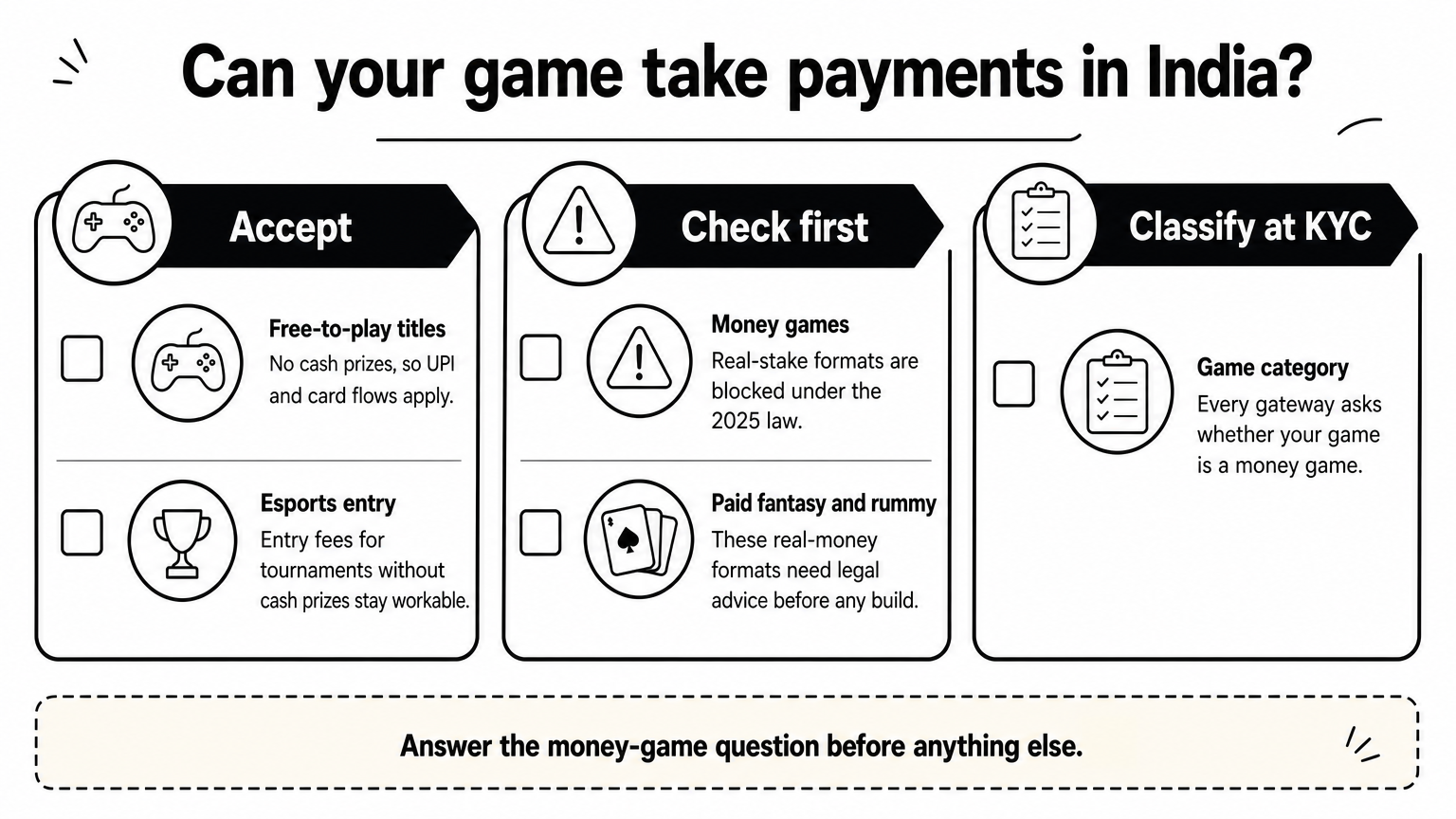
In India, the first thing a gateway checks is whether your game is a money game.
What the 2025 law means
India passed the Promotion and Regulation of Online Gaming Act in August 2025. It prohibits online money games, and it stops banks and payment providers from facilitating transactions for them. This affects real-money formats such as paid fantasy, rummy and poker apps. The law is also meant to promote esports and social games.
Because the rules and their enforcement keep developing, get advice from an Indian lawyer before you build a payment flow. Expect every gateway to classify your game during KYC, and expect rejection if the answer is a money game.
What you can still accept
Free-to-play titles, esports entry and in-game purchases for games without cash prizes remain workable. Players mostly pay with UPI, then cards, wallets and net banking. A good gaming payment gateway in India must therefore offer:
- UPI collect and intent flows
- Card payments with 3D Secure
- Wallet and net banking options
- INR settlement and clear reconciliation
How to choose a gaming payment gateway
Pick the gateway by matching four things: your player markets, your game model, your risk profile and your payout needs. Price comes last, because the cheapest option on paper often costs more through declines and disputes.
Judge a gateway by approved revenue, not by its posted rate.
Five criteria that decide the shortlist
Start with coverage. List your top ten player countries and mark which payment methods each provider supports there. Then check approval for your vertical, fraud and chargeback controls, payout capability, and the quality of support after launch. Building your own gateway is not a realistic shortcut, since you would still need an acquirer and PCI DSS compliance to handle card data.
Side-by-side comparison
| Provider | Best for | Standout strength | Main trade-off |
|---|---|---|---|
| CoinPay | Southeast and South Asia | Local rails, USDT, hands-on support | Asia-only coverage |
| Nuvei | Global mobile and free-to-play | 720+ methods, routing, payouts | Sales-led, custom pricing |
| Paysafe | Wallet-led iGaming | Skrill, NETELLER, paysafecard | Wallet-heavy payment mix |
| Noda | Bank-based deposits | Open banking in 26 geographies | Limited by bank coverage |
| Adyen | Large studios | One platform for all channels | Selective onboarding |
Hosted page or direct API
A hosted payment page redirects players to the provider's secure page, which keeps card data off your servers and simplifies compliance. A direct API or SDK keeps players inside your game, which feels smoother on a gaming app, but it puts more security duty on you. Most studios start hosted and move to a direct integration once volume justifies it.
Pick the gateway that matches your players
The right payment gateway for online gaming follows your players. Choose a global platform such as Nuvei or Adyen for broad reach, Paysafe for wallet-led iGaming, and Noda for bank-based deposits. Choose a local specialist when most of your revenue comes from one region. In India, settle the money-game question before anything else.
If your players are in Thailand, Vietnam, the Philippines, Malaysia, Bangladesh, India or Indonesia, talk to us. We will walk through your deposit journey, your markets and the onboarding steps, and tell you honestly whether we fit. You can book a free demo call with CoinPay and bring your payment flow with you.