
Payment Gateway Fraud in Indonesia: Risks and Prevention
If you process payments in Indonesia, you already know the market rewards speed but punishes carelessness. Payment gateway fraud in Indonesia shows up in familiar forms: stolen card data run through checkout pages, fake merchant accounts built to launder money, and manipulated deposit flows that drain funds before anyone notices. For merchants scaling e-commerce, gaming, or fintech products across the archipelago, these risks aren't hypothetical. They show up in chargeback reports and frozen settlements.
This article breaks down what payment gateway fraud actually looks like in Indonesia right now, why local infrastructure and payment habits create specific vulnerabilities, and which prevention measures genuinely reduce exposure rather than just checking a compliance box. You'll get a clear picture of the fraud tactics most common in this market and the controls that stop them before they hit your bottom line.
We've built payment infrastructure across Southeast and South Asia for five years, so this isn't theory. It's drawn from what actually happens when merchants onboard without proper KYC screening or ignore deposit journey monitoring. You'll walk away knowing exactly what to watch for and how to build a payment operation that keeps fraud out while keeping legitimate customers paying without friction.
Why payment gateway fraud is a growing risk in Indonesia
Indonesia has over 270 million people and one of the fastest-growing digital economies in Southeast Asia, and that growth is exactly what makes it a target. Payment gateway fraud in Indonesia thrives where transaction volume outpaces the controls built to monitor it. E-wallets like GoPay, OVO, and DANA process millions of transactions daily, QRIS has standardized QR payments across small merchants and large platforms alike, and Bank Indonesia keeps pushing financial inclusion into rural areas where digital literacy is still catching up. Every new user who signs up for mobile banking without understanding phishing risks is a potential fraud victim, and every merchant who onboards without proper screening is a potential fraud vector.
Fast growth without matching fraud controls is exactly what turns a payment market into a target.
Fragmented payment rails create blind spots
Unlike markets with one or two dominant payment methods, Indonesian merchants often need to support a dozen local rails to reach their full customer base: QRIS, bank transfer and e-wallet payments in Indonesia, virtual accounts, and convenience store payments like Alfamart and Indomaret. Each rail has different verification standards, different settlement timelines, and different fraud patterns. A gateway that monitors card transactions closely but treats virtual account deposits as low-risk is leaving a door open. Fraudsters know which channels get less scrutiny, and they route activity accordingly.
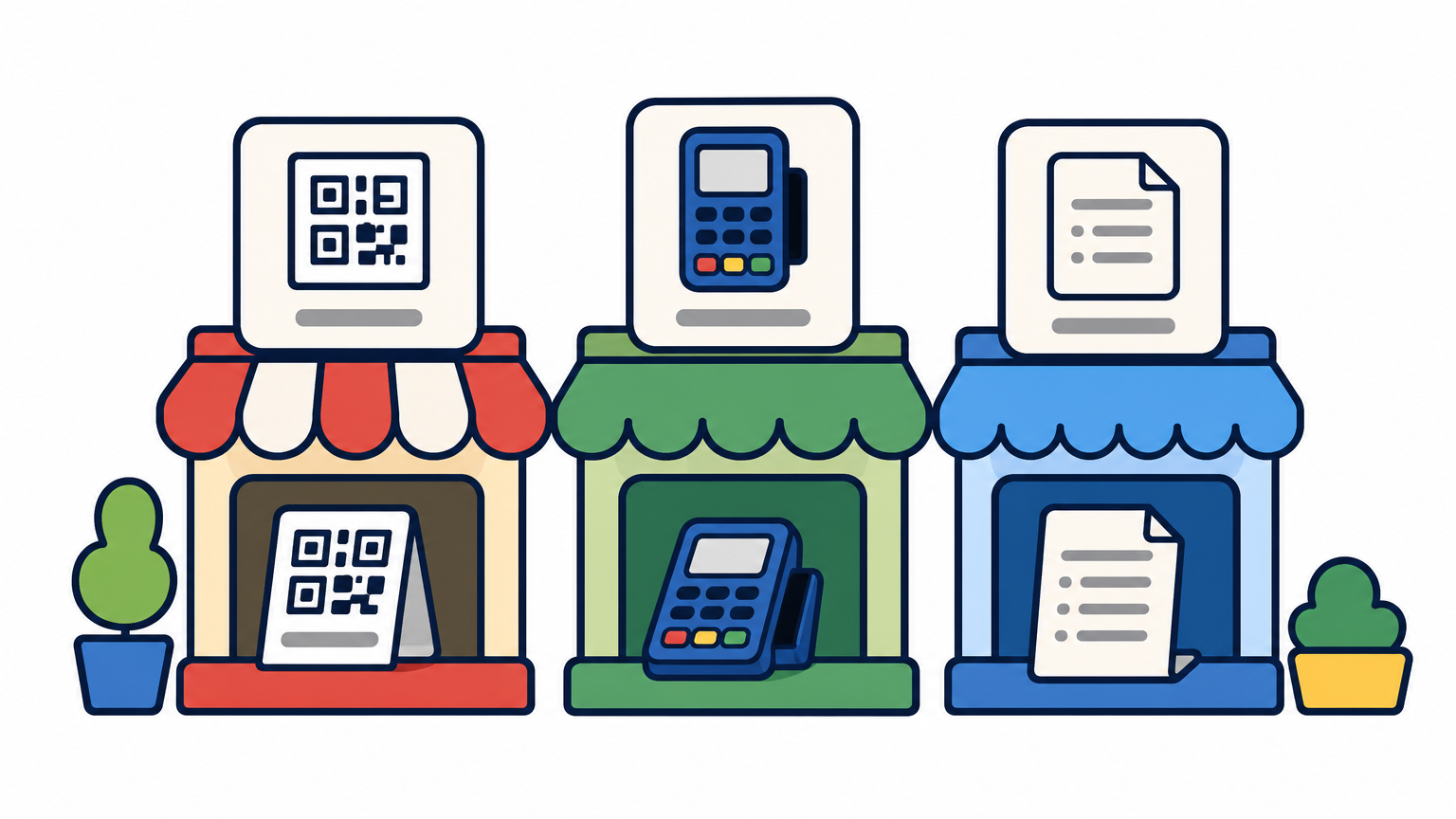
| Payment Channel | Common Fraud Exposure | Typical Oversight Gap |
|---|---|---|
| Credit/debit card checkout | Stolen card data, card testing | Weak 3DS enforcement |
| E-wallets (GoPay, OVO, DANA) | Account takeover, mule accounts | Thin KYC at onboarding |
| Bank transfer/virtual account | Fake deposit confirmations | Manual reconciliation delays |
| QRIS | Spoofed merchant QR codes | Limited merchant verification |
Regulatory pressure is increasing, not decreasing
Bank Indonesia and the Financial Services Authority (OJK) have tightened rules around merchant onboarding, anti-money laundering checks, and payment licensing over the past several years, partly in response to a rise in online gambling fronts and fraudulent lending apps operating through payment gateways. Legitimate merchants sometimes get caught in stricter review cycles because bad actors used weak onboarding processes to slip through first. That regulatory tightening is a good thing long-term, but it means merchants working with a gateway that hasn't kept pace with compliance checks face slower approvals, frozen settlements, or account suspensions triggered by association rather than actual wrongdoing.
Cross-border merchants face extra scrutiny
Businesses expanding into Indonesia from outside the region often underestimate how differently local fraud patterns behave compared to their home markets. A gaming platform that saw low chargeback rates in Europe might suddenly face a wave of disputed transactions in Jakarta because local card issuers apply different fraud scoring, or because a fraud ring has identified the platform as new and untested. Fintech products offering credit or lending features attract a specific kind of fraud: fabricated identities built to secure quick payouts before disappearing. Without a payment partner who understands these regional patterns and applies KYC screening calibrated to them, cross-border merchants end up learning the hard way, usually through a spike in fraudulent transactions in their first few months of operation.
The combination of rapid digital adoption, fragmented payment infrastructure, and increasing regulatory attention means fraud risk in Indonesia isn't static. It shifts as new payment methods roll out and as fraudsters adapt to whichever channel currently has the weakest oversight. Merchants who treat fraud prevention as a one-time setup rather than an ongoing operational discipline are the ones who end up absorbing the losses.
Common types of payment gateway fraud to watch for
Merchants rarely face one type of fraud. They face several running simultaneously, each targeting a different weak point in the payment chain. Knowing the specific patterns that show up in payment gateway fraud in Indonesia helps you build controls that match the actual threat instead of generic checklist items pulled from a Western fraud playbook.
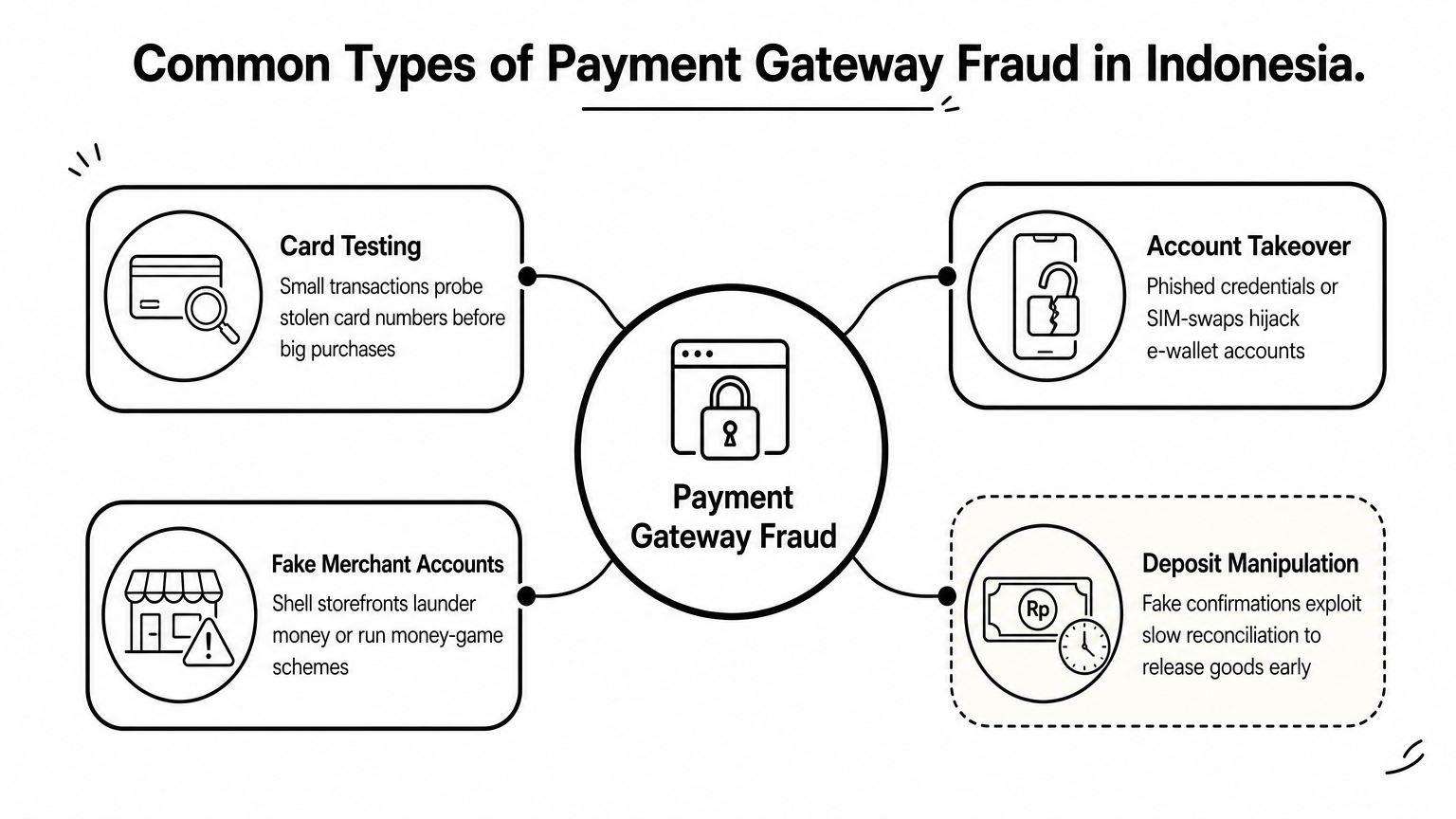
Card-based and account takeover fraud
Stolen card data still drives a large share of losses, but the method has shifted. Fraudsters run card testing scripts against checkout pages, pushing small transactions through to find which stolen numbers still work before attempting larger purchases. Account takeover follows a similar logic on the e-wallet side: attackers use phished credentials or SIM-swap tactics to hijack GoPay, OVO, or DANA accounts, then drain balances or use them to receive fraudulent payouts. Both patterns exploit weak session monitoring and thin authentication at login rather than any flaw in the payment rail itself.
Most fraud doesn't break the system, it just finds the step nobody checks twice.
Merchant-side and identity fraud
Not all fraud comes from customers. Fake merchant accounts get built specifically to launder money or run money-game schemes disguised as legitimate e-commerce. Fabricated identities target fintech lending products, securing a payout and disappearing before the first repayment is due. These schemes depend entirely on weak onboarding, which is why the merchant review stage matters as much as transaction-level monitoring.
Common patterns worth flagging in your own review process:
- Chargeback fraud, where a legitimate purchase gets disputed as unauthorized after the goods or service is delivered
- Triangulation fraud, where a fraudulent storefront collects real payments but fulfills orders using stolen card data elsewhere
- Synthetic identity fraud, combining real and fake data to pass basic KYC checks
- Spoofed QRIS codes, redirecting scanned payments to an attacker's account instead of the intended merchant
Deposit and settlement manipulation
Fraud also targets the back end of a transaction rather than the front end. Fake deposit confirmations exploit manual reconciliation delays on bank transfer and virtual account channels, tricking merchants into releasing goods or credit before funds actually clear. Settlement manipulation works similarly, timing withdrawal requests to exploit processing gaps between channels. These schemes rarely show up in standard fraud dashboards because they target operational timing rather than transaction content, which is exactly why they persist longer than card fraud once discovered.
How to prevent payment gateway fraud in your business
Prevention works when it's built into daily operations, not bolted on after a loss. Merchants who treat fraud prevention as an ongoing discipline, checking onboarding rules, transaction patterns, and settlement timing on a regular schedule, catch problems while they're still small. The ones who set up a fraud policy once and never revisit it are the ones who get blindsided when fraudsters shift tactics, which they do constantly in a market as fast-moving as Indonesia's.
Screen every merchant and customer at onboarding
Good screening stops most fraud before it ever reaches your payment gateway. That means verifying business registration, checking beneficial ownership, and running identity checks that go beyond a name and a scanned ID. A structured process catches synthetic identities and shell merchants that slip through basic checks.
- Verify business documents against government registries, not just accepted uploads
- Cross-check identity data for duplicates or mismatched details across applications
- Flag high-risk categories like lending, gaming, or high-ticket goods for manual review
- Set transaction limits for new accounts until a track record builds
The cheapest fraud you'll ever stop is the fraud you never onboard in the first place.
Monitor transactions across every channel, not just cards
Fraud teams often over-index on card monitoring because that's where Western fraud tooling was built. In Indonesia, virtual accounts, QRIS, and e-wallet transfers need the same scrutiny. Set velocity limits per channel, watch for mismatched IP and device data, and flag deposits that don't match a customer's typical behavior. Reconciliation delays are where fake deposit confirmations thrive, so automate matching between payment confirmations and actual bank settlement wherever possible instead of relying on manual checks.
| Prevention Control | What It Catches | Where to Apply It |
|---|---|---|
| Device fingerprinting | Account takeover, mule accounts | Login and checkout |
| Velocity rules | Card testing, rapid payout fraud | All payment channels |
| Automated reconciliation | Fake deposit confirmations | Bank transfer, virtual accounts |
| Merchant re-verification | Fake storefronts, laundering | Ongoing, not just onboarding |
Train your team and educate your customers
Systems catch patterns, but people catch context. Support staff who understand common fraud tactics in Indonesia will flag a suspicious deposit dispute faster than a rule engine tuned for global averages. Educating customers matters too: clear warnings about phishing links and fake QRIS codes reduce the account takeover attempts that start outside your platform but end up as chargebacks on your books. Combine trained people with automated monitoring, and you close the gaps that either approach misses on its own.
What to look for in a fraud-resistant payment partner
Not every payment provider treats fraud prevention the same way, and the difference shows up fast once volume grows. A fraud-resistant payment partner builds screening and monitoring into the core of how they operate, not as an add-on service you have to request separately. Before you sign a contract, ask direct questions about how a provider actually handles onboarding, transaction monitoring, and dispute resolution across Indonesian payment rails, because vague answers here usually mean thin controls later.
Ask about their merchant rejection standards
Good providers reject applicants, and they should be able to explain why. A gateway that approves nearly every merchant that applies isn't screening properly, it's just processing volume. Merchant vetting that includes business registry checks, beneficial ownership review, and category-based risk flagging catches the shell accounts and money-game schemes before they ever touch a live transaction.

A payment partner that never turns anyone away isn't protecting you, it's exposing you.
When evaluating a provider, look for:
- Documented KYC and due diligence steps, not a one-line compliance statement
- Category-specific review, especially for lending, gaming, or high-ticket goods
- Transparency about rejected applicant types, such as gambling fronts or unlicensed lenders
- A named compliance contact, not just a support ticket queue
Check how they monitor after integration goes live
Onboarding screening matters, but fraud shifts over time, so ongoing monitoring matters just as much. Providers should track transaction patterns across cards, e-wallets, QRIS, and virtual accounts separately, since each rail carries different fraud signatures. Reconciliation between payment confirmations and actual settlement should happen automatically, not through a manual review that lags behind the transaction by hours or days. If a provider can't describe how they catch a spoofed deposit confirmation before funds get released, that's a gap you'll eventually pay for.
Evaluate the support behind the technology
Integration is the easy part. Support after go-live is where fraud-resistant partners separate themselves from simple payment connectors. Look for a provider that reports success rate per payment service back to the merchant regularly, flags unusual deposit patterns proactively, and adjusts controls as new fraud tactics emerge in the Indonesian market. CoinPay's merchant onboarding and payment support process reflects this approach directly, combining structured KYC review with ongoing monitoring across local payment methods, so merchants get a partner that stays engaged well past the initial setup.
Staying secure as Indonesia's digital payments grow
Indonesia's digital payment volume isn't slowing down, and neither are the fraud tactics chasing it. Payment gateway fraud in Indonesia will keep shifting toward whichever channel has the weakest oversight this quarter, whether that's QRIS, virtual accounts, or a fintech lending flow nobody's watching closely enough. Merchants who win aren't the ones who install a fraud tool once and move on. They're the ones who treat onboarding screening, transaction monitoring, and settlement reconciliation as ongoing work, revisited as the market changes.
Getting this right takes local knowledge you can't fake with generic fraud software built for other regions. That's the gap a hands-on payment partner closes, one that rejects the wrong merchants, monitors every rail, and stays engaged after integration instead of disappearing once the contract's signed. If you want to see how that actually works for your business, book a call with our team and get a free demo.