
6 Top Payment Gateways in Indonesia for 2026
Indonesian shoppers pay the way they want, whether that's a QRIS scan, a bank transfer through Virtual Account, GoPay, or a credit card. If your checkout can't handle that mix, you lose the sale before it even starts. Finding the right payment gateway in indonesia means matching local payment methods, settlement speed, and compliance requirements to how your business actually operates, not just picking whatever provider has the flashiest website.
This guide breaks down six providers worth serious consideration if you're running an e-commerce store, a gaming platform, or a fintech product that needs to accept money from Indonesian customers in 2026. We look at what each one covers in terms of local payment rails, how their onboarding and merchant support actually work, and where they fall short, so you can shortlist based on real operational needs instead of marketing copy.
We built this comparison from the merchant side, having handled onboarding, KYC, and deposit friction across several Southeast Asian markets ourselves. You'll get a clear view of settlement options, API integration effort, and which providers also support USDT payments if crypto settlement matters to your business model.
1. CoinPay
CoinPay operates as a merchant-focused payment gateway across Southeast and South Asia, including Indonesia, rather than a simple technical connector. Five years of running payment operations in markets like Thailand, where it also ranks among the top Thailand payment gateway options, plus Vietnam, the Philippines, and Bangladesh feed directly into how it handles Indonesian merchants: careful screening, hands-on support, and a willingness to reject businesses that don't pass compliance checks. If you've been burned by a gateway that disappears once integration is done, this is the alternative built specifically to avoid that gap.
How it works
Onboarding starts with a structured application and business verification process, including how CoinPay reviews a business and completes KYC, with due diligence checks that screen out scams and money-game schemes before they ever touch the platform. Once approved, CoinPay sets up your payment gateway API for the specific markets and payment journeys your business needs, then stays involved through ongoing merchant support rather than handing you documentation and walking away.
A payment gateway is only as reliable as the team behind it once integration is finished.
Payment methods supported
Coverage in Indonesia is built around the QRIS, BI-FAST and IDR settlement rails local customers actually use, plus a dedicated crypto option for businesses that need it:
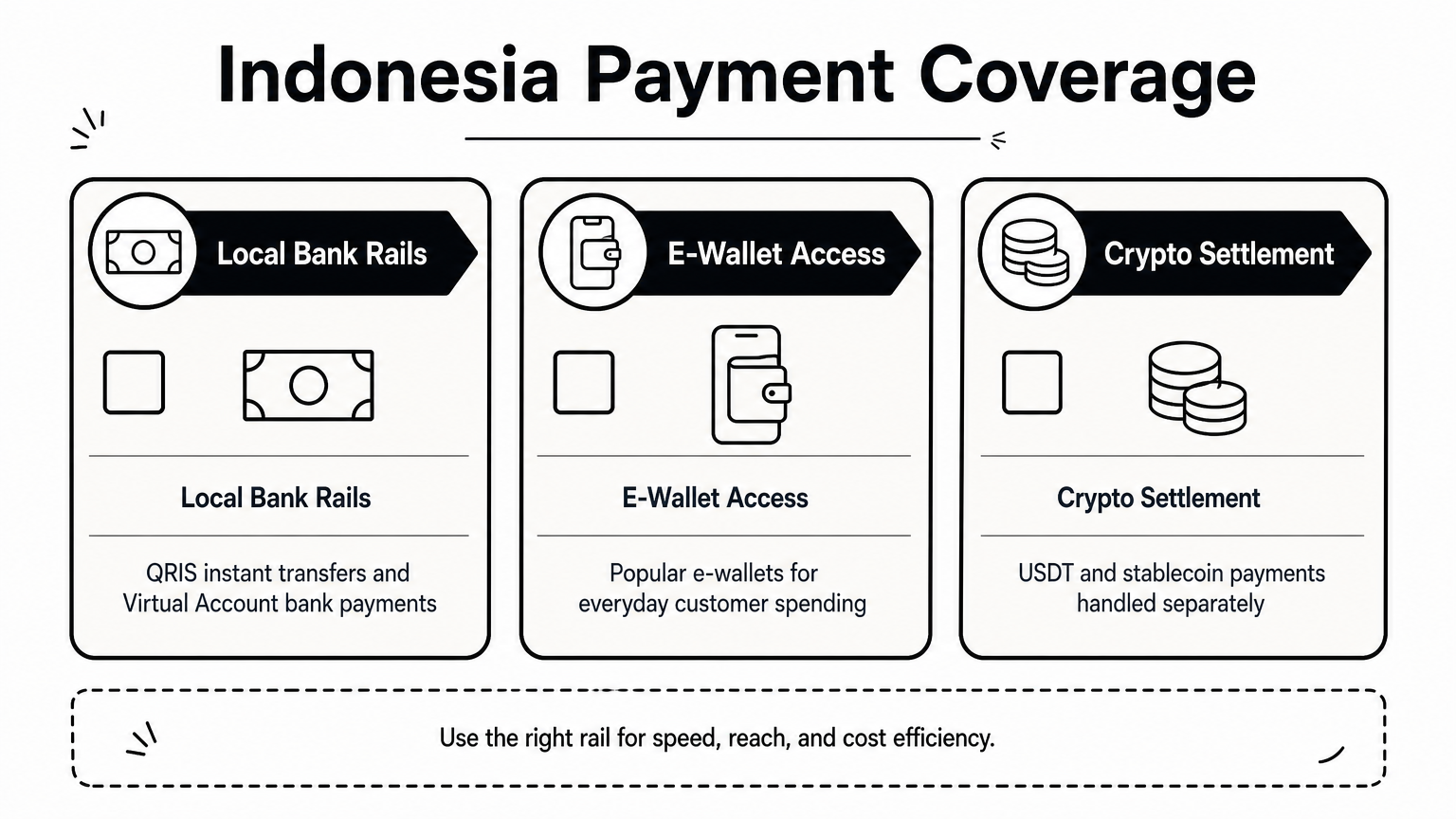
- QRIS for instant local transfers
- Bank transfer via Virtual Account
- Popular e-wallets
- USDT and other stablecoin payment services, handled as a separate offering from fiat rails
Best for
This provider suits merchants who need more than a payment API, particularly gaming platforms, fintech products, and e-commerce operators expanding across multiple Asian markets at once. It's also the strongest pick if your business model includes USDT deposits and 1-3 minute payouts alongside traditional Indonesian payment methods, since most competitors treat crypto as an afterthought rather than a core service.
Pricing
CoinPay doesn't publish flat rate cards, because pricing depends on your transaction volume, market mix, and settlement currency. You'll get a quote after the application review, which also means the team has already assessed your business for compliance risk before money starts moving, a step worth the extra day or two it takes.
2. Midtrans
Midtrans is one of the best-known names when businesses search for an online payment gateway indonesia merchants trust, largely because it's backed by Gojek's GoTo ecosystem and has years of local market presence. It's built for developers who want a self-service setup rather than a hands-on onboarding relationship, which makes it a fast option if your team already has engineering resources in place.
How it works
Developers integrate through Midtrans's Snap checkout widget or a full API, both documented for quick implementation without much back-and-forth with support. Merchant accounts go through a verification process tied to business legality documents, then transactions route through Midtrans's own settlement infrastructure before funds land in your bank account.
Payment methods supported
Coverage spans the core Indonesian rails plus card networks:
- QRIS
- Bank transfer and Virtual Account
- GoPay and other e-wallets
- Credit and debit cards
- Convenience store payments (Indomaret, Alfamart)
Best for
Startups and mid-sized e-commerce businesses that want a self-service API with minimal onboarding friction fit Midtrans well. It suits teams comfortable managing their own integration and troubleshooting rather than expecting ongoing account management.
Pricing
Midtrans charges per-transaction fees that vary by payment method, typically higher for cards than for bank transfers or QRIS, with rates disclosed after you register a merchant account.
3. Xendit
Xendit built its reputation as an API-first payment gateway for developers across Indonesia and the wider region, and it's a common answer when founders search for an indonesia payment gateway comparison before picking infrastructure. Backed by serious venture funding, it positions itself less as a merchant support partner and more as programmable payment infrastructure you plug into your own product.
How it works
Teams integrate through Xendit's REST API or prebuilt SDKs, with sandbox testing available before you go live. Approval runs through a merchant verification step tied to business documents, and once live, Xendit handles routing, reconciliation, and payouts through its own dashboard.
Payment methods supported
Coverage is broad and skews toward digital-first customers:
- QRIS
- Virtual Account across major Indonesian banks
- OVO, DANA, and other e-wallets
- Credit and debit cards
- Retail outlet payments
Best for
Engineering-led startups and fast-growing platforms that want full control over checkout flow, plus multi-country expansion later, since Xendit also operates in the Philippines. It suits teams that would rather build their own support layer than lean on a provider's account managers.
Pricing
Fees are transaction-based and vary by payment method, with cards typically costing more than Virtual Account or QRIS transfers. Exact rates depend on your negotiated volume tier after signup.
4. DOKU
DOKU is one of Indonesia's oldest payment processors, running since 2007, well before QRIS or most e-wallets existed. That history matters if you're evaluating an indonesia payment gateway for regulatory staying power, since DOKU has weathered multiple shifts in Bank Indonesia's payment rules and adapted its stack each time.

How it works
Merchants integrate through DOKU's API or a hosted checkout page, with documentation aimed at developers who want a working payment flow without heavy customization. Verification runs through standard business licensing checks, and DOKU settles funds to your local bank account on a set schedule once transactions clear.
Payment methods supported
DOKU's rail coverage is broad and leans on its banking relationships:
- QRIS
- Virtual Account across major Indonesian banks
- OVO, ShopeePay, and other e-wallets
- Credit and debit cards
- DOKU Wallet, its own proprietary e-wallet
Best for
Established e-commerce businesses and enterprises that value a processor with a long compliance track record over a startup-style, self-service API. It also suits merchants who want the option of DOKU's own wallet product alongside standard rails.
Longevity in payments usually means the provider has already survived the regulatory changes you haven't faced yet.
Pricing
DOKU charges per-transaction fees that scale with payment method and monthly volume, with enterprise merchants able to negotiate custom rates directly with the sales team.
5. iPaymu
iPaymu targets small and micro businesses that want a payment gateway indonesia option without enterprise-level onboarding requirements. It's built around simplicity, letting individual sellers and small online shops start accepting digital payments faster than most competitors on this list, often within a day of signing up.

How it works
Merchants sign up through a straightforward registration form, verify their identity with basic KYC documents, and get access to a hosted payment page or a lightweight API almost immediately. There's no lengthy business licensing review the way DOKU or Xendit require, which speeds things up but also means less scrutiny of who's on the platform, something worth weighing against the risks of payment gateway fraud in Indonesia.
Payment methods supported
iPaymu covers the essentials smaller merchants need without much extra complexity:
- QRIS
- Bank transfer and Virtual Account
- E-wallets including OVO and DANA
- Credit card payments
- iPaymu Balance, its internal wallet for peer transfers
Best for
Solo entrepreneurs, small online shops, and side-business sellers who need a working payment gateway api indonesia solution fast and don't have engineering resources for a heavier integration. It's less suited to gaming platforms or fintechs with compliance-heavy transaction flows.
Pricing
iPaymu charges a flat percentage fee per transaction, generally on the higher end compared to enterprise-tier providers, but with no setup cost or minimum volume commitment, which keeps the barrier to entry low.
6. Faspay
Faspay has served Indonesian merchants since 2003, making it one of the longest-running names on this list alongside DOKU. Banks and larger corporates often choose Faspay when they need a payment gateway di indonesia that already has established relationships with the country's major financial institutions rather than a newer entrant still building those connections.
How it works
Merchants connect through Faspay's API or a hosted payment page, with integration support handled by a dedicated technical team rather than pure self-service documentation. Verification follows standard business licensing checks, and Faspay routes settlements through its banking partnerships, which tend to favor larger transaction volumes over micro-merchant setups.
Payment methods supported
Faspay's rail coverage reflects its banking-heavy background:
- QRIS
- Virtual Account across major Indonesian banks
- E-wallets including OVO and DANA
- Credit and debit cards
- Direct debit for recurring payments
Best for
Corporates, financial institutions, and established e-commerce businesses that value bank-grade infrastructure and direct account management over a lightweight, developer-first API fit Faspay well. Smaller merchants or startups looking for fast, low-friction onboarding will likely find the process heavier than they need.
A gateway's banking relationships matter most when your transaction volume is too large for a self-service provider to handle smoothly.
Pricing
Faspay negotiates rates individually based on transaction volume and payment method mix, with no public pricing page, so expect a sales conversation before you see actual numbers.
Picking the right gateway for your business
Every provider on this list solves a different problem. Xendit and Midtrans reward teams with engineering resources ready to build their own integration. DOKU and Faspay fit corporates that need banking-grade infrastructure and don't mind a slower sales process. iPaymu works for solo sellers who just need to start collecting payments today. None of that makes any of them wrong, it just means the choice depends on your volume, your compliance appetite, and how much hands-on support you actually want after go-live.
If your business operates across more than one Southeast or South Asian market, or you need crypto settlement alongside local Indonesian rails like QRIS and Virtual Account, a single-market API often leaves gaps. That's the case for choosing a payment gateway in indonesia that also covers your other markets under one relationship instead of stitching together separate providers. If that sounds like your situation, book a call with CoinPay for a free demo built around your actual payment mix.