
8 Best Payment Gateway Companies in Indonesia for 2026
If you run an online business in Indonesia, you already know that choosing the right payment processor affects everything from checkout conversion to how fast you actually get your money. Searching for the payment gateway indonesia terbaik usually means you're comparing local settlement options, fees, and integration effort before locking in a long-term provider. That decision gets harder once you add QRIS, virtual accounts, e-wallets, and crypto settlement into the mix, all with different approval timelines and support quality.
This article answers that search directly by ranking the eight strongest payment gateway companies in Indonesia for 2026, based on merchant coverage, local payment method support, pricing structure, and how responsive each provider is once you're live. We looked at both established local players and regional gateways with Indonesian market expertise, so you can compare a real daftar perusahaan payment gateway indonesia instead of a generic list, and you can cross-check it against our shorter guide to choosing a payment gateway in Indonesia.
You'll find breakdowns of onboarding requirements, settlement currencies, and where each provider fits depending on your industry, whether that's e-commerce, gaming, or fintech. We also flag which options work best if you need USDT settlement alongside standard rupiah processing, since that's increasingly common for merchants operating across multiple Southeast Asian markets, including through providers like CoinPay.
1. CoinPay for regional merchant support and crypto payments
CoinPay stands apart from most entries on this list because it isn't a generic gateway trying to cover every market at once. It's built specifically for merchants operating across Thailand, Vietnam, the Philippines, Malaysia, Bangladesh, India, and Indonesia, which means onboarding is designed around regional compliance realities rather than a one-size-fits-all checklist. If you're comparing a perusahaan payment gateway di indonesia that also needs to settle payments in neighboring markets, this cross-border focus is the main reason CoinPay shows up first on any serious shortlist.

Key features
What makes CoinPay different is the hands-on merchant support that continues well past integration. The team runs a structured merchant onboarding and KYC review before approval, which filters out scam operations and money-game schemes, and that same rigor extends to ongoing monitoring of your payment performance once you're live. Merchants get a consulting-style relationship: CoinPay identifies friction points in your deposit journey and works with you to fix them, rather than leaving you to troubleshoot failed transactions alone.
A payment gateway is only as good as the support you get after something breaks, not just how fast it processed your first transaction.
Payment methods supported
CoinPay handles IDR settlement with QRIS, BI-FAST and local bank rails alongside regional methods tailored to each market it operates in, plus a dedicated USDT payment service for merchants who want stablecoin settlement running in parallel with fiat rails. This dual-track setup suits gaming operators, fintech platforms, and e-commerce businesses that need flexibility beyond a single currency or rail.
Pricing
CoinPay doesn't publish flat-rate pricing because fees depend on your industry risk profile, transaction volume, and which markets you're settling in. You'll get a quote after the verification step, which also means pricing reflects your actual risk tier rather than an inflated blanket rate applied to every merchant. Check CoinPay's payment gateway solutions directly for a tailored quote.
Best for
Businesses expanding across multiple Southeast and South Asian markets, especially those in gaming, fintech, or e-commerce that need both local currency settlement and crypto payment options, and that value a provider willing to say no to sketchy business models.
2. DOKU for Indonesia's most established payment network
DOKU has been processing payments in Indonesia since 2007, making it one of the oldest names in the space and a frequent answer when people search for the payment gateway terbesar di indonesia. That longevity matters because banks and e-wallet providers trust DOKU's rails, which translates into fewer declined transactions and steadier uptime than newer entrants still building those relationships.
Key features
DOKU's dashboard gives you real-time transaction monitoring alongside fraud detection tools tuned specifically for Indonesian consumer behavior, not a generic global model retrofitted for the market. It also supports recurring billing and subscription payments, which fits SaaS and membership businesses that need predictable monthly collection.
Longevity in payments isn't just a marketing point, it's evidence a provider has already survived the regulatory and banking changes that break newer gateways.
Payment methods supported
DOKU covers virtual accounts across major Indonesian banks, QRIS, e-wallets like OVO and DANA, credit and debit cards, and convenience store payments through Indomaret and Alfamart. That retail payment coverage is genuinely useful if a meaningful share of your customers pay in cash.
Pricing
Expect transaction fees in the 1.5% to 2.9% range depending on the payment method, with card payments typically priced higher than bank transfers or e-wallets. Enterprise merchants can negotiate custom rates based on volume.
Best for
Established businesses that want a proven, bank-trusted gateway with deep retail payment coverage rather than the newest feature set.
3. Xendit for fast-growing and scaling businesses
Xendit built its reputation as the go-to perusahaan payment gateway indonesia for startups that outgrow basic gateways fast. Backed by Y Combinator and serving thousands of businesses across Southeast Asia, it's designed for companies expecting rapid transaction growth rather than steady, predictable volume. If your business is scaling month over month, Xendit's infrastructure was built to handle that pace without requiring a mid-growth migration to another provider.
Key features
Xendit's biggest draw is its developer-first API design, with extensive documentation, sandbox testing, and webhooks that make custom integration genuinely fast. It also offers disbursement tools for paying out to multiple recipients at once, which suits marketplaces and gig-economy platforms handling split payments.
The gateways worth scaling with are the ones built for your growth curve, not just your launch day volume.
Payment methods supported
Xendit supports virtual accounts, QRIS, e-wallets including OVO, DANA, and LinkAja, credit cards, and retail outlet payments. Coverage extends to the Philippines too, useful if you're expanding regionally.
Pricing
Fees generally run between 1.5% and 3% depending on payment method, with volume-based discounts available for high-transaction merchants. There's no setup fee, and pricing is transparent on their site.
Best for
Startups and scale-ups that need a flexible, API-heavy gateway capable of growing alongside rapidly increasing transaction volume.
4. Midtrans for e-commerce and WooCommerce integrations
Midtrans, owned by Gojek's parent company GoTo, is the gateway most Indonesian online store owners run into first, mostly because of how tightly it plugs into WooCommerce, Shopify, and Magento. If your business runs on a standard e-commerce stack rather than custom-built software, Midtrans removes most of the integration headache other providers still leave for your developer to solve.
Key features
Snap, Midtrans's pre-built checkout widget, handles the entire payment UI for you, so you don't need to design your own payment form or manage PCI compliance yourself. It also includes fraud detection scoring on every transaction and a merchant dashboard that breaks down settlement timing by payment method, which helps with cash flow planning.
A gateway that plugs straight into your existing store platform saves you more development time than one with a longer feature list.
Payment methods supported
Midtrans covers QRIS, virtual accounts across major banks, GoPay, ShopeePay, credit and debit cards, and Indomaret/Alfamart over-the-counter payments. GoPay integration in particular gives you an edge given Gojek's user base across Indonesia.
Pricing
Transaction fees sit around 2% to 2.9% for cards and roughly 0.7% for bank transfers and e-wallets, with no monthly minimums for smaller merchants. Larger merchants can negotiate tiered pricing once volume justifies it.
Best for
Online retailers running WooCommerce, Shopify, or Magento stores that want a plug-and-play checkout without building custom payment infrastructure from scratch.
5. Faspay for flexible invoicing and payment links
Faspay has quietly served Indonesian merchants since 2003, and it built its reputation on something narrower than the giants above: sending customers a payment link or invoice without requiring any custom checkout page at all. If you run a business that invoices clients directly, sells through social media, or handles B2B orders without a full storefront, Faspay solves a problem the bigger e-commerce-focused gateways don't prioritize.
Key features
Faspay's payment link generator lets you create a shareable checkout in seconds, no website or app required, which suits businesses selling through WhatsApp, Instagram, or direct sales calls. It also offers a recurring invoicing tool for subscription billing and installment collection, plus a merchant portal that tracks payment status across every link you've sent out.
The best gateway for invoice-heavy businesses is the one that skips the website entirely and just sends a link.
Payment methods supported
Faspay covers virtual accounts across major Indonesian banks, QRIS, e-wallets including OVO and DANA, credit cards, and Alfamart/Indomaret retail payments. That range means your payment link works regardless of how the customer prefers to pay.
Pricing
Transaction fees typically fall between 1.5% and 2.8%, depending on the payment method chosen, with no fixed monthly fee for standard accounts. Higher-volume merchants can request custom rates after a sales conversation.
Best for
Small businesses, freelancers, and B2B sellers who need to collect payments without building a website, especially those relying on social selling or invoice-based billing.
6. OY! Indonesia for API-driven payment automation
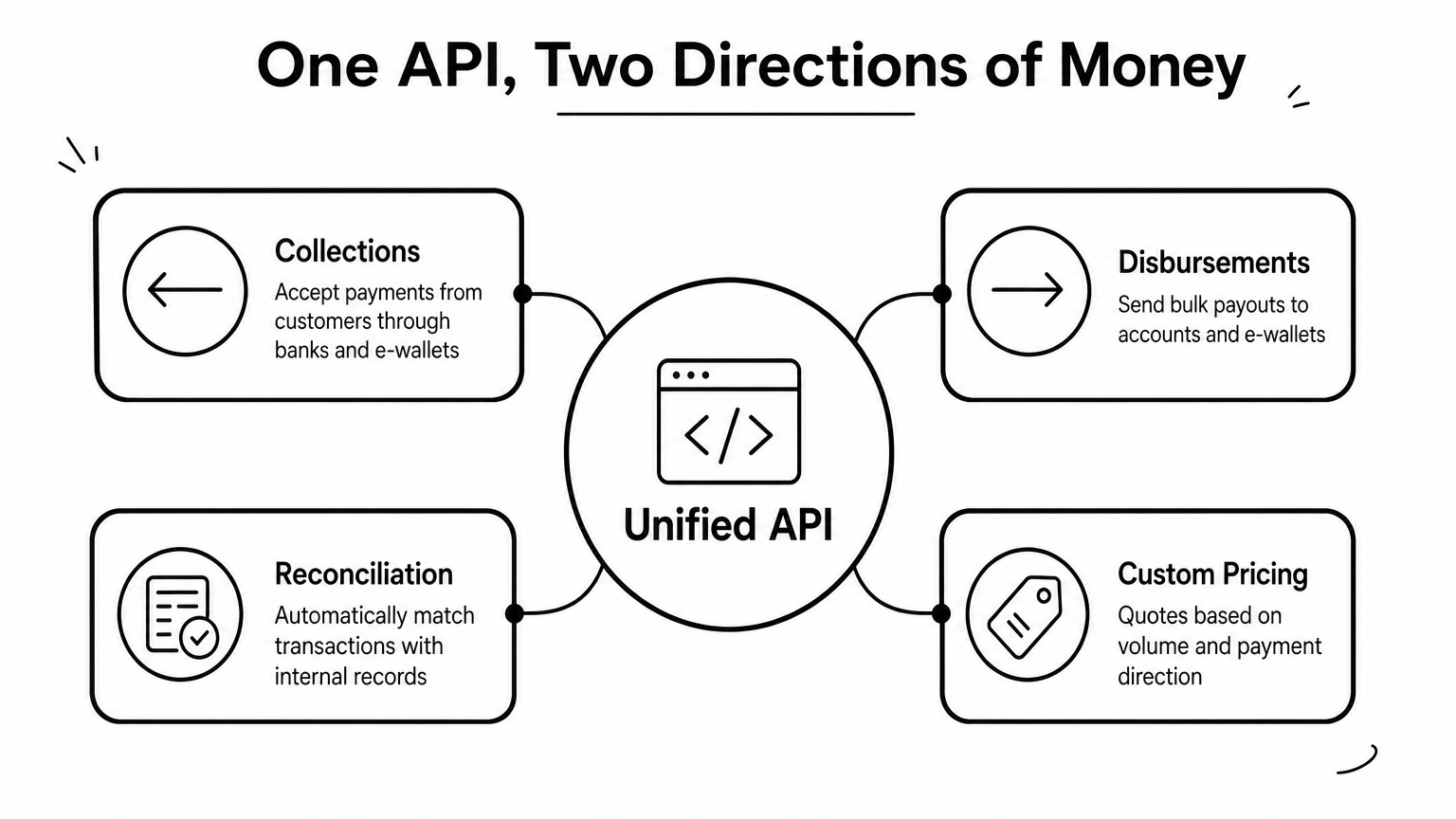
OY! Indonesia built its name on payment automation rather than checkout pages, positioning itself as infrastructure for businesses that need to move money in and out at scale, not just collect a one-time sale. Companies handling payroll, vendor payouts, or high-volume disbursements alongside customer collections often land here after outgrowing a standard e-commerce gateway.
Key features
OY!'s platform centers on a unified API that combines collection and disbursement in a single integration, so you're not stitching together separate tools for incoming and outgoing payments. It also offers a reconciliation dashboard that automatically matches transactions against your internal records, cutting down the manual accounting work that eats time at month-end.
Automation only saves you time if collections and payouts run through the same system instead of two disconnected tools.
Payment methods supported
OY! supports virtual accounts across major Indonesian banks, QRIS, e-wallet payments, and bulk disbursement to bank accounts and e-wallets alike. That disbursement side sets it apart from gateways focused purely on collecting customer payments.
Pricing
Pricing runs on a custom quote model based on transaction volume and whether you need collection, disbursement, or both. There's no public rate card, so expect a sales conversation before you get firm numbers.
Best for
Businesses that need to automate both collections and payouts, including marketplaces, payroll platforms, and fintech products managing money in two directions at once.
7. iPaymu for simple all-in-one payment integration
iPaymu targets small and mid-sized merchants who want a working checkout without hiring a developer for weeks. It's been around since 2012, and its pitch is straightforward: sign up, verify your business, and start collecting payments through a hosted page or a lightweight API within days. If you're comparing a payment gateway indonesia terbaik option specifically because your team lacks in-house engineering resources, iPaymu is built for exactly that situation.
Key features
iPaymu's hosted payment page handles the entire checkout flow, so you can start accepting payments with just a link, no coding required. It also includes an invoicing tool, a simple e-commerce plugin for platforms like WooCommerce, and a mobile app for merchants who want to check transaction status without logging into a dashboard.
A gateway that gets you collecting payments in days beats one with more features that takes weeks to configure.
Payment methods supported
iPaymu covers virtual accounts across major banks, QRIS, e-wallets including OVO and DANA, credit cards, and Alfamart/Indomaret retail payments. That's enough coverage for most small business checkout needs without added complexity.
Pricing
Transaction fees typically range from 0.7% for bank transfers to around 2.9% for card payments, with no setup or monthly fee for standard accounts. Pricing is published openly on their site, which helps smaller merchants budget without a sales call.
Best for
Small businesses and solo entrepreneurs who need a fast, low-maintenance checkout without dedicated technical staff to manage a more complex integration.
8. Nicepay for reliable all-in-one payment processing
Nicepay rounds out this list as a steady, no-surprises option that's been processing Indonesian transactions since 2011. It doesn't chase the newest fintech trend, and that's the point: Nicepay built its name on consistent uptime and straightforward bank integrations, which suits merchants who'd rather have a boring, reliable gateway than a flashy one that occasionally drops transactions during peak hours.
Key features
Nicepay's core strength is its direct bank partnerships, which means fewer intermediary hops between your customer's payment and your settlement account. It also provides a merchant dashboard with settlement reports broken down by payment method, plus a sandbox environment for testing integrations before you go live, something smaller providers sometimes skip.
Reliability beats novelty when a failed transaction costs you a customer, not just a support ticket.
Payment methods supported
Nicepay covers virtual accounts across major Indonesian banks, QRIS, credit and debit cards, and e-wallets including OVO and DANA. Coverage isn't as broad as Midtrans or DOKU, but it's solid enough for standard e-commerce and subscription businesses.
Pricing
Transaction fees generally sit between 1.8% and 2.8%, depending on payment method, with volume discounts available for merchants processing above a certain monthly threshold. Custom enterprise pricing is available on request.
Best for
Mid-sized merchants who value dependable bank connectivity and straightforward reporting over the widest possible feature set or the newest payment rails.
9. How to choose the right payment gateway in Indonesia
Picking from a daftar payment gateway Indonesia gets easier once you rank your own priorities instead of comparing feature lists side by side. Start with your customer base: if most of your buyers pay through QRIS or Indomaret, prioritize a gateway with strong retail and e-wallet coverage over one built purely for card processing. Consider your growth trajectory too, since a gateway that suits a steady 500 transactions a month might buckle once you're processing 50,000.
The right gateway isn't the one with the most payment methods, it's the one that matches how your actual customers already pay.
Run through this checklist before signing anything:
- Settlement speed: same-day or next-day settlement matters more than a lower headline fee if cash flow is tight.
- Onboarding requirements: some providers approve merchants in 24 hours, others run stricter KYC that takes a week but filters out unreliable partners.
- Support responsiveness: test their support channel before you integrate, not after a transaction fails.
- Cross-border needs: if you're expanding beyond Indonesia, confirm the provider actually operates in those markets rather than just claiming coverage.
- Fee transparency: published rate cards beat vague "contact sales" pricing when you're comparing a payment gateway indonesia termurah option against a full-service partner.
Don't just compare fee percentages in isolation. A gateway charging 0.5% more but settling funds a day faster, or stopping payment fraud before it hits your account, often saves you more money over a quarter than the cheapest option on paper.
Finding your payment partner for 2026
There's no single payment gateway indonesia terbaik that fits every business, and this list should have made that clear. A high-volume marketplace needs disbursement automation, a WooCommerce store needs plug-and-play checkout, and a merchant expanding across Southeast Asia needs a partner who understands compliance in each market, not just Indonesia, which is why it's worth reviewing the gateway options in Thailand before you commit. Match the provider to your actual customer base and growth stage, not to whichever name shows up first in search results.
Weigh fees against reliability before you sign anything. The cheapest processor rarely stays cheapest once you factor in failed transactions, slow settlement, or support that disappears after integration. If you're expanding beyond Indonesia into Thailand, Vietnam, or the Philippines and want a partner that handles KYC, local settlement, and USDT payments under one roof, request a CoinPay demo built around your actual transaction volume.