
9 Best International Payment Gateways for India in 2026
If you sell to customers outside India, you already know the headache: a domestic-only checkout that rejects foreign cards, settlement delays that stretch into weeks, and compliance paperwork that never seems to end. Finding a working payment gateway international india merchants can actually rely on means looking past marketing pages and comparing who really supports multi-currency settlement, RBI compliance, and low decline rates for cross-border cards.
This guide answers that search directly. We've ranked the providers worth considering in 2026 based on transaction fees and charges in India, supported currencies, settlement speed to Indian bank accounts, and how each handles KYC for exporters, SaaS companies, freelancers, and platforms billing customers abroad. Whether you're comparing options for a payment gateway usa to india flow or looking for broader coverage across multiple regions, you'll see where each option actually fits.
Below, we break down nine gateways, from established global names to newer regional specialists, including where fiat to crypto payment gateway options and USDT settlement make sense as a backup rail. At CoinPay, we work with merchants across South and Southeast Asia daily, so we've built this list around what actually holds up in production, not just what looks good on a pricing page.
1. CoinPay – regional gateway for Asia-Pacific merchants
CoinPay sits apart from the typical international payment gateway india shortlist because it wasn't built as a generic global processor with an India add-on. It was built for merchants operating across Thailand, Vietnam, the Philippines, Malaysia, Bangladesh, India with UPI, IMPS and INR settlement, and Indonesia from day one, which matters if your customer base straddles several of these markets rather than sitting neatly inside one. Regional expertise shapes everything from onboarding to settlement, and that shows up in how quickly disputes and payment friction get resolved compared to a support ticket queue at a large multinational processor.

How it works
Merchants apply through a structured onboarding process that includes business verification, KYC documentation, and a due diligence review before any integration begins. This isn't a rubber-stamp signup form. CoinPay reviews the nature of your business, and it explicitly rejects scam operations, money-game schemes, and deceptive platforms, which keeps the merchant pool clean and settlement times predictable for everyone else on the rails. Once approved, you get access to local payment method coverage per market, such as PromptPay and THB settlement in Thailand, alongside a separate option for USDT deposits and merchant withdrawals for merchants who want a crypto/stablecoin rail as backup or primary settlement.
Pricing and fees
CoinPay doesn't publish a flat public rate card, and that's intentional. Fees are structured around your market, payment journey, and settlement currency, since a Philippines-focused e-commerce merchant has a different cost profile than a Bangladesh-based fintech platform. You'll get a quote after the onboarding review, based on transaction volume and the specific local payment methods you need.
A payment gateway that screens out bad actors before onboarding is worth more to legitimate merchants than one that approves anyone and sorts out the fraud later.
Who it's best for
This gateway fits online platforms and gaming, e-commerce, and fintech businesses already operating or expanding across South and Southeast Asia, especially those that need local currency settlement in more than one country. If your primary volume is US or European customers only, CoinPay's regional depth won't be the deciding factor. If your customers are spread across Thailand, where PromptPay and THB settlement dominate, Vietnam, India, and Indonesia, it's hard to match with a single global processor.
Pros and cons
- Pro: Deep local payment method coverage across seven Asian markets
- Pro: Hands-on merchant support and ongoing performance monitoring, not just integration help
- Pro: Strict compliance screening reduces fraud exposure and account freezes
- Pro: USDT settlement available as a stablecoin backup rail
- Con: No self-serve instant signup; onboarding takes real review time
- Con: Pricing isn't published upfront, so you need to apply to get exact rates
2. Razorpay – homegrown gateway with strong India coverage
Razorpay built its name processing domestic UPI and card payments, but it has expanded into cross-border collections for Indian businesses that need to bill customers abroad. As an international payment gateway for indian merchants already running domestic operations, it's often the path of least resistance since you're adding a feature to an account you already have rather than starting from scratch with a new provider.
How it works
Razorpay Payment Links and its International Payments feature let you accept cards issued outside India, with automatic currency conversion into INR at settlement. You integrate through the same dashboard and API you'd use for domestic transactions, which cuts down on the dev work needed to add a second checkout flow just for foreign customers.
Pricing and fees
Domestic transactions typically run 2% per transaction, while international card payments carry higher fees, generally in the 3% range plus currency conversion markup. Settlement to your Indian bank account usually takes T+2 to T+4 working days depending on your account type and risk profile.
The easiest international gateway to add is usually the one you're already using domestically, provided its cross-border rates don't quietly eat your margin.
Who it's best for
Razorpay suits Indian SaaS companies and service exporters who already process the bulk of their volume domestically and need occasional or moderate foreign card collections, not a full multi-currency operation.
Pros and cons
- Pro: Fast setup if you already have a Razorpay account
- Pro: Single dashboard for domestic and international transactions
- Con: Higher fees than dedicated cross-border specialists
- Con: Limited local payment method coverage outside India
3. Cashfree – wide currency support for global checkout
Cashfree built a reputation in India for its payouts and payment links product, and it now runs a dedicated international payments stack aimed at merchants who need to accept dozens of currencies without stitching together multiple processors. If you're comparing an international payment gateway list in india and want one name that covers both domestic UPI collections and foreign card acceptance under a single contract, Cashfree tends to show up near the top.
How it works
Cashfree's international checkout supports over 100 currencies through a single integration, with settlement converted into INR at prevailing rates. You get access to a hosted checkout page or API-based integration, and the platform handles currency detection based on the customer's card issuer, so you don't need separate checkout flows for domestic versus foreign buyers.
Pricing and fees
International transactions on Cashfree generally run around 3% per transaction, with settlement cycles similar to Razorpay, typically T+2 working days. Enterprise merchants processing higher volumes can negotiate custom rates, but the published pricing tier is built for small and mid-sized exporters rather than large multinational retailers.
Wide currency support only matters if the settlement math still works once conversion spreads are factored in.
Who it's best for
Cashfree fits exporters and SaaS platforms billing customers across a wide spread of countries, where the priority is currency breadth over deep local payment method options in any single market.
Pros and cons
- Pro: Broad currency coverage in one integration
- Pro: Combines domestic and international collections under one account
- Con: Fees sit higher than pure domestic processors
- Con: Less local payment method depth compared to region-specific providers
4. PayU – broad currency reach for established exporters
PayU has been running payment infrastructure across emerging markets for over a decade, and its India operation carries that scale into cross-border collections for merchants who've outgrown a basic starter gateway. Established exporters comparing a best international payment gateway for india shortlist often land on PayU because it was built to handle high transaction volumes across multiple countries from the start, not retrofitted from a domestic-only product.
How it works
PayU's Global Payment Gateway supports card acceptance from over 100 countries, plus a range of alternative payment methods depending on the buyer's region. You integrate through PayU's API or hosted checkout, and the system routes transactions through the appropriate acquiring bank based on card origin, which helps reduce decline rates compared to a single-acquirer setup. Settlement converts into INR, with reporting dashboards built for finance teams reconciling volume across several currencies at once.
Pricing and fees
Domestic transaction fees start around 2%, while international card processing typically runs 3% to 3.5% depending on card network and merchant category. Larger exporters processing significant monthly volume can negotiate custom rates, since PayU's pricing tiers are built with room for enterprise-level negotiation rather than a fixed public rate card.
Volume-based negotiation only pays off once you're processing enough monthly transactions to justify the sales conversation.
Who it's best for
PayU suits established exporters and mid-to-large e-commerce businesses already processing meaningful international volume, where negotiated rates and dedicated account management matter more than a quick self-serve signup.
Pros and cons
- Pro: Wide country and card network coverage
- Pro: Negotiable rates for high-volume merchants
- Con: Onboarding takes longer than smaller competitors
- Con: Better suited to established businesses than early-stage exporters
5. Stripe – developer-first gateway for global businesses
Stripe built its reputation on clean APIs and global reach, and for developers comparing a best international payment gateway in india option built around code rather than dashboards, it's still the default choice. The catch worth knowing upfront: Stripe paused new merchant onboarding for India-registered entities in 2022, so most Indian businesses now access it through a foreign subsidiary or a platform like Stripe Atlas, not a direct India account.
How it works
Stripe processes payments through modular APIs covering checkout, subscriptions, invoicing, and marketplace payouts, all documented well enough that a single developer can integrate a full billing flow in days. Cards from virtually every country route through Stripe's global acquiring network, and the platform handles currency conversion automatically at settlement.
Pricing and fees
Standard international card transactions run 2.9% plus a fixed fee per successful charge, with an added 1% for currency conversion when the customer pays in a currency other than your settlement currency. There's no setup fee or monthly minimum, which suits smaller teams testing global demand before scaling volume.
Stripe rewards developers who can build around its API, not merchants looking for a plug-and-play India signup.
Who it's best for
Stripe fits SaaS companies and platforms with in-house engineering that operate through a US, UK, or Singapore entity and need deep customization over checkout flows and billing logic.
Pros and cons
- Pro: Best-in-class developer documentation and API flexibility
- Pro: Extensive global card and currency coverage
- Con: No direct onboarding for India-registered businesses
- Con: Requires engineering resources to get full value from the platform
6. PayPal – trusted option for quick global payments
PayPal remains the name most international buyers already trust, which matters more than any technical feature when you're weighing which payment gateway is best in india for international transactions for a small business or freelance operation. Customers in the US and Europe recognize the checkout button instantly, and that familiarity alone can lift conversion rates for merchants who don't have a strong brand of their own yet.
How it works
Merchants sign up for a PayPal Business account and either send invoices directly or embed a PayPal checkout button on their site. Buyers pay from their PayPal balance, linked card, or bank account, and the funds land in your PayPal balance before you withdraw to your Indian bank account, typically converted through PayPal's own exchange rate.
Pricing and fees
International transactions carry a fee of around 4.4% plus a fixed amount based on currency, and PayPal's conversion rate typically runs 3-4% above the interbank rate. Withdrawals to Indian bank accounts usually settle within a few business days once you initiate the transfer.
Recognition drives conversion, but PayPal's conversion spread quietly erodes margin on every single payout.
Who it's best for
Freelancers and small service exporters billing individual overseas clients benefit most, especially those who need quick client payments without building a full checkout integration.
Pros and cons
- Pro: Instantly recognized by international buyers, which can lift trust at checkout
- Pro: No technical integration needed for invoicing or simple payment links
- Con: Fees and conversion spread run higher than most dedicated gateways
- Con: Account holds and freezes are a known risk for new or high-risk merchants
7. CCAvenue – deepest local payment method coverage
CCAvenue has been running payment infrastructure in India since 2001, and it shows in how many local payment rails it supports beyond the usual cards and net banking. If you're building out an international payment gateway in india setup and want one processor that also covers every regional Indian payment method your domestic customers use, CCAvenue's breadth is hard to match, even against newer competitors with slicker dashboards.
How it works
CCAvenue integrates through a hosted checkout page or API, and it supports over 200 payment options across cards, net banking, UPI, wallets, and international cards from major networks. Foreign currency transactions get routed through CCAvenue's international acquiring partnerships, with settlement converting into INR at the prevailing exchange rate before it lands in your linked bank account.
Pricing and fees
Domestic transaction fees typically start around 2%, while international card payments run higher, generally 3% to 3.5% depending on card network and merchant risk category. CCAvenue doesn't publish a fixed international rate card, so larger merchants often negotiate custom pricing during onboarding, similar to PayU's approach.
A gateway with 200 payment options only earns its complexity if your customer base actually uses more than a handful of them.
Who it's best for
CCAvenue suits e-commerce businesses with a mixed domestic and international customer base, where you need deep local payment method coverage for Indian buyers alongside occasional foreign card acceptance, rather than a pure cross-border specialist.
Pros and cons
- Pro: Extensive local payment method coverage, among the deepest in India
- Pro: Long operating history with established banking relationships
- Con: Dashboard and onboarding experience feel dated next to newer competitors
- Con: International-specific features are less polished than domestic ones
8. Payoneer – built for marketplace and freelance payouts
Payoneer earned its reputation as the payout method built into Amazon, Upwork, Fiverr, and dozens of other marketplaces, which makes it less of a checkout gateway and more of a receiving account for money that platforms already owe you. If you're an Indian freelancer or a small exporter pulling income from multiple marketplaces rather than running your own storefront, Payoneer often shows up before any traditional gateway even enters the conversation.
How it works
You open a Payoneer account and get local receiving accounts in USD, GBP, EUR, and a handful of other currencies, which marketplaces treat like a domestic bank account in that country. Clients or platforms pay into that receiving account, and you withdraw to your Indian bank account whenever you choose, with Payoneer converting the currency at its own rate.
Pricing and fees
Receiving marketplace payments into your Payoneer balance is typically free, but withdrawing to an Indian bank account costs around 2% on the currency conversion, with the amount landing in one to two business days. Payoneer also charges a small annual fee if your account sits inactive for a full year without any transactions.
Payoneer works best as a collection point for money already owed to you, not as a checkout button for a website.
Who it's best for
This option fits freelancers, marketplace sellers, and agencies getting paid by platforms like Upwork or Amazon that already integrate Payoneer natively, rather than merchants who need to build a custom checkout for direct customer payments.
Pros and cons
- Pro: Native integration with major freelance and marketplace platforms
- Pro: Multiple currency receiving accounts without opening foreign bank accounts
- Con: Not designed for direct website checkout integration
- Con: Conversion rates run less favorable than dedicated cross-border specialists
9. Wise – low-cost transfers for freelancers
Wise built its name on transparent currency conversion, and for freelancers or small exporters comparing an international payment gateway for india setup purely on cost, it's hard to beat on the exchange rate alone. It isn't a checkout gateway in the traditional sense, since there's no hosted payment page for customers to click through, but as a receiving and transfer tool for money already owed to you, it competes directly with Payoneer and PayPal on price.
How it works
You open a Wise multi-currency account and get local account details in USD, GBP, EUR, and several other currencies, similar to Payoneer's receiving account model. Clients pay you as if they're sending a domestic transfer in their own country, and Wise converts the balance at the mid-market exchange rate whenever you move funds to your Indian bank account, with no markup hidden inside the rate itself.
Pricing and fees
Conversion fees typically run 0.5% to 2% depending on the currency pair and transfer amount, charged transparently upfront rather than baked into a worse exchange rate. Transfers to Indian bank accounts usually land within one to two business days, and there's no monthly fee for holding the account itself.
A transparent conversion fee beats a hidden markup every time, even when the headline percentage looks similar on paper.
Who it's best for
Wise suits freelancers and consultants invoicing overseas clients directly, where the client can pay into your foreign currency account without needing a full e-commerce checkout integration.
Pros and cons
- Pro: Mid-market exchange rates with transparent, upfront fees
- Pro: Multi-currency account setup takes minutes online
- Con: No hosted checkout page for website sales
- Con: Not built for high-volume e-commerce transaction processing
10. How to choose the right gateway for your business
Picking a payment gateway international india setup isn't about finding the provider with the lowest headline rate. It's about matching the tool to how your customers actually pay and how fast you need that money in your account. A freelancer invoicing three clients a month has completely different needs than an e-commerce brand shipping to five countries or running a Shopify store checkout in India, and treating them the same leads to either overpaying for features you never use or hitting limits right when volume picks up.
Start by mapping your actual customer geography before you compare fee schedules. If most of your buyers sit in Southeast Asia, a regional specialist with local payment method depth will outperform a global processor that treats every market the same way. If you're mostly invoicing US and European clients directly, a low-cost transfer tool matters more than checkout breadth.
The right gateway isn't the cheapest one on paper, it's the one that matches where your customers actually are.
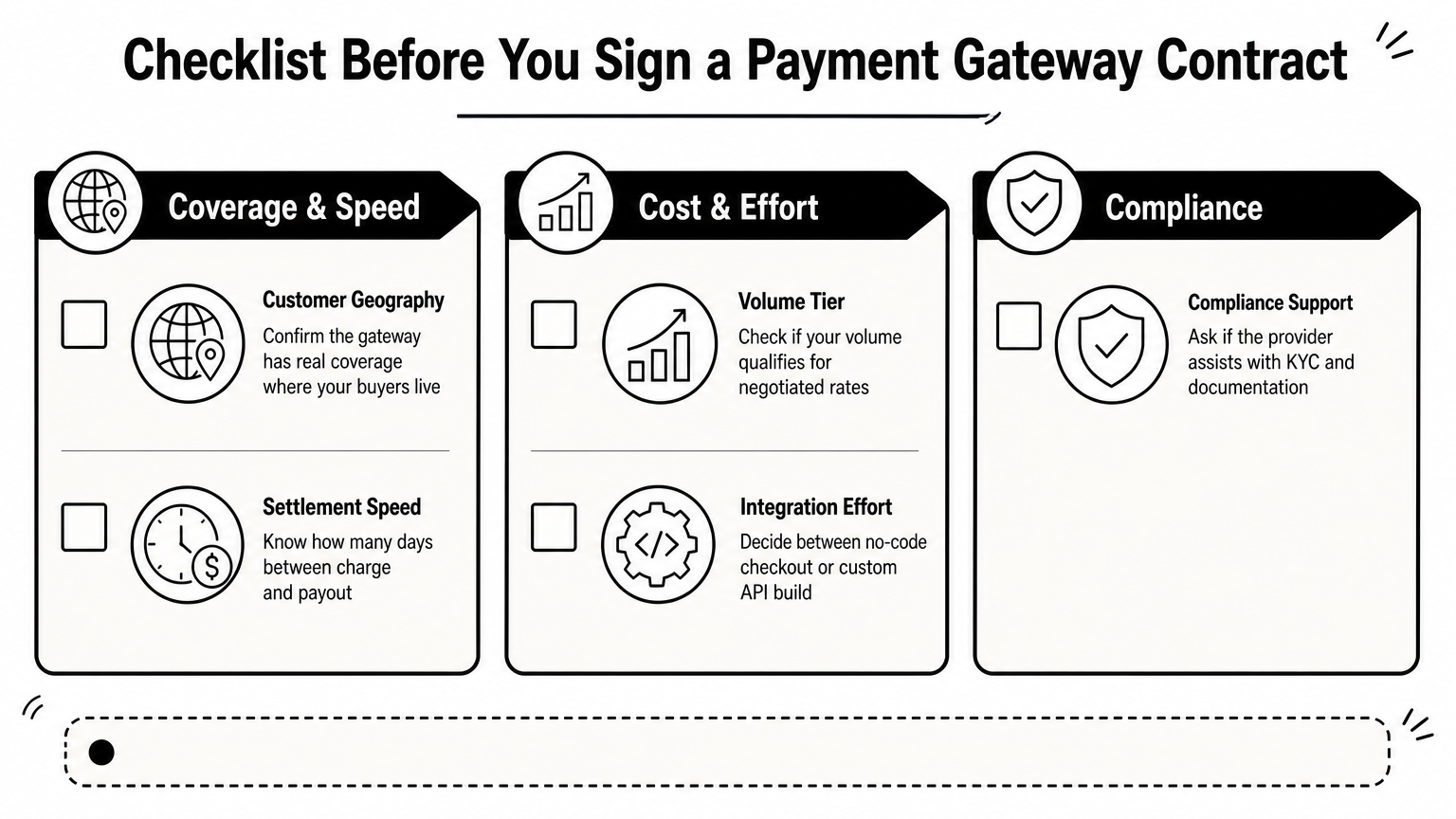
Use this checklist when narrowing your shortlist:
- Customer geography: Where do most of your paying customers live, and does the gateway have real coverage there?
- Settlement speed: How many days between a successful charge and money landing in your Indian bank account?
- Volume tier: Are you processing enough monthly transactions to negotiate custom rates?
- Integration effort: Do you have engineering resources, or do you need a no-code checkout?
- Compliance support: Does the provider help with KYC and documentation, or leave that entirely on you?
Running your business through this list before signing a contract saves you from discovering a gateway's limits only after you've built your checkout around it.
11. Compliance essentials: RBI licensing, KYC, and FIRC
Before you sign with any provider, check whether it actually holds the right authorization to move foreign currency into India. The Reserve Bank of India requires payment aggregators handling cross-border transactions to register as a Payment Aggregator-Cross Border (PA-CB), a licensing category the RBI formalized to bring exporters' foreign inflows under proper oversight. Ask your shortlisted gateway directly whether they hold this authorization or operate under a partner bank's license, because an unlicensed intermediary can freeze your settlement the moment a regulator asks questions.

KYC for international collections goes deeper than a domestic account signup. Expect requests for your IEC (Import Export Code), GST registration, business PAN, bank statements, and sometimes a description of the goods or services you're exporting. Gateways serving exporters seriously, including CoinPay's own onboarding process across its Asian markets, treat this documentation as the starting point for a relationship, not a one-time checkbox.
Skipping the paperwork now just moves the delay to the day you actually need your money to settle.
Once money lands, keep your Foreign Inward Remittance Certificate (FIRC) for every batch of foreign currency you receive. Your bank or payment aggregator issues this document, and you'll need it for:
- GST refund claims on export services
- Income tax filings that reference foreign income
- RBI compliance audits if your bank flags unusual inflow patterns
- Closing out your IEC-linked export obligations at year end
Don't treat FIRC as an afterthought filed away and forgotten. Reconcile it against your invoices monthly, because a mismatch between invoiced amounts and certified remittances is one of the fastest ways to trigger a compliance query from your bank.
12. Common mistakes to avoid when choosing a gateway
Merchants comparing an international payment gateway india shortlist tend to repeat the same handful of errors, and most of them show up only after money is already stuck somewhere. Signing with the first provider that offers the lowest advertised rate is the most common one, because that headline percentage rarely includes currency conversion markup, chargeback fees, or the cost of a settlement delay when your business hits a risk threshold nobody warned you about.
Overlooking settlement currency mismatches causes real damage too. If your gateway settles in USD but your accounting and GST filings run in INR, you're absorbing an extra conversion step and an extra spread that nobody budgeted for at signup. Ignoring compliance requirements until a regulator or bank asks for documentation is another version of the same mistake: postponing the paperwork doesn't remove it, it just moves the deadline to a worse moment.
The cheapest gateway on the pricing page is rarely the cheapest one once conversion spreads and compliance delays get counted.
Here's a quick list of the mistakes worth checking off before you sign anything:
- Choosing on rate alone without checking conversion markup and hidden fees
- Skipping a test of actual decline rates for the card networks your customers use
- Assuming domestic support quality carries over to cross-border disputes
- Ignoring whether the provider holds proper RBI authorization for cross-border collections
- Underestimating how long onboarding and KYC review actually takes
Assuming every provider handles disputes the same way is the last trap worth naming. A chargeback process built for domestic card fraud looks nothing like one built for cross-border disputes spanning different consumer protection rules, and finding that out mid-dispute costs far more than checking it upfront.
Finding the right fit for your payments
No single international payment gateway india option wins every category. Stripe and PayPal give you global recognition and clean checkout flows, but neither was built around RBI compliance or regional payment method depth. Razorpay, Cashfree, PayU, and CCAvenue understand Indian settlement rules well, yet their cross-border coverage thins out once your customers span multiple Asian markets. Payoneer and Wise solve the freelancer payout problem cheaply, but they won't run a storefront checkout for you.
If your business sells across Thailand, Vietnam, the Philippines, Bangladesh, India, or Indonesia, the calculation changes. You need a partner that screens merchants properly, settles in local currency fast, and answers support tickets from someone who actually knows the market. That's the gap CoinPay was built to close, with strict compliance screening and hands-on merchant support baked into onboarding, not bolted on after a dispute.
Talk to our team and get a free demo to see whether regional coverage solves what your current gateway can't.