
How to Get a Payment Gateway License in Bangladesh
Getting a payment gateway license in Bangladesh means applying to the Payment Systems Department of Bangladesh Bank for a Payment System Operator (PSO) license under the Bangladesh Payment and Settlement Systems Regulations 2014 (BPSSR 2014). You incorporate a company, show the minimum paid-up capital, file the prescribed application with a BDT 25,000 fee, win a No Objection Certificate (NOC), deploy your system, pass an onsite inspection, and pay a BDT 100,000 license fee. If you plan to issue wallets or e-money, you need the Payment Service Provider (PSP) license instead.
The hard part is not the form. It is knowing which license fits your model, which documents the regulator expects, and what happens if you operate without approval. A 2022 Prothom Alo report counted 10 of 15 gateways working without approval, with merchant money stuck at some of them. The Bangladesh Bank spokesperson said the central bank had no control over those operators. Unlicensed status is a real risk for you and for every merchant you serve.
This guide covers the choice between PSO and PSP, then three application steps, then the gateways that already hold licenses. CoinPay runs payment gateway services for merchants in Bangladesh and six other Asian markets, so we also explain what to do if you only need to accept payments and do not want to become a gateway yourself.
PSO or PSP: pick the right license first
You need a PSO license if you run a gateway or aggregator that settles payments among participants, and a PSP license if you serve customers directly with wallets or e-money. Choosing wrong wastes months, because the two licenses carry different capital and settlement rules.

What each license covers
Under BPSSR 2014, the PSO is the infrastructure role. It operates a settlement system where the principal participant must be a scheduled bank or financial institution. The PSP is the customer-facing role. It facilitates payments directly for customers and settles through a scheduled bank. The figures below come from published summaries of the licensing guideline, so confirm them with the regulator before you commit funds.
| PSO | PSP | |
|---|---|---|
| Typical business | Payment gateway, payment aggregator | E-wallet, mobile wallet |
| E-money or payment instruments | Prohibited | Allowed under regulated terms |
| Settlement | Through scheduled commercial banks | Trust cum Settlement Account at a scheduled bank |
| Minimum paid-up capital | BDT 5,000,000 | BDT 200,000,000 |
| Key personnel | 3 years of payments or financial services experience | 3 years of payments or financial services experience |
Why most gateway startups apply for a PSO
If your product connects merchants to cards, internet banking and mobile financial services, the PSO fits. It also costs far less to capitalize. A worked example: a new gateway company needs BDT 5,000,000 in paid-up capital plus BDT 125,000 in regulator fees (BDT 25,000 application and BDT 100,000 license). That is BDT 5,125,000 to line up before you spend anything on technology.
Apply for a PSO if you move merchant payments, and for a PSP only if you hold customer money.
Step 1. Check eligibility and gather documents
Before you file, confirm three things: your company form, your capital, and your people. Then collect the document pack, because Bangladesh Bank scrutinizes it before anything else happens.

Confirm company, capital, and people
Meet these requirements first:
- Register the company under the Companies Act, 1994.
- Hold the minimum paid-up capital for your license type, which Bangladesh Bank can adjust.
- Employ key personnel with at least three years in payments or financial services.
- For a PSP, build technology infrastructure inside Bangladesh.
Directors and key personnel also need CIB clearance, so start those requests early.
Assemble the document pack
Group your documents so nothing is missed:
- Company: Certificate of Incorporation, Memorandum and Articles of Association, Trade License, e-TIN Certificate, Corporate Profile, Form-XII, CIB clearance.
- Business: list of proposed services, business plan with market analysis and execution plan, organizational structure, financial settlement process, five-year business projection.
- Technical: process flow description, hardware, software and network overview, data security and interoperability measures.
Your business plan and technical flow must describe the same services, or the application can be rejected.
Step 2. File the application and pay the fee
File the prescribed application with the Payment Systems Department and attach a BDT 25,000 pay order or demand draft. Everything after this depends on how clean this submission is.
Submit the application
Use the prescribed format (Annexure-A) and attach the required documents (Annexure-B). Bangladesh Bank reviews the file and may ask for additional documents. If your proposed services do not match what the license allows, it can reject the application with written notice. A PSO that lists e-wallet issuing, for example, contradicts its own license type.
Know what you pay and when
Both fees are non-refundable, and they fall due at different stages.
| Fee | Amount (BDT) | When |
|---|---|---|
| Application fee | 25,000 | With the application, by pay order or demand draft to the General Manager, Payment Systems Department |
| License fee | 100,000 | After final approval |
| Total | 125,000 |
Pay the application fee with the file, but hold the license fee until final approval.
Step 3. Clear the NOC, deploy, and pass inspection
Approval comes in two gates: a No Objection Certificate after document review, then final approval after your live system passes inspection. Skipping ahead is not possible, so plan the build around both.
Win the No Objection Certificate
An evaluation committee examines your documents and submits a report. Based on it, Bangladesh Bank decides whether to issue the NOC. Reviewers weigh market demand, business rationale, regulatory requirements, risk management and settlement systems. Approval is not guaranteed. EasyPayWay applied in 2016 and had still not received a license by 2022, and the Bangladesh Financial Intelligence Unit had objected to some applicants.
Deploy and pass the onsite inspection
After the NOC, deploy your system and submit a declaration (Annexure-C) confirming it is ready. Bangladesh Bank then runs an onsite inspection of operational readiness and compliance. Approval follows a satisfactory inspection report and fulfilment of the NOC conditions. Pay the BDT 100,000 license fee at that point. Test your settlement flow with your partner bank before inspection day.
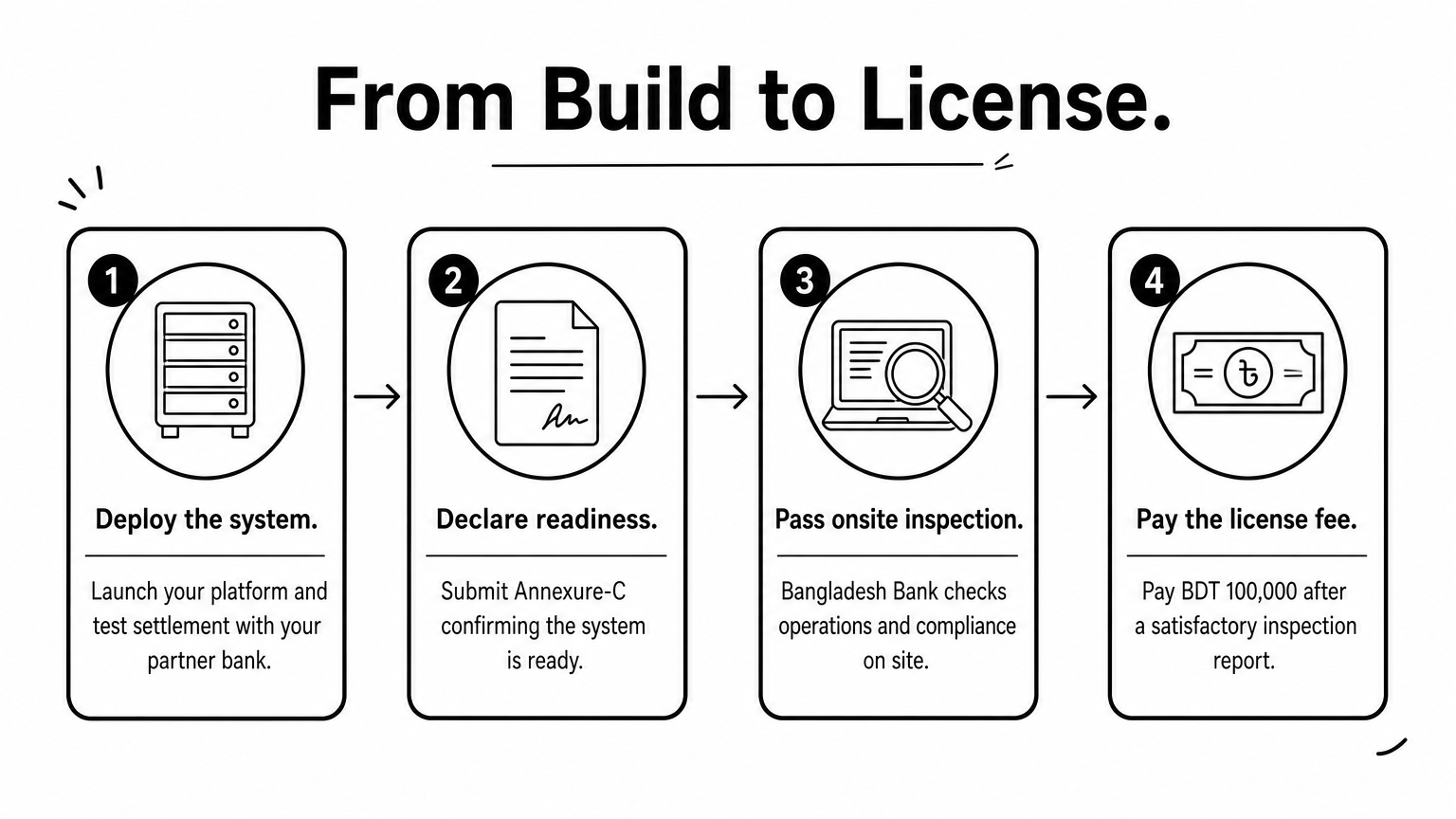
Build and test the system before you declare readiness, because the inspector checks a working platform.
Licensed gateways and what merchants should do
Several gateways already hold PSO or PSP licenses, but the list changes, so verify any name on Bangladesh Bank's official website before you rely on it. If you only accept payments, you do not need a license at all, only a licensed partner.
Gateways already licensed
SSLCOMMERZ received the first PSO license in 2016. By 2022 only five PSOs were licensed, and SSLCOMMERZ handled about 80 percent of transactions. Published lists since then show more names.
| Type | Examples |
|---|---|
| PSO | SSLCOMMERZ (SSL Wireless), IT Consultants, Software Shop, ShurjoMukhi, Portonics, Soft Tech Innovation, Optimum Solution & Services, Service Hub, Fingerprint Information Technology, DGePay Services, Paperless |
| PSP | iPay Systems, D Money Bangladesh, Recursion FinTech, Green & Red Technologies, ABG Technologies, Digital Payments, Sheba Fintech |
If you only accept payments
A merchant selling online does not apply for a PSO. You contract a payment gateway provider in Bangladesh that operates within the licensing rules, and you ask three questions. Which licensed entity handles settlement? Which banks and wallets are supported? How is payment performance reported? CoinPay's Bangladesh services include bank deposits, e-wallet deposits, and bank transfer payouts with an average processing time of 1 to 3 minutes. We review every merchant through KYC and due diligence, and we send monthly success-rate reports.
Apply for a license only if you want to be the gateway, not just use one.
Where to go from here
To get a payment gateway license in Bangladesh, choose PSO or PSP, meet the company, capital and staffing rules, file Annexure-A with the documents and the BDT 25,000 fee, earn the NOC, then pass inspection and pay the license fee. Check each figure against Bangladesh Bank's current guidance before you commit funds.
If you would rather skip the licensing build and start accepting payments from Bangladeshi customers, talk to a provider that screens merchants carefully and supports you after integration. You can book a free CoinPay demo call to see how bank and e-wallet payments would work for your business.