
6 Best Payment Gateways in the Philippines for 2026
Choosing a payment gateway Philippines merchants can actually rely on is harder than it looks. GCash, Maya, credit cards, bank transfers, and now stablecoins all pull customers in different directions, and picking the wrong provider means failed transactions, delayed settlements, or fees that quietly eat your margin every month.
This guide gives you a straight answer: which providers handle local payment methods well, which ones support fast peso settlement, and where the pricing actually makes sense for your transaction volume. Whether you're running e-commerce, gaming, or a fintech platform, you'll see how each option stacks up on integration effort, approval speed, and ongoing support once you're live.
We've built this comparison from the perspective of merchants who've dealt with rejected applications, slow onboarding, and gateways that disappear once something goes wrong. At CoinPay, we've spent five years processing payments across Southeast and South Asia, including the Philippines, so we know what separates a reliable payment partner from a connector that just forwards transactions. Below are the six providers worth your attention for 2026, with the details that actually affect your bottom line.
1. CoinPay
CoinPay built its reputation on merchant onboarding done right, not just transaction forwarding. As a payment gateway in the Philippines and across six other Asian markets, covering GCash, Maya and local bank deposits with PHP settlement, we screen every applicant through KYC and due diligence before approving an account, which means legitimate merchants get a partner who won't vanish when a dispute lands. That screening also keeps the network clean of scam operations, so banks and card networks trust transactions coming through our rails, and your approval rates stay high.

Key features
What sets CoinPay apart is the consulting layer wrapped around the technical integration. We map your deposit journey step by step, flag where customers drop off, and support merchants after launch instead of disappearing post-integration. You also get a dedicated support contact, not a ticket queue, for anything from failed settlements to sudden volume spikes.
A payment gateway is only as good as the support you get after something breaks.
Payment methods supported
CoinPay covers the payment methods Philippine customers actually use day to day:
- Bank transfers and local bank rails
- Cards (Visa, Mastercard)
- E-wallets popular in the region
- USDT and stablecoin settlement for merchants who want crypto rails alongside fiat
That mix matters if you're running an e-commerce or gaming platform where customers switch between GCash-style wallets and card payments depending on the promotion running that week.
Pricing and fees
Pricing depends on your transaction volume, market mix, and settlement currency, since a merchant settling in PHP with local bank rails has a different cost structure than one running USDT payouts. We quote per-merchant after reviewing your application, rather than publishing a flat rate that doesn't reflect real processing costs. If you want an exact number, the fastest path is applying directly through our payment gateway solutions page and getting a quote tied to your actual volume.
Who it's for
CoinPay suits merchants who've been burned before: rejected by mainstream processors, dropped mid-integration, or stuck with a gateway that ghosts them during a settlement delay. If you run e-commerce, gaming, or fintech and need a partner that treats compliance seriously while still moving fast on approvals, this is built for you.
2. PayMongo
PayMongo built its name as a developer-first payment gateway in Philippines startups reach for when they want to ship fast. It's a Stripe-style API layer, well documented, with SDKs that get a basic checkout running in an afternoon rather than a week. If your team has an engineer on staff, PayMongo removes a lot of the integration friction other local gateways still carry.

Key features
Beyond the API, PayMongo offers a no-code Payment Links option and a Checkout page you can embed without writing much backend logic. Its dashboard gives you transaction-level reporting and basic reconciliation tools, useful if you're a small team without a dedicated finance function watching settlements daily.
A clean API saves you weeks of dev time, but it won't fix a rejected merchant application.
Payment methods supported
PayMongo covers the essentials Filipino shoppers expect:
- GCash and Maya e-wallets
- Visa and Mastercard
- GrabPay
- Over-the-counter payments via partner networks
Pricing and fees
PayMongo publishes flat percentage rates per transaction type, which makes it one of the more transparent online payment gateway Philippines options for budgeting. Card and e-wallet rates typically sit in the mid-single digits, with no fixed monthly fee for standard accounts, though high-risk industries can face additional review or rejection outright.
Who it's for
PayMongo fits small to mid-sized online stores and SaaS businesses with in-house developers who want self-service setup over hands-on account management. If your business falls into a higher-risk category like gaming, expect stricter underwriting or a flat no.
3. Maya Business
Maya Business grew out of one of the Philippines' most recognized e-wallet brands, and that consumer trust carries over into its merchant-facing gateway. Businesses already using Maya for payroll or personal transfers often default to Maya Business simply because the brand recognition shortens the trust gap with customers at checkout. It's a solid option if you want a payment gateway in the Philippines that customers already recognize on their bank statements.
Key features
Maya bundles a merchant dashboard, invoicing tools, and a physical card reader option for businesses that also sell in person. Its API supports both hosted checkout and custom integration, so you can start with the simple route and move to full control later without switching providers.
Recognition at checkout can lift conversion just as much as a lower fee.
Payment methods supported
Maya covers a practical mix for Filipino consumers:
- Maya wallet payments
- Visa, Mastercard, and JCB cards
- QR Ph transfers
- Over-the-counter cash payments via partner outlets
Pricing and fees
Rates vary by payment method and merchant tier, with card transactions typically costing more than wallet-to-wallet transfers. Maya doesn't always publish exact numbers upfront, so smaller merchants should request a quote before committing, since volume-based pricing can shift meaningfully once you're processing at scale.
Who it's for
Maya Business suits retail and hospitality merchants who want a recognizable local wallet at checkout and don't need heavy customization. It's less suited to gaming or fintech platforms needing crypto rails or complex settlement logic.
4. Xendit
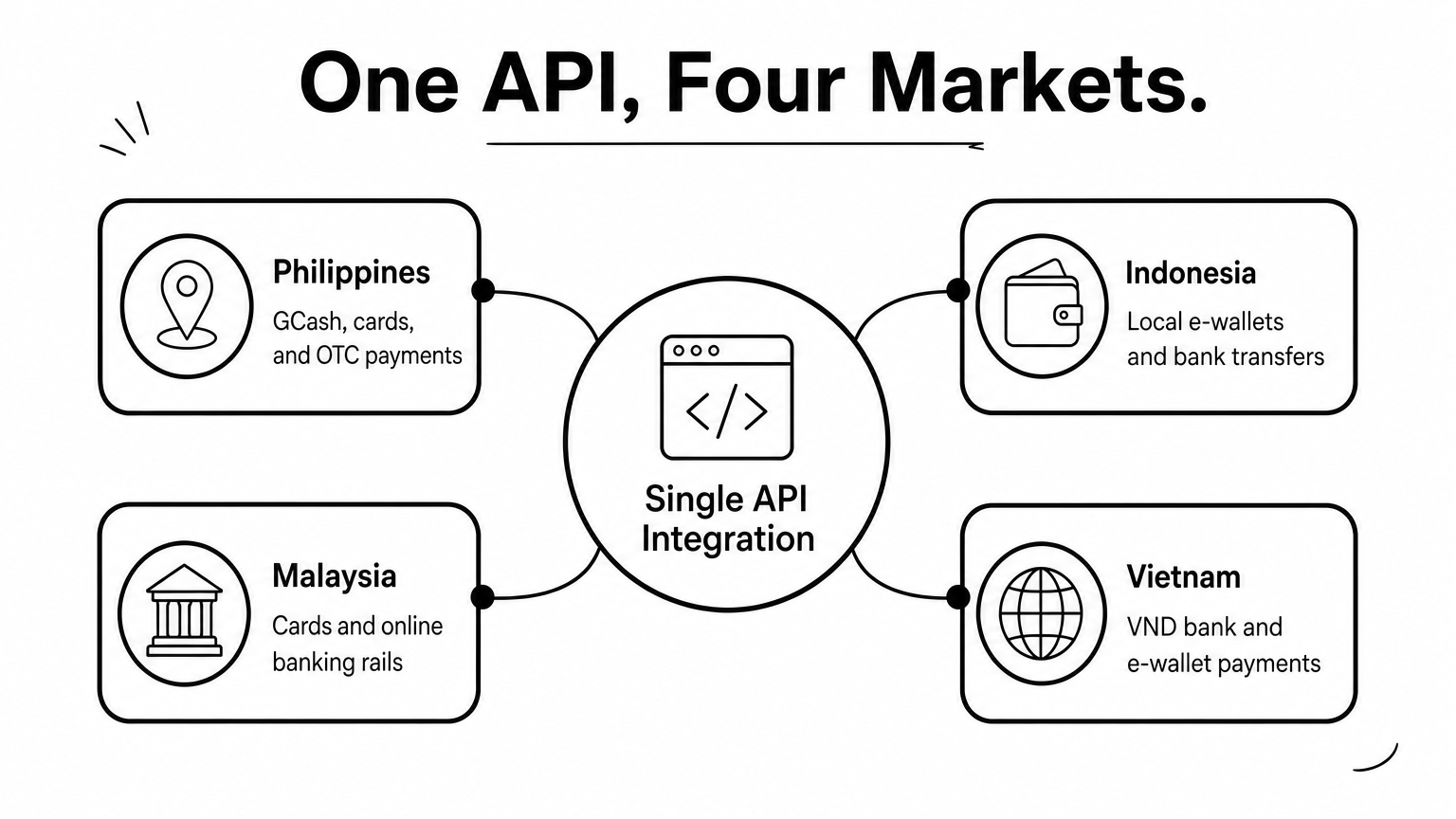
Xendit operates across Southeast Asia, and its Philippines coverage reflects that regional scale rather than a purely local build. Businesses expanding beyond the Philippines into Malaysia or looking at top payment gateways in Indonesia often pick Xendit precisely because one API integration covers multiple markets, saving your dev team from rebuilding payment logic every time you launch in a new country.
Key features
Xendit's dashboard includes disbursement tools alongside collection, so you can pay out to suppliers or affiliates through the same platform you use to accept customer payments. Its fraud detection layer flags suspicious transactions automatically, and the reporting suite exports cleanly into most accounting software, which matters once your transaction volume climbs past a few thousand a month.
Regional coverage only helps if the Philippine-specific payment methods still work reliably.
Payment methods supported
Xendit's Philippine coverage includes:
- GCash and Maya e-wallets
- Visa, Mastercard, and JCB cards
- Over-the-counter payments via 7-Eleven and other partner outlets
- Direct debit through select local banks
Pricing and fees
Xendit publishes indicative rates per payment method, with card and e-wallet fees landing in a similar range to PayMongo. Enterprise merchants processing high volume can negotiate custom rates, but standard accounts pay the published transaction fees without much room to negotiate below a certain threshold.
Who it's for
Xendit fits merchants planning regional expansion who want one provider handling the Philippines today and Indonesia or VND bank and e-wallet payments in Vietnam next year. If you're staying purely local with no plans to scale beyond the Philippines, a dedicated local gateway may serve you just as well at a lower integration cost.
5. Dragonpay
Dragonpay carved out its niche years before GCash and Maya dominated the conversation, focusing on customers who still pay through banks and over-the-counter channels rather than cards or e-wallets. Merchants running a philippines payment gateway comparison guide search often land on Dragonpay because it fills a gap newer, app-first providers miss entirely: shoppers without a card or wallet balance who still want to buy online. If your customer base skews toward provincial or unbanked buyers, that channel coverage carries real weight.
Key features
Dragonpay's dashboard centers on payment code generation, giving customers a reference number to pay at a bank branch, ATM, or partner outlet within a set window. It also offers webhook notifications once payment clears, so your backend updates order status without manual reconciliation, plus a merchant portal for tracking pending versus completed transactions.
A gateway that reaches unbanked customers can unlock sales other providers simply can't capture.
Payment methods supported
Dragonpay's channel list leans heavily toward offline-to-online payment:
- Over-the-counter payments at banks and remittance centers
- Online bank transfers through major Philippine banks
- Select e-wallets
- Prepaid and postpaid mobile credit in some integrations
Pricing and fees
Each transaction carries a per-channel fee rather than a single flat rate, with over-the-counter payments often costing a fixed peso amount instead of a percentage, making Dragonpay one of the more cheapest payment gateway philippines options for smaller-ticket orders. Confirm current rates directly with their sales team, since channel-specific fees shift more often than standard card processing rates do.
Who it's for
Smaller-ticket sellers targeting customers outside the major banked, app-using demographic tend to get the most value here, particularly in education, ticketing, and remittance-adjacent services where over-the-counter payment remains the default choice for a large share of buyers.
Finding the right fit for your business
Picking a payment gateway Philippines merchants can trust comes down to matching the provider to your actual customer base, not chasing the lowest advertised rate. PayMongo and Xendit suit developer-led teams shipping fast, Maya Business works for retail brands leaning on recognition, and Dragonpay still wins for unbanked, over-the-counter buyers. None of that matters if your application gets rejected or your account gets frozen mid-scale.
Scale changes what you need from a provider. Underwriting, settlement speed, and compliance standards matter more once you're processing real volume, especially if you run gaming, fintech, or crypto-adjacent products that mainstream processors quietly avoid. That's the gap CoinPay was built to close, with five years of merchant screening and hands-on support across seven Asian markets.
You don't have to guess which tier fits your volume and risk profile. Book a free demo with the CoinPay team and get a straight answer on fees, approval odds, and settlement timelines before you commit.