
7 Best Shopify Payment Gateways for India in 2026
Shopify Payments doesn't work in India, and that single gap trips up more merchants than any other setup issue. You build a store, load products, and then hit a wall when it's time to actually accept a customer's rupee payment. If you're searching for a shopify payment gateway india merchants can rely on, you're likely comparing names like Razorpay, Cashfree, PayU, and Stripe without a clear sense of which one fits your volume, industry, and settlement needs.
This guide answers that question directly. We break down the best payment gateway options available to Indian Shopify sellers in 2026, covering transaction fees, settlement times, and integration steps so you can compare them side by side instead of guessing. Whether you're running a small D2C brand or a higher-volume platform needing local currency settlement, you'll see what each provider actually costs once you factor in setup and per-transaction charges.
We also look at where crypto and USDT payment rails fit into the picture, since more Indian merchants are adding stablecoin settlement alongside traditional gateways to cut friction on cross-border deposits. By the end, you'll know exactly which gateway matches your business model and how to get it running on your Shopify store.
1. Why Shopify Payments isn't available in India
Shopify Payments runs on Stripe's infrastructure, and Stripe only issues that built-in processing to merchants in a select group of countries where it holds direct banking and regulatory licenses. India isn't on that list, and it hasn't been for years, despite Shopify's rapid growth among Indian D2C brands. That's not an oversight. It's a direct consequence of how India regulates payment processing.
Under the Reserve Bank of India's guidelines, any company that wants to hold, route, or settle customer payments on behalf of merchants must register as a Payment Aggregator (PA) with the RBI. This requires a minimum net worth, a physical compliance presence in India, and ongoing audits of how funds move between customers, the aggregator, and merchants. Stripe has pursued this licensing path in India separately from its Shopify Payments product, but that approval doesn't automatically extend Shopify Payments into the Indian market. Until Shopify itself, or Stripe on Shopify's behalf, secures that specific authorization for aggregator-style checkout on Shopify stores, the native option stays switched off for Indian merchant accounts.
If you sell from India on Shopify, you need a third-party gateway, full stop, because the native processing option simply isn't licensed to operate here.
Here's what that means practically: Shopify's own settings panel will let you list a store address in India, but it quietly disables the Shopify Payments toggle the moment your business location is set there. Shopify actually acknowledges this gap in its own documentation, pointing merchants toward supported third-party providers instead. That's exactly why so many store owners end up comparing a shopify payment gateway india option like Razorpay or Cashfree against international names like PayU or Stripe's standalone checkout product, rather than just flipping on a default setting.
The upshot is that Indian merchants carry an extra setup step their US or UK counterparts skip entirely. You'll need to pick a gateway, complete its own KYC and business verification process, and connect it to Shopify through an app or API before you can take your first rupee payment. The next section walks through exactly what to weigh when making that choice.
2. How to choose the right gateway for your store
Before you compare specific providers, get clear on what actually matters for your business. Transaction volume changes the math fast: a gateway with a low percentage fee but a stiff monthly minimum can cost you more at low volume than a flat-rate option, while high-volume merchants should chase the lowest per-transaction rate even if onboarding takes longer. Your industry matters just as much, since gaming, forex, and crypto-adjacent businesses get flagged or rejected by mainstream aggregators that stick to low-risk retail categories.
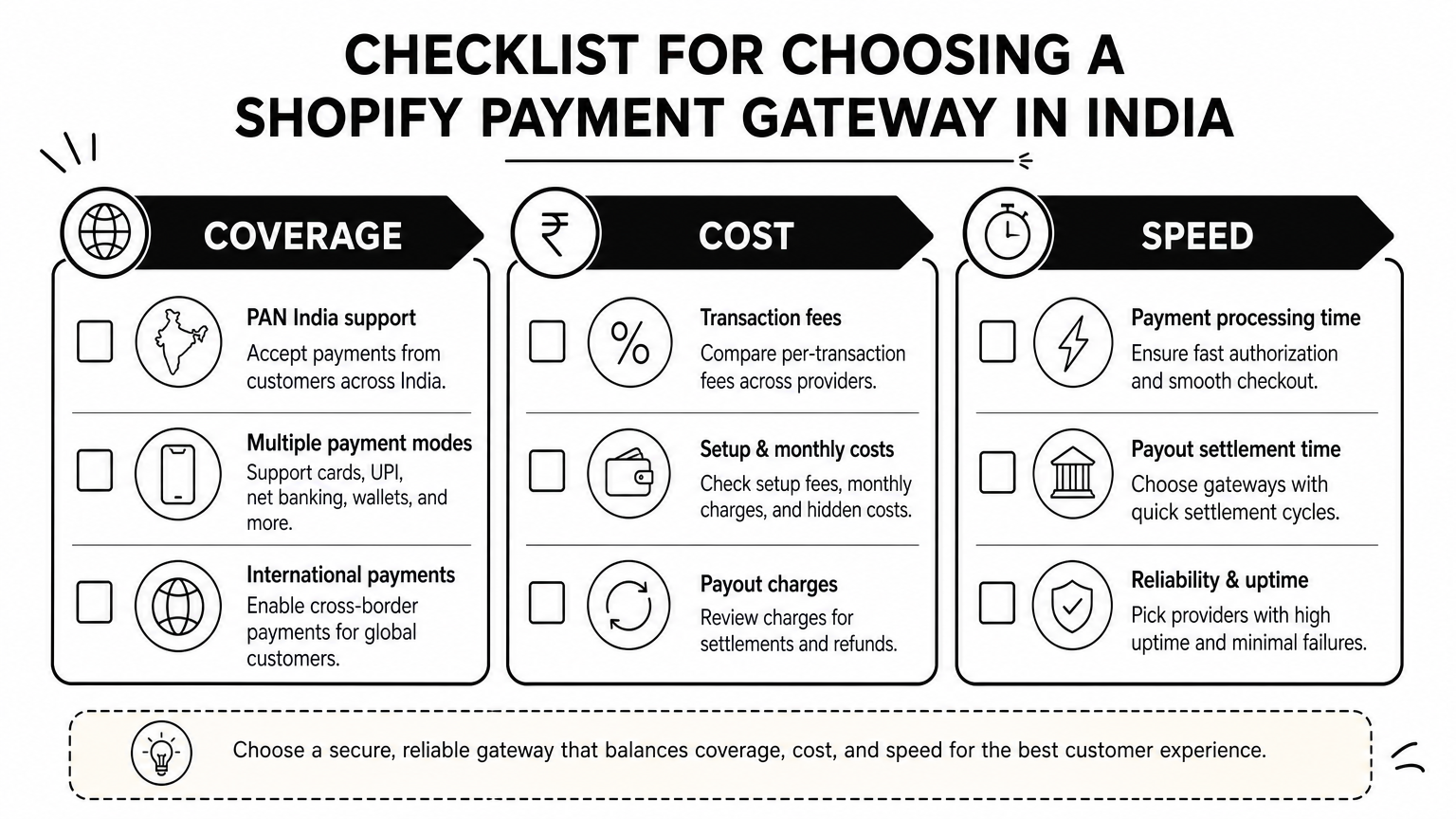
Settlement speed is the next filter. Some gateways settle in T+1 or T+2 days, others hold funds longer during your first few months while they build a risk profile on your account. If you're asking which payment gateway is best in India for Shopify, the honest answer depends on whether you need same-day cash flow or can tolerate a short settlement lag in exchange for lower fees.
The right gateway isn't the cheapest one on paper, it's the one that matches your volume, industry risk profile, and settlement needs without surprise holds.
Run through this checklist before signing up:
- Does it support your local payment methods (UPI, net banking, wallets)?
- What's the real settlement timeline, not just the advertised one?
- Does your industry get accepted without extra scrutiny?
- Are there hidden setup, refund, or chargeback fees pushing up the real payment gateway cost in India?
- Does it integrate directly with Shopify or require a workaround?
3. CoinPay
CoinPay takes a different approach than the other names on this list. Rather than competing purely on UPI and net banking rails, it specializes in USDT deposits and merchant payouts for merchants across Southeast and South Asian markets, India included. If you're running a Shopify store that serves customers paying in crypto, or you want a settlement layer that sidesteps some of the friction of traditional banking rails, CoinPay fills a gap Razorpay and Cashfree don't touch.

How it integrates with Shopify
CoinPay connects to Shopify through API integration handled during onboarding, alongside a structured merchant verification process. You'll go through KYC and due diligence checks before your account goes live, which takes longer than a self-serve app install but reflects five years of merchant payment operations spent screening out scam and money-game operators.
Payment methods supported
USDT and other stablecoin payments sit at the center of CoinPay's offering, with local coverage layered on depending on your market, including UPI, net banking and INR settlement for India.
Fees and pricing
Pricing is quoted per merchant based on volume, industry risk, and settlement currency rather than a flat published rate, so you'll need to talk to their team directly through CoinPay to get exact numbers for your store.
A shopify payment gateway india search rarely surfaces crypto rails, but for cross-border merchants, stablecoin settlement solves problems local UPI gateways simply can't.
Best for
Merchants handling cross-border deposits, gaming platforms, or any business wanting USDT settlement alongside traditional local rails.
4. Razorpay
Razorpay is the name most Indian founders reach for first when they need a shopify payment gateway india option, and for good reason: it's built specifically for the Indian market and processes billions in transactions annually for D2C brands.
How it integrates with Shopify
Installing Razorpay on your store takes minutes through the official Shopify app, which connects your Razorpay merchant account directly to checkout without custom code. Onboarding requires standard KYC documents (PAN, GST, bank account proof), and most straightforward retail businesses get approved within two to three business days.
Payment methods supported
Shoppers can pay via UPI, credit and debit cards, net banking, and wallets like Paytm and PhonePe, all from a single checkout screen. Razorpay also supports EMI options and Buy Now Pay Later providers, which matters for higher-ticket D2C brands.
Fees and pricing
Standard pricing runs around 2% per transaction for domestic cards and UPI, with international cards costing more, typically 3%. There's no setup fee for standard accounts, though larger merchants can negotiate custom rates once volume climbs.
For most Indian D2C stores, Razorpay's blend of UPI coverage and fast Shopify integration makes it the default starting point, not just one option among many.
Best for
Retail and D2C brands wanting the broadest local payment method coverage with minimal integration effort will find Razorpay the easiest gateway to get running on day one.
5. Cashfree Payments
Cashfree runs a close second to Razorpay for Indian merchants, and it's often the pick for stores that need faster settlement or more granular payout controls. Founded specifically to serve Indian businesses, Cashfree has built a reputation for handling high-volume marketplaces and subscription models that need automated split payments.
How it integrates with Shopify
Getting Cashfree onto your storefront works through its dedicated Shopify plugin, which links your merchant dashboard to checkout in a similar setup flow to Razorpay. Verification asks for the same core documents (PAN, GST, canceled cheque), and approval typically lands within two to four business days for standard retail categories.
Payment methods supported
Here's what Cashfree covers at checkout: UPI, debit and credit cards, net banking, and popular wallets, plus international card acceptance for stores selling beyond India. Subscription and recurring billing support comes built in, which few competitors offer natively.
Fees and pricing
Standard transaction fees sit around 1.95% to 2% for domestic cards and UPI, with no mandatory setup cost for new accounts. International transactions run higher, closer to 3%, and enterprise merchants can negotiate volume-based discounts.
Cashfree's edge isn't lower fees, it's settlement speed and payout automation for merchants managing recurring or split payments.
Best for
Subscription businesses and marketplaces needing automated payouts and faster settlement will get more out of Cashfree than a straightforward retail checkout gateway.
6. PayU
PayU has operated in India longer than most of its rivals, and that history shows up in its enterprise-heavy client base. Businesses running large catalogs or multi-region operations often lean on PayU because it handles high transaction volumes without the friction that smaller aggregators sometimes hit at scale.
How it integrates with Shopify
Connecting PayU to your storefront requires a bit more setup than Razorpay or Cashfree, usually through a third-party Shopify app or a custom API integration if you're on Shopify Plus. Onboarding documentation mirrors the standard KYC set (PAN, GST, business registration), but approval can stretch to three to five business days for merchants outside simple retail categories.
Payment methods supported
Checkout options include UPI, credit and debit cards, net banking, and wallets, alongside EMI and buy-now-pay-later plans for higher-ticket purchases. PayU also supports international payment acceptance, which suits stores selling to customers outside India.
Fees and pricing
Standard rates land around 2% per transaction for domestic cards and UPI, similar to Razorpay, with custom pricing available once volume justifies negotiation. International transactions typically cost more, often exceeding 3%.
PayU rewards merchants who already run at scale, but smaller stores may find the onboarding process slower than it needs to be.
Best for
Enterprise merchants and high-volume stores that need a proven processor and are willing to trade a slightly longer setup for negotiated rates.
7. CCAvenue
CCAvenue was one of India's first payment aggregators, and it still carries that legacy client base of large enterprises and government-linked merchants who never bothered switching. That history means deep payment method coverage, but also an interface and onboarding process that feels dated compared to newer entrants on this shopify payment gateway india list.
How it integrates with Shopify
Getting CCAvenue running on Shopify usually means installing a third-party connector app rather than a polished native plugin, since CCAvenue's own tooling wasn't built with Shopify's checkout flow in mind. Expect a longer setup window, often five to seven business days, plus more manual document review than Razorpay or Cashfree require.
Payment methods supported
Coverage is broad: UPI, cards, net banking, wallets, and a wide roster of regional banking partners that smaller gateways sometimes skip. CCAvenue also supports EMI and international cards, which suits merchants selling both domestically and abroad.
Fees and pricing
Standard domestic rates hover around 2% per transaction, with a setup fee that varies by business category, unlike most competitors on this list who've dropped upfront charges entirely.
CCAvenue's breadth of banking partnerships beats newer gateways, but that strength comes bundled with slower onboarding and a clunkier Shopify connection.
Best for
Enterprise merchants with existing CCAvenue relationships or those needing niche regional banking coverage that newer aggregators haven't built out yet.
8. Instamojo
Instamojo built its reputation on serving small businesses and solo founders who found Razorpay or Cashfree's onboarding too heavy for a side hustle. It's less common among larger Shopify stores now, but it still fills a real niche for merchants just starting out who want a simple payment link and checkout setup without much technical lifting.
How it integrates with Shopify
Instamojo connects to Shopify through a third-party app rather than a first-party plugin, and setup leans more on payment links than a fully embedded checkout. Verification asks for basic KYC (PAN, bank details), and approval usually comes through within one to three business days, faster than most enterprise-focused gateways on this list.
Payment methods supported
Shoppers can pay via UPI, cards, and net banking, with wallet support more limited than Razorpay or Cashfree offer.
Instamojo trades payment method breadth for a faster, lighter onboarding process, which suits new sellers more than established brands.
Fees and pricing
Standard transaction fees run around 2% to 2.5% per transaction, slightly higher than the bigger players, with no mandatory setup fee for standard accounts.
Best for
New and small-scale Shopify sellers testing their store before committing to a heavier, enterprise-grade gateway will find Instamojo the quickest option to get live.
9. PayPal for international sales
PayPal doesn't solve domestic UPI or net banking needs, but it fills a different gap: letting Indian Shopify merchants accept payments from overseas customers who trust PayPal more than an unfamiliar local gateway. If your store sells to buyers in the US, UK, or Europe alongside Indian customers, running PayPal beside a domestic gateway like Razorpay or Cashfree covers both audiences without forcing international shoppers through an unfamiliar checkout.
How it integrates with Shopify
Shopify includes native PayPal support as a built-in option in your payment settings, so activation takes minutes rather than an app install. You'll still need a verified PayPal Business account registered in India, which requires standard KYC and links to an Indian bank account for withdrawals.
Payment methods supported
Customers pay using their PayPal balance, linked cards, or bank accounts, and PayPal handles currency conversion automatically at checkout.
Fees and pricing
Cross-border transactions typically cost more than domestic gateways, often landing between 4% and 5% once you factor in currency conversion, plus a fixed fee per transaction that varies by country.
PayPal isn't cheap for domestic sales, but for cross-border trust and conversion, nothing else on this list matches it.
Best for
Exporters and international-facing D2C brands that need a familiar, trusted checkout option for customers paying from outside India.
Picking the right payment partner for your store
No single shopify payment gateway india option wins for every merchant. Razorpay and Cashfree cover most domestic retail needs with fast setup and broad UPI coverage. PayU and CCAvenue suit enterprises that need scale and negotiated rates over quick onboarding. Instamojo works for small sellers testing the waters, and PayPal fills the gap for cross-border trust.
But if your store handles cross-border deposits, gaming transactions, or customers who prefer stablecoin payments, a purely domestic gateway leaves money on the table. That's the gap CoinPay closes, pairing USDT settlement with the compliance rigor Indian merchants increasingly need as regulators tighten scrutiny on payment aggregators.
Start by matching your volume, industry, and settlement timeline against the checklist earlier in this guide, then test your top pick with real transactions before committing fully. If crypto settlement fits your business model, book a free demo with CoinPay to see how it runs alongside your existing gateway setup.