
6 Best Shopify Payment Gateways in Thailand for 2026
If you launched a Shopify store aimed at Thai customers, you already hit the wall: Shopify Payments doesn't operate in Thailand. That leaves you searching for a shopify payment gateway thailand shoppers actually trust, one that settles in THB and supports PromptPay, the payment method most Thai buyers reach for first at checkout. Without it, you're stuck with awkward workarounds or watching carts get abandoned at the payment step.
This guide answers that search directly. We looked at gateways that plug into Shopify, handle local currency settlement, and pass the kind of merchant verification standards Thai banks and card networks expect, not just generic global processors with Thailand tacked on as an afterthought.
Below you'll find six options for 2026, covering everything from established local acquirers to crypto-friendly gateways for merchants who also want USDT settlement. We break down onboarding requirements, supported payment methods, and where each provider fits based on your business type. If you run gaming, fintech, or e-commerce operations and need a partner who actually understands Thai payment infrastructure rather than just connecting an API, this comparison will save you weeks of trial and error.
1. CoinPay: local payment coverage with crypto settlement
CoinPay built its business around merchants that other gateways turn away, which makes it worth a look if your Shopify store has been rejected elsewhere or you need both PromptPay deposits and THB settlement for Thai merchants and stablecoin payments in one setup. Rather than acting as a plain API connector, CoinPay runs a hands-on onboarding process that screens for legitimate operations while rejecting scams and money-game schemes, so approved merchants get a partner that actually monitors payment performance instead of disappearing after go-live.

How it integrates with Shopify
CoinPay connects to Shopify through a custom payment integration built during onboarding, not a one-click app install. Their team maps your specific checkout flow, whether that's gaming top-ups, e-commerce carts, or fintech deposits, and configures the gateway to reduce friction at the exact steps where Thai customers usually drop off. This Thailand deposit flow case study style approach takes a bit longer upfront than installing a plugin, but it means your payment gateway is tuned to your actual customer journey before launch.
Payment methods supported
CoinPay covers the payment rails Thai shoppers expect plus crypto options most competitors skip entirely:
- PromptPay QR with direct THB settlement
- Local bank transfers across major Thai banks
- USDT and other stablecoin payments for merchants comparing fiat to crypto payment gateways
- Regional coverage extending into Vietnam, Shopify payment options in the Philippines, Malaysia, Bangladesh, India, and Indonesia if you expand beyond Thailand
A payment gateway that doubles as a compliance partner saves you more headaches than one that just processes transactions.
Pricing and fees
CoinPay doesn't publish flat-rate pricing because fees depend on your industry, transaction volume, and settlement currency. You'll get a custom quote after the verification stage, which includes the KYC and merchant review process behind CoinPay onboarding, typical of regulated Thai payment processing. This isn't the fastest path to a rate card, but it reflects the reality that gaming or fintech merchants carry different risk profiles than a standard online shop.
Best for
CoinPay suits merchants who need both traditional Thai payment methods and USDT settlement, particularly gaming platforms, fintech apps, or e-commerce operations that have struggled to get approved by mainstream processors. If ongoing merchant support and compliance guidance matter as much as the integration itself, CoinPay's payment gateway services are worth requesting a consultation for before you commit to a competitor.
2. Opn Payments: Thailand's homegrown payment gateway
Opn Payments, formerly known as Omise, is the closest thing Thailand has to a native payment processor built for online merchants. It's licensed by the Bank of Thailand and has served Thai businesses since long before Shopify made a serious push into Southeast Asia, which gives it a level of regulatory familiarity that international gateways struggle to match.
A gateway built inside the regulatory system it serves tends to handle edge cases better than one bolted on from outside.
How it integrates with Shopify
Opn offers a dedicated Shopify app that you install directly from the Shopify App Store, so setup takes minutes rather than weeks. You connect your merchant account, verify your business details, and the checkout integration goes live without custom development work.
Payment methods supported
Opn covers the core methods Thai shoppers use daily:
- Visa, Mastercard, and JCB credit and debit cards
- PromptPay QR
- Mobile banking apps from major Thai banks
- Installment payment plans through partner banks
Pricing and fees
Card transactions typically run around 3.65% per transaction, with PromptPay and bank transfers priced lower. Settlement lands in THB directly, and there's no long-term contract lock-in for standard accounts.
Best for
Opn suits standard e-commerce merchants selling straightforward products who want fast setup and don't need crypto settlement or specialized industry support.
3. Xendit: multi-country gateway for Southeast Asia
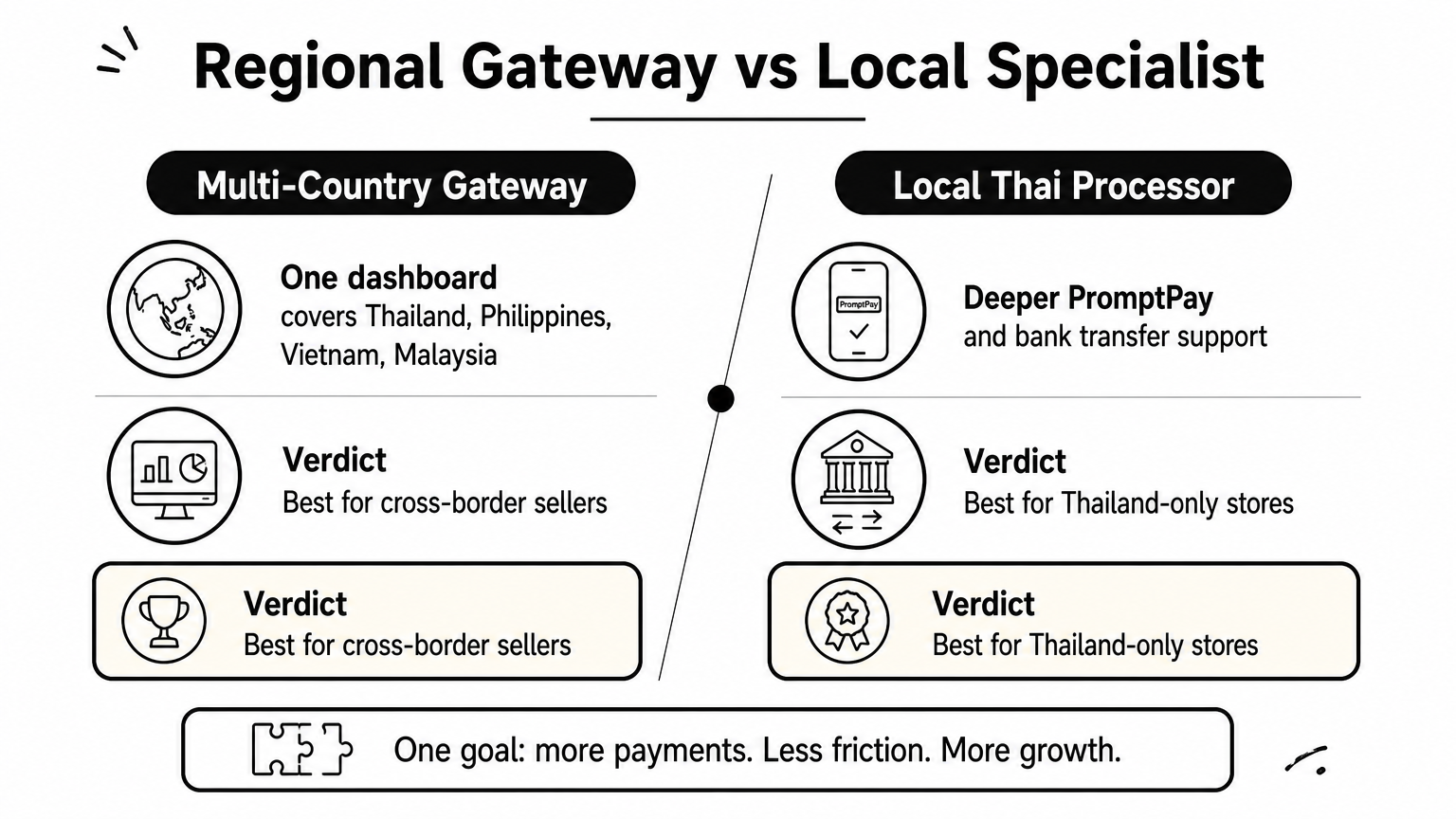
Xendit started in Indonesia and expanded across the region, so it now handles payments in Thailand, the Philippines, Vietnam, and Malaysia through one dashboard. That regional reach matters if your Shopify store sells to customers beyond Thailand, since you avoid juggling separate gateway contracts for each market.
How it integrates with Shopify
Xendit connects to Shopify through its API or a third-party plugin rather than a native app in the Shopify App Store. Developers on your team, or a freelancer familiar with Xendit's documentation, typically need a few days to wire up the checkout flow and test settlement across currencies.
Payment methods supported
Xendit's Thai coverage is narrower than dedicated local processors:
- Credit and debit cards (Visa, Mastercard)
- Bank transfers through Thai banks
- PromptPay QR (available but less refined than Opn's implementation)
- Regional wallets if you also sell into Indonesia or the Philippines
A gateway built for five countries at once rarely nails every local payment method as well as one built for a single market.
Pricing and fees
Xendit charges per-transaction fees that vary by payment method and country, generally in the 2.5% to 3.5% range for cards. There's no published flat rate for Thailand specifically, so you'll want a quote before committing, and settlement timing can run slower than local-only processors since funds route through Xendit's regional infrastructure.
Best for
Xendit fits merchants running Shopify stores across multiple Southeast Asian countries who want one integration instead of six, even if the Thailand-specific experience isn't the deepest option on this list.
4. 2C2P: enterprise-grade regional payment processor
2C2P has processed payments across Southeast Asia since 2003, and Thai enterprises use it more than any gateway on this list for high-volume operations. Banks, airlines, and large e-commerce brands rely on it, which tells you something about the regulatory track record behind the platform, even if the onboarding process feels heavier than what a small Shopify merchant expects.

How it integrates with Shopify
2C2P doesn't offer a plug-and-play Shopify app. You'll integrate through their API, usually with help from an in-house developer or a 2C2P-certified integration partner, since the setup process involves more configuration than Opn's App Store install. Expect a few weeks from application to live checkout, not days.
Payment methods supported
Coverage runs deep across the region:
- Cards (Visa, Mastercard, JCB, UnionPay)
- PromptPay QR and Thai bank transfers
- Installment plans through Thai banks
- Regional wallets across Vietnam, the Philippines, and Malaysia
Enterprise-grade infrastructure buys you reliability at scale, but it rarely buys you speed at launch.
Pricing and fees
Pricing is negotiated per merchant based on volume, so there's no public rate card. Expect volume-based discounts once you clear a few thousand transactions monthly, but smaller stores may find the minimum commitments steep compared to Opn or Xendit.
Best for
2C2P suits established brands with real transaction volume who need a shopify thailand payment gateway built for enterprise reliability rather than fast, self-serve setup.
5. LianLian Pay: cross-border payments for global sellers
LianLian Pay built its reputation helping Chinese and international sellers move money across borders, and that background shapes how it handles Thailand. Rather than positioning itself as a local specialist, it works as a cross-border settlement bridge, useful if you're running a Shopify store from outside Thailand but selling into the market and need funds to land back in USD, CNY, or another home currency instead of staying locked in THB.
How it integrates with Shopify
LianLian connects through API integration or a payment service provider partner rather than a native Shopify app, so you'll typically loop in a developer to configure the checkout connection. Setup leans toward merchants who already have technical resources, not solo store owners looking for a five-minute install.
Payment methods supported
Coverage in Thailand centers on cards and select local wallets rather than the full PromptPay ecosystem:
- Visa and Mastercard processing
- Limited PromptPay support depending on merchant category
- Cross-border settlement to USD, CNY, and other major currencies
- Multi-currency reporting across markets
A gateway built for moving money out of a country rarely matches one built to keep it flowing smoothly within it.
Pricing and fees
Pricing runs on negotiated merchant agreements tied to transaction volume and settlement currency, with no published flat rate for Thai transactions specifically. Expect additional fees for currency conversion if you settle outside THB.
Best for
LianLian Pay fits overseas sellers using Shopify to reach Thai customers who care more about repatriating revenue efficiently than about deep local payment method coverage.
6. Stripe: a global option with limited Thai coverage
Stripe powers checkout for millions of stores worldwide, and its Shopify integration is about as smooth as they come, but Thailand sits outside Stripe's list of supported countries for local business registration. That means Thai-registered merchants can't open a standard Stripe account, so this option only works if you incorporate elsewhere, typically Singapore, the US, or the UK, and use that entity to accept payments from Thai customers.
How it integrates with Shopify
Stripe connects to Shopify natively through Shopify Payments infrastructure in supported countries, or through the Stripe app for merchants routing payments via a foreign entity. Setup takes minutes once your business entity qualifies, since Stripe's documentation and developer tools are the most polished on this list.
Payment methods supported
Stripe's Thailand-facing coverage stays limited to international rails rather than local ones:
- Visa, Mastercard, and Amex cards
- Apple Pay and Google Pay
- No native PromptPay or Thai bank transfer support
A gateway with the smoothest developer experience still fails Thai shoppers if it can't take PromptPay.
Pricing and fees
Stripe charges around 3.4% plus a fixed fee per transaction for international cards, with additional currency conversion costs when settlement currency isn't THB.
Best for
Stripe suits merchants with a foreign business entity who sell to Thai customers as a secondary market and don't need deep local payment method coverage or PromptPay support.
Finding the right fit for your Thai store
Picking a shopify payment gateway thailand shoppers will actually use comes down to matching the gateway to your business, not chasing the biggest name, and it helps to weigh it against the wider field of payment gateway providers serving Thai merchants. Opn wins on fast setup for standard e-commerce. 2C2P suits enterprise volume. Xendit and LianLian make sense if your operations stretch across borders. Stripe only works once you've solved the entity problem.
But if your business has faced rejection elsewhere, needs both PromptPay and USDT settlement, or operates in gaming and fintech where compliance scrutiny runs higher, CoinPay's hands-on onboarding and regional coverage across Thailand and six other Asian markets solves problems the plug-and-play options can't touch.
Don't guess your way through another failed integration. Book a free consultation with CoinPay's team and get a straight answer on whether your Shopify store qualifies before you spend another week troubleshooting checkout drop-off.