
5 Best Payment Gateway Providers in Thailand for 2026
If you're selling into Thailand, you already know the problem: Thai shoppers overwhelmingly prefer PromptPay, mobile banking apps, and local cards over international credit cards, so a generic checkout built for Western markets quietly kills your conversion rate. Picking a thailand payment gateway isn't just a technical integration decision, it's what decides whether a Thai customer actually completes a purchase or abandons the cart at the payment page.
This guide answers the question directly: which providers actually deliver reliable local settlement, PromptPay support, and card acceptance for merchants operating in Thailand right now. We looked at settlement speed, compliance requirements, and how each provider handles onboarding for businesses that need to go live fast without tripping over KYC delays or rejected applications.
Below, you'll find our list of the 5 best payment gateway providers in Thailand for 2026, covering everything from card processing to stablecoin and USDT options for merchants who need alternatives to traditional banking rails. We break down onboarding requirements, supported payment methods, and where each provider fits best, whether you're running e-commerce, gaming, or a fintech platform expanding into the Thai market.
1. CoinPay
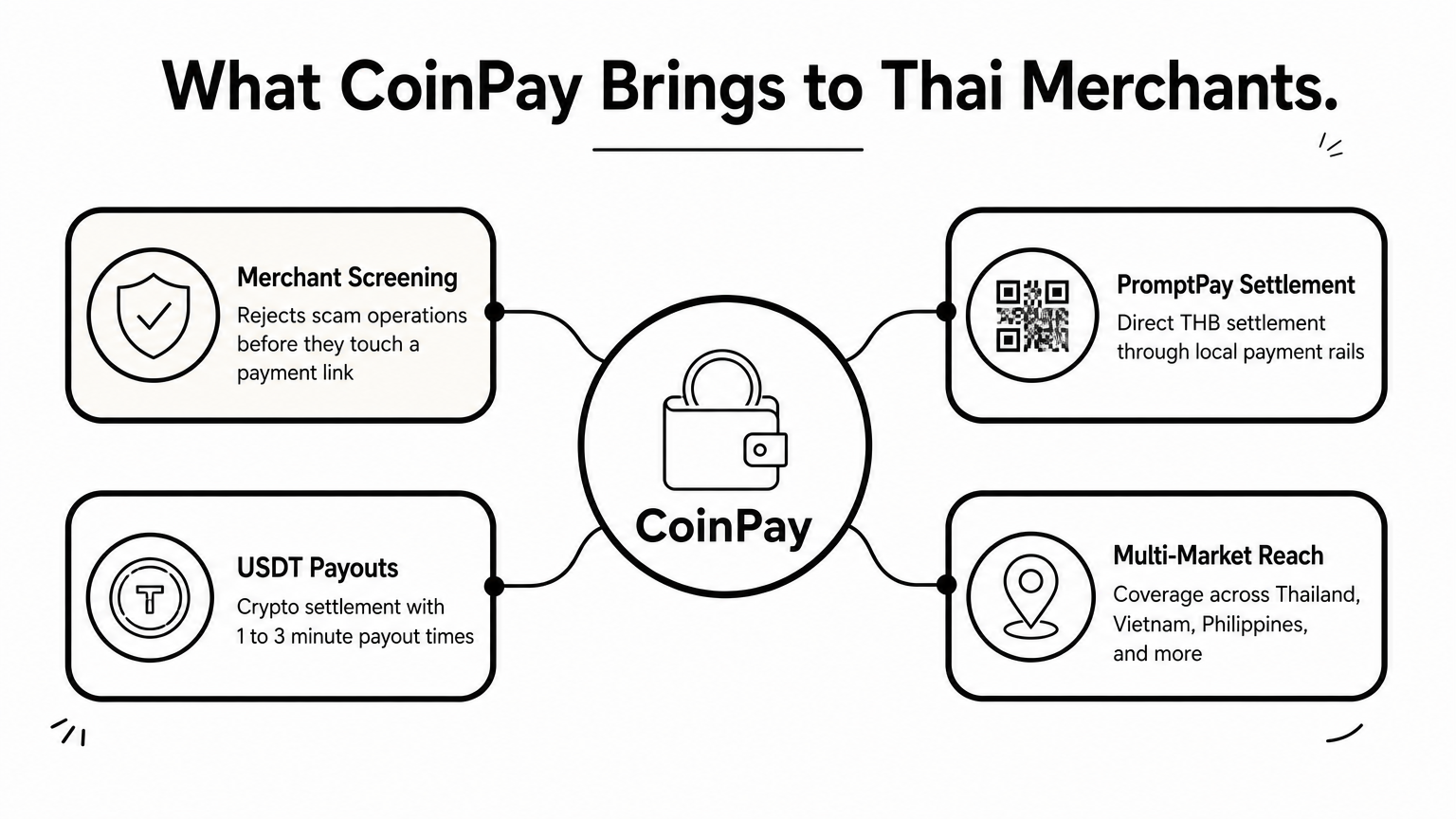
CoinPay tops this list because it treats Thailand as a market to understand, not just a currency to process. The company runs a merchant-first onboarding process built around merchant onboarding, KYC review and post-launch support, rejecting scam operations and money-game schemes before they ever touch a payment link. That screening matters if you're a legitimate merchant, because it keeps CoinPay's settlement rails clean and reduces the compliance flags that slow down payouts for everyone else on a shared processor.
How it works
Merchants apply through a structured verification flow, submit business documentation, and get matched to a payment setup organized around their specific journey and settlement needs. Once approved, you get access to PromptPay and THB settlement, plus a dedicated support contact instead of a ticket queue.
A payment gateway is only as reliable as the merchant screening standing behind it.
Key features
- Five years of operating history across Thailand, Vietnam bank transfer and e-wallet deposits, the Philippines, Malaysia, Bangladesh, India, and Indonesia
- Local payment method coverage per market, including PromptPay for Thai baht settlement
- Separate USDT deposits and withdrawals with 1-3 minute payouts for merchants who want a crypto settlement option
- Ongoing performance monitoring and consulting-style support to reduce deposit friction after you go live, documented in Thailand deposit flow rebuilds
Who it's for
CoinPay suits e-commerce, gaming, and fintech merchants who need a payment gateway in Thailand with hands-on support rather than a self-service dashboard, especially businesses expanding into multiple Southeast and South Asian markets at once.
Pricing
CoinPay doesn't publish flat rate cards, since pricing depends on your industry risk profile, transaction volume, and settlement currency. Reach out directly through CoinPay to get a quote matched to your business.
2. Stripe
Stripe is the default answer many founders reach for when they think online payment gateway Thailand, mostly because it's already the name they know from building products elsewhere. It's a solid engineering-first platform, though Thailand support sits behind its global infrastructure rather than in front of it.
How it works
Developers integrate Stripe through its API or prebuilt checkout elements, and Thai baht transactions settle through Stripe's international processing rather than a dedicated local rail. That works fine for card payments, but PromptPay support is limited compared to gateways built specifically for the Thai market.
A global gateway can process Thai transactions without actually understanding Thai payment behavior.
Key features
- Extensive developer documentation and SDKs
- Card processing across major international networks
- Some PromptPay and local payment method support, though narrower than local providers
- Strong fraud detection tooling built into the platform
Who it's for
Stripe suits software-first teams with in-house developers who need international card acceptance alongside Thailand, not merchants relying primarily on local payment methods.
Pricing
Stripe charges a standard percentage plus fixed fee per transaction, with rates varying by card type and currency, published openly on its site.
3. GB Prime Pay
GB Prime Pay is a Thai payment gateway provider built specifically for the domestic market, which shows in how deep its local rail coverage runs. It's a common pick among merchants who searched a thailand payment gateway list and wanted a name headquartered in Bangkok rather than routed through a foreign parent company.
How it works
Merchants integrate through GB Prime Pay's API or hosted checkout page, and transactions settle directly into a Thai bank account. The gateway handles PromptPay, bank transfers, and card payments through a single dashboard, so you're not stitching together multiple providers for different payment methods.
Local infrastructure usually beats global brand recognition when the goal is Thai customer conversion.
Key features
- Native PromptPay and QR code payment support
- Thai and international card acceptance
- Installment payment options for higher-ticket purchases
- Bangkok-based support team
Who it's for
GB Prime Pay fits domestic Thai merchants and regional businesses that need strong local rail coverage without heavy international card volume.
Pricing
Rates are quoted per merchant based on industry and volume, available directly through GB Prime Pay's sales team.
4. TrueMoney
TrueMoney built its reputation as a Thai e-wallet before it became a payment gateway providers Thailand option for merchants, and that wallet-first history still shapes how it processes transactions today. Millions of Thai consumers already hold a TrueMoney Wallet balance, so accepting it as a payment method taps into spending habits that predate most online checkout flows.

How it works
Customers pay by scanning a QR code or authorizing a transfer straight from their TrueMoney Wallet app, and funds settle to the merchant account without routing through a traditional card network. Merchants integrate via API or a hosted payment page, similar to other online payment gateway Thailand setups.
A wallet-based payment method converts best when your customers already trust the wallet.
Key features
- TrueMoney Wallet acceptance alongside standard card processing
- QR code payments popular with younger, mobile-first Thai shoppers
- Bill payment and top-up integrations for platforms needing recurring collection
- Wide retail partner network for cash top-ups
Who it's for
Merchants targeting younger, mobile-first Thai consumers, particularly in gaming, retail, and telecom-adjacent services, get the most value here.
Pricing
TrueMoney negotiates rates per merchant agreement, quoted after an application review.
5. ChillPay
ChillPay rounds out this list as a 2D payment gateway in Thailand built for merchants who want fast setup without a heavy compliance runway upfront. It's popular with smaller e-commerce shops and SME sellers who need to start collecting payments quickly rather than negotiate a custom enterprise contract.
How it works
Onboarding runs through a straightforward application, and once approved, merchants get a hosted checkout page or API integration that supports card payments, PromptPay, and bank transfers in a single flow. Settlement lands in a Thai bank account on a set schedule, which keeps cash flow predictable for smaller operations.
Simplicity in setup matters most for merchants who don't have a dedicated payments team.
Key features
- 2D and 3D card processing options
- PromptPay QR code acceptance
- Installment plans for select card issuers
- Self-service merchant dashboard for transaction tracking
Who it's for
ChillPay suits small to mid-sized Thai merchants who want quick onboarding and don't need multi-market coverage or crypto settlement options.
Pricing
ChillPay publishes tiered rate estimates on request, with final pricing depending on transaction volume and industry category.
Finding the right fit for your business
Each provider on this list solves a different problem. Stripe wins on developer tooling if you're already global. GB Prime Pay and ChillPay work well for merchants who need domestic Thai rails without much fuss. TrueMoney captures wallet-first shoppers. But if you're expanding across Thailand and neighboring markets, need both PromptPay and USDT settlement, and want a partner who actually screens merchants instead of processing anything that shows up, CoinPay is built for that job specifically.
Getting a thailand payment gateway decision right means matching the provider to your customer base, not just your tech stack. Look at where your buyers already pay, check settlement speed against your cash flow needs, and confirm the onboarding process won't stall your launch.
If hands-on support and regional coverage matter more than a self-service dashboard, see how CoinPay handles PromptPay deposits and THB settlement in Thailand before you commit to an integration.