
UPI Payment Gateway in India: How It Works, Fees, and Setup
If you want to sell to Indian customers, you need to accept UPI. It now handles most digital payments in the country, and shoppers expect to pay with a single tap from their banking app. A UPI payment gateway in India is the layer that connects your checkout to that network, so you can collect money from any UPI app and reconcile it in your own account.
Here is the short answer. A gateway generates a payment request through a QR code, intent link, or collect request. The customer approves it with a PIN, the bank confirms, and the gateway reports the result to you and settles the funds. Fees and settlement terms vary a lot between providers, and integration depth decides how many failed payments you will see.
This guide walks through how the flow works step by step, what you will actually pay, and which setup options exist, from hosted pages to API integration. We also cover merchant verification and KYC, because at CoinPay we review every merchant closely and have supported payments across South and Southeast Asia for five years.
Why UPI payment gateways matter for Indian merchants
UPI is the default way India pays
UPI is run by NPCI and now moves more than 16 billion transactions a month. Most are small, everyday payments, which is exactly what online merchants sell. Many of your shoppers have a UPI app but no credit card, so a checkout without UPI turns away real buyers. A UPI payment gateway fixes that.
Without a gateway, you can still share a static QR code. That works for a corner shop. It breaks down online, because you cannot match payments to orders automatically and every refund becomes a manual chore.
A UPI gateway turns a payment into a confirmed, reconcilable order, not just money landing in a bank account.
What a gateway adds to your operations
Beyond collecting money, a gateway gives you the tools a growing business needs. You get real-time payment status and automated reconciliation, which means your team stops checking bank statements by hand. In practice, the gains look like this:
- Instant status callbacks, so orders ship without manual checks
- Settlement reports that tie each payout to specific orders
- Refunds and disputes handled from one dashboard
- Success-rate monitoring across banks and UPI apps
Failed payments are the hidden cost. A weak integration can lose a meaningful share of attempts to timeouts and bank downtime, so provider quality shows up directly in revenue. That is why the choice of gateway matters more than the checkbox that says "UPI accepted."
How a UPI payment gateway works behind the scenes
The five-step payment flow
Every payment follows the same path between your checkout and the customer's bank. The gateway sits in the middle, translating requests and confirmations in both directions. Here is the sequence on a typical UPI payment gateway in India:
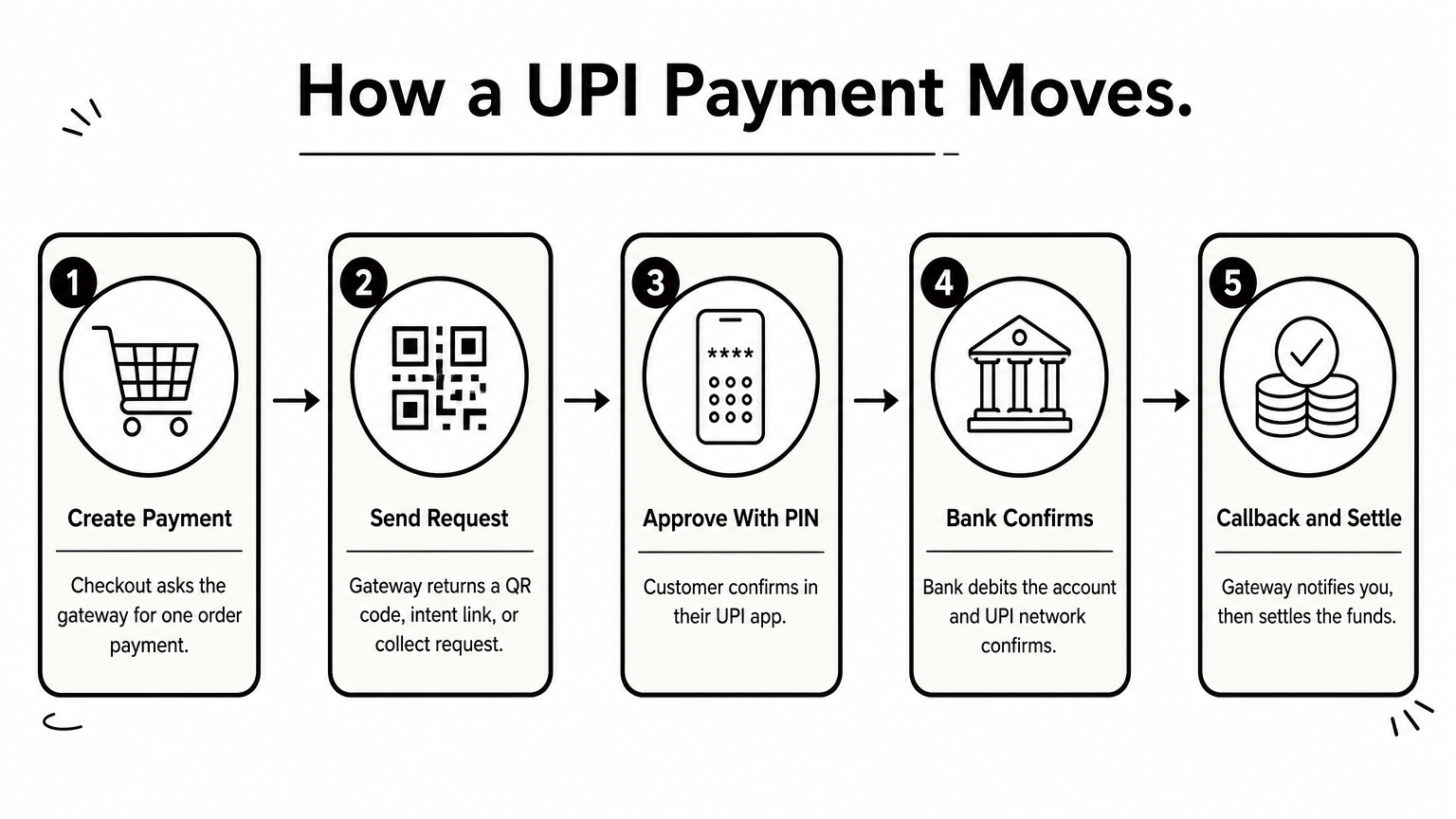
- Your checkout asks the gateway to create a payment for one order.
- The gateway returns a QR code, intent link, or collect request.
- The customer opens a UPI app and approves with a PIN.
- The bank debits the account and the UPI network confirms.
- The gateway sends you a callback, then settles the funds.
Where the flow breaks
Step four is where most problems start. Customers close the app early or lose signal, so the browser redirect is not proof of payment. Wait for the server-to-server callback, then confirm the status through the gateway's API.
Ship the order only after your server confirms the payment, never on a browser redirect.
Settlement runs separately from collection. Most providers pay out on T+1 settlement, meaning the next business day, and send reconciliation reports that match each payout to your orders.
How to set up a UPI payment gateway for your business
Prepare your business for verification
Setup starts with paperwork, not code. To go live with a UPI payment gateway in India, expect to submit business registration and KYC documents before live payments switch on. Reviews usually take a few days.

- PAN of the business and its directors
- GST registration or proof of incorporation
- Current bank account in the business name
- Live website with refund policy, terms, and contact details
Reputable providers reject scams and money games, which works in your favor. A screened merchant network also lowers the risk of sudden account freezes.
Choose an integration method and test it
Hosted checkout is the fastest route. You send customers to the provider's payment page and launch in days with little development. API integration takes longer, but gives you full control over the intent flow on mobile.
| Option | Best for | Effort |
|---|---|---|
| Payment link | Small sellers, invoices | None |
| Hosted page | Fast launch | Low |
| API | Apps, high volume | Medium to high |
Before launch, run test payments in the sandbox. Simulate failed payments, expired requests, and duplicate callbacks, not just successes.
Test every failure path before go-live, because your customers will find them first otherwise.
UPI gateway fees and what drives the cost
What you actually pay
Zero MDR has applied to UPI merchant payments under government policy since 2020, so the network does not charge you a percentage. Gateways still price their service, though, so compare gateway fees in India closely. Quotes on a UPI payment gateway in India range from free to a small per-transaction fee, and rules can change, so confirm current terms.
| Fee type | What to ask |
|---|---|
| Setup | One-time charge or waived? |
| Per transaction | Flat amount or percentage? |
| Refunds | Is the original fee returned? |
| Settlement | Is T+1 free, and what does instant cost? |
| Tax | GST is added on gateway fees |
What pushes the price up
Several factors move the quote. Monthly volume earns better rates, while instant settlement and dedicated support cost extra. Risk matters too. Gaming and fintech merchants usually pay more than a fashion store, because the provider carries more compliance work.
Hidden costs deserve a hard look. Check for minimum monthly commitments and dispute handling charges before you sign. A cheap rate with a weak success rate costs you more in lost orders than a higher rate that converts.
Compare the total cost per successful payment, not the headline rate.
How to compare and choose a UPI gateway provider
Score providers on what affects revenue
Start with UPI success rates. Ask every provider for the last 90 days, split by bank and app. A vendor who cannot share them is guessing. Then compare the rest side by side when you shortlist a UPI payment gateway provider:
| Criterion | What good looks like |
|---|---|
| Success rate | Shared and tracked by bank and app |
| Settlement | T+1 standard, instant optional |
| Integration | Sandbox, clear docs, intent support |
| Support | Named contact, fast replies |
| Compliance | Transparent KYC, screened merchants |
Test support and fit before you commit
Next, judge the people, not the brochure. Send a technical question during evaluation and note how fast a real person answers. Slow replies before signing mean slower fixes after launch. Also confirm the provider's merchant screening standards, since a lax network raises your own freeze risk.
The best provider is the one that still answers quickly when your payments fail.
Finally, run a small pilot with real transactions for two weeks. Compare success rate and settlement timing against the sales promise before you move full volume.
Choosing the right UPI setup
A UPI payment gateway in India does more than let customers tap and pay. It turns each payment into a confirmed order, and that quality shows up in your revenue. Start with verified success rates and the total cost per successful payment, not the headline fee.
Then match the setup to your stage. A payment link or hosted page gets small sellers live in days, while API integration suits apps and high-volume checkouts. Whichever you pick, test the failure paths, wait for the server callback, and run a pilot before moving full volume.
Finally, choose a partner who stays reachable after launch. At CoinPay, we screen merchants strictly and support them well beyond integration. If you want to see how that would work for your business, book a free demo with our team and we will walk you through your options.