
Vietnam Online Payment Report: Key Data and What It Means
A Vietnam online payment report is a structured look at how people and businesses in Vietnam pay online: how big the market is, how fast it grows, which methods win, and how much users trust them. The short version of the current data is that volumes are growing fast. E-wallets lead online checkout at roughly 31% of e-commerce payments, cards and bank transfers follow, and fear of fraud is the main thing holding adoption back.
This article puts figures from several reports side by side and explains why they disagree. It then shows how to turn them into decisions about checkout, settlement, and security. You also get a short checklist for judging any report before you rely on it.
CoinPay has five years of experience running payment gateway services for merchants across Southeast and South Asia, Vietnam included. So we read these reports the way an operator does, looking for what changes a customer's deposit journey.
Why a Vietnam online payment report matters
A Vietnam online payment report matters because its numbers decide which methods you offer, what volumes you plan for, and where customers drop out. Merchants who skip the data tend to build checkout around international cards, and in Vietnam that is the wrong starting point.
The headline numbers
Market-size figures vary widely because each source measures a different slice of the market. This table sets the most cited ones side by side.

| Measure | Figure | Source type |
|---|---|---|
| Mobile payments market | USD 83.02 billion by 2031, 9.73% CAGR | Market research forecast |
| Digital payment transaction value | Over USD 45 billion in 2028 | Statistics forecast |
| B2C e-commerce | USD 13 billion, rising to USD 24 billion by 2027 | Payments industry data |
| Non-cash payments, 2024 | Volume up 43.32%, value up 24.23% | State Bank of Vietnam data |
| Adults with a bank account | 42% in 2023, up from 31% in 2014 | Banking statistics |
| Buy now, pay later | About USD 2.6 billion in 2025 | Market forecast |
Read the 2024 line closely. Volume grew faster than value, which points to more payments of smaller size. That is the pattern you expect when everyday purchases move from cash to QR codes and wallets. Also, more than half of adults had no bank account in 2023, so part of this growth comes from wallets reaching people that banks have not.
Vietnam's payment growth is driven by many small digital payments, not a few large ones.
Which methods shoppers actually use
One widely cited breakdown of online checkout in Vietnam looks like this.
| Method | Share of online payments |
|---|---|
| E-wallet | 31% |
| Card | 27% |
| Bank transfer | 21% |
| Cash | 18% |
| Other | 3% |
Cards look strong at 27%, but the detail matters. Only about 4% of the population holds a credit card, and local card schemes account for 87% of card payments, against 7% for Visa and 6% for Mastercard. A checkout that accepts only international cards therefore misses most of the market.
How to turn the data into a payment setup
You turn the data into a payment setup in three moves: cover the methods that carry the volume, price and settle in Vietnamese dong, and measure success rates every month.
Cover the methods that carry the volume
Work down this list in order.
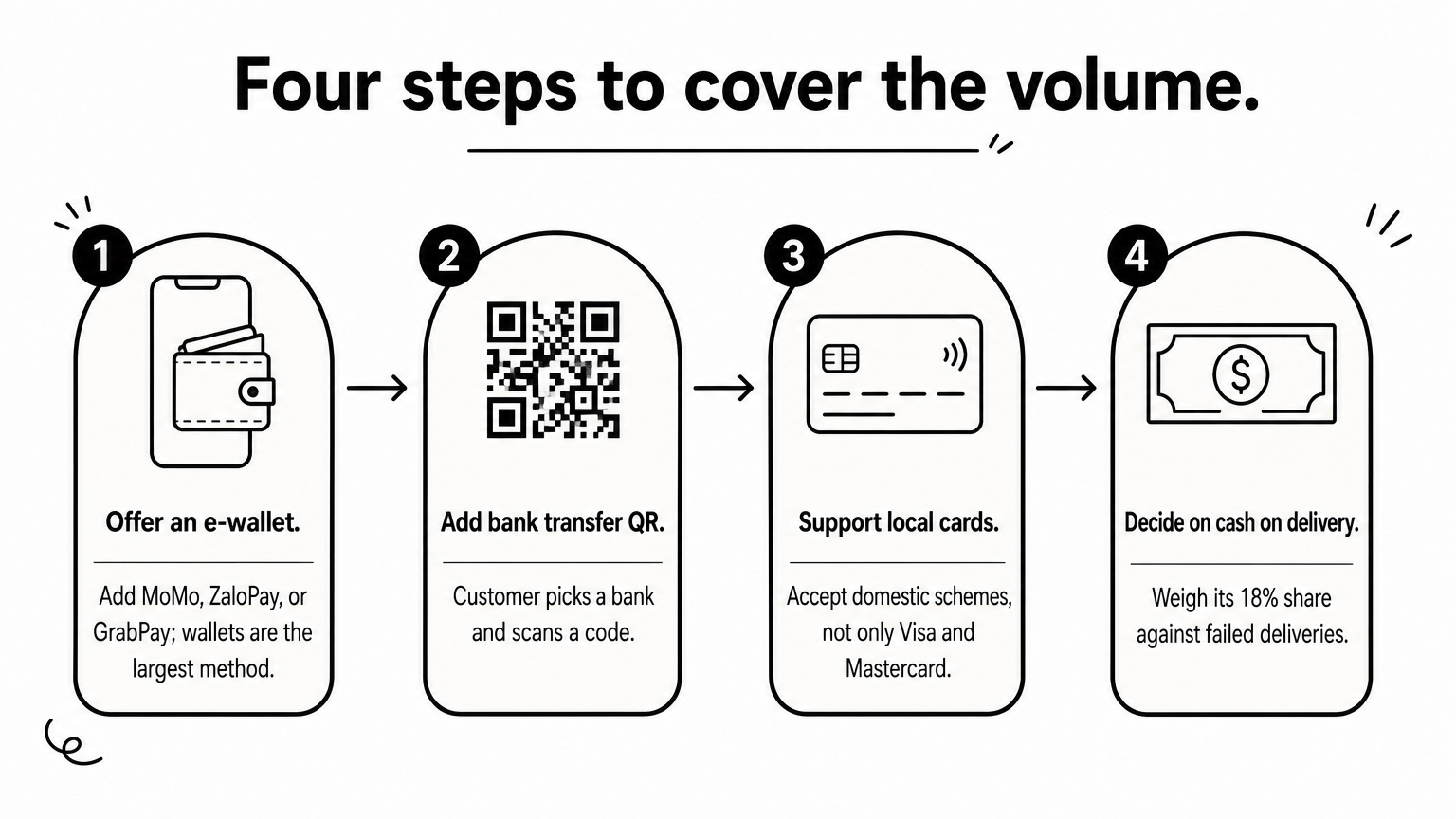
- Offer at least one major e-wallet. MoMo, ZaloPay, and GrabPay are the names that recur in market reports, and wallets are the largest single method.
- Add bank transfer with QR. The customer picks a bank and pays by scanning a code or entering the bank details shown.
- Support local cards, not only Visa and Mastercard.
- Decide on cash on delivery case by case. It still holds 18% of online payments, but it adds failed deliveries and manual reconciliation.
Design for phones first. About 51% of Vietnamese online purchases happen on a mobile device, and more than 69 million people own a smartphone. If you sell from abroad, quote prices in dong. Currency conversion usually costs 1% to 3%, and the government prohibits cryptocurrencies as a form of payment, so customers pay in dong.
Benchmark speed and success rate
Speed benchmarks give you something concrete to hold a Vietnam payment gateway provider to. These are the timings for CoinPay's Vietnam services.
| Service | Whole process | Submit to deposit complete |
|---|---|---|
| Bank & QR Deposit | 13.75s | 7.85s |
| Vietnam E-Wallet Deposit | 13.45s | 7.55s |
| Bank Transfer Payout | 1 to 3 minutes processing | Not applicable |
Both deposit flows finish in well under 15 seconds, so speed is rarely the problem. The share of started payments that finish is the metric that moves revenue. Ask every provider for a monthly success-rate report. CoinPay produces one for each merchant it works with. As an illustration, if 10,000 customers start a deposit in a month and 9,200 complete it, your success rate is 92%. Lifting it to 94% recovers 200 payments without any new traffic.
Track how many started payments finish, because that number matters more than raw speed.
What the report data says about trust and security
Trust is the main brake on adoption. A Visa-commissioned study published in January 2026 found that 52% of Vietnamese consumers and 43% of small businesses worry about fraud, scams, or misdirected payments.
Fraud fears and refund confusion
The same study surveyed 5,500 consumers and 2,100 small businesses across six Southeast Asian markets. It found that 34% of Vietnamese consumers hold back because they struggle to track a transfer or understand how refunds work. That is a checkout design problem as much as a security problem.
The fixes are practical. Show payment status in real time and send confirmation by SMS or app notification. Publish your refund rules before the customer pays. Use one-time passwords or two-factor authentication where the flow allows it. Businesses seem ready for this: 94% of small businesses in the study already accept real-time payments in store, and 66% are very interested in using payment data to strengthen security and credit scoring.
Most payment anxiety in Vietnam comes from not knowing where the money went, so show customers where it is.
Rules and screening that shape your setup
The State Bank of Vietnam is the central bank and primary payments regulator. Its Circular 23/2019 sets rules for cashless payment activity, including payment gateways and intermediary services. Treat this as general information, not legal advice, and confirm licensing and tax questions with Vietnamese counsel.
Provider screening is the other half of trust. A gateway that lets deceptive merchants onto its rails raises fraud and dispute noise for everyone on them. That is why CoinPay reviews company information, ownership, identity, and business activity, and declines money-game and misleading investment models.
How to judge a Vietnam payment report before you use it
Judge a report on four things: what it measures, when it was published, who paid for it, and whether it fits your business. A report that fails two of these should not drive a budget.
Four checks before you rely on a number
- Scope. The USD 83.02 billion mobile payments forecast and the USD 13 billion e-commerce figure are not in conflict. One covers the whole mobile payments market, the other covers online consumer shopping.
- Date and type. Separate actuals from forecasts. Buy now, pay later projections range from about 37% to almost 42% annual growth depending on the source.
- Source. Central bank data records what happened. A commissioned study, like the Visa one, measures attitudes and may cover several countries at once.
- Fit. Consumer surveys tell you what customers fear. They do not tell you whether your own flow converts.
Where primary data lives
Use secondary reports to find leads and primary sources to confirm them. The State Bank of Vietnam publishes payment statistics, and the World Bank's Global Findex tracks account ownership over time. Your own gateway data, such as success rate by method and by bank, is the most useful source of all. A report describes the market, but your logs describe your customers.
Use reports to choose what to test, then let your own payment data settle the question.
Using the data in your own checkout
The main finding is simple. Vietnamese online payment runs on e-wallets, bank transfers with QR codes, and local cards, and it grows through many small mobile payments. The biggest barrier is trust, not technology. Treat reports as a map of that market, check what each figure measures, and confirm against your own success-rate data.
If you sell to customers in Vietnam and want deposits and payouts set up around these methods, you can schedule a free demo call with CoinPay. We will walk through your payment journey and show you what to measure first.