
What Is an INR Payment? Meaning, Process, and INR vs. USD
You searched what is INR payment, and the short answer depends on context. In finance, INR is the code for the Indian Rupee, so an INR payment is money sent or received in rupees. In medicine, INR means International Normalized Ratio, a blood-clotting test. This article focuses on the payment meaning and briefly covers the medical one so you can confirm you found the right answer.
An INR payment is a transaction settled in Indian Rupees, usually through local rails such as UPI, bank transfers, or net banking. Paying in USD is different. The payer's bank converts currency, adds a foreign exchange margin, and often takes longer to settle. Paying in INR avoids conversion at checkout, which tends to improve approval rates and lets customers use methods they already trust.
Below, you will see how an INR payment moves from customer to merchant, how it compares with USD on cost, speed, and customer experience, and where the blood-test meaning fits. At CoinPay, we help merchants accept local payments across South and Southeast Asia, including India, so we focus on what matters when you run a business and need to get paid.
Why INR payments matter for global businesses
A market built around local rails
The question "what is INR payment" is really a question about how Indian customers choose to pay. UPI processes billions of transactions every month, and shoppers use it for everything from groceries to software subscriptions. They scan a QR code or approve a request in an app, and the money moves in seconds.

Foreign cards fit this habit poorly. Credit card use is still limited in India, and many debit cards are not enabled for international purchases. Customers who see a USD price often hit a decline or abandon the cart before they even try.
If your checkout only accepts USD, you are asking Indian customers to pay in a way most of them do not use.
What accepting INR changes for your business
Offering INR payments turns checkout from a hurdle into a routine step. Customers see a rupee price and pick a method they already trust. Fewer steps and fewer surprises usually mean more completed orders.
Here is what merchants typically see after adding local INR payment options:
- Higher approval rates. Domestic transactions are not flagged as cross-border by issuing banks, so fewer get declined.
- Better conversion. A clear rupee price removes the mental math and the fear of hidden exchange fees.
- Faster confirmation. UPI and net banking confirm in seconds, which helps deposit flows, top-ups, and instant-delivery products.
- Simpler refunds. You refund the same rupee amount, so exchange rate swings do not change what the customer gets back.
The cost of staying USD-only
Staying with USD looks simpler, but the hidden cost is the customers you never see. They do not complain. They leave. For e-commerce, gaming, and fintech platforms, where speed and trust drive repeat deposits, that gap compounds every month.
Accepting INR is not free of work, though. You take on settlement decisions, fees, and compliance duties that differ from card payments in dollars. Those are covered below, but the trade is usually worth it for any business that expects meaningful revenue from India.
How to make and receive an INR payment
To see what is INR payment in practice, follow one order from checkout to payout. The customer's side takes seconds. The merchant's side has a few more steps, and each one affects how quickly you get paid.
Paying in rupees as a customer
Most Indian shoppers pick UPI at checkout. They scan a QR code or enter a UPI ID, approve the request with a PIN in their banking app, and see a confirmation almost immediately. Because the price and the debit are both in rupees, no currency conversion happens on the customer's side.
| Method | How the customer pays | Typical confirmation |
|---|---|---|
| UPI | QR code or app approval | Seconds |
| Net banking | Logs in to their bank | Seconds to minutes |
| Debit or credit card | Enters card details | Seconds |
Receiving rupees as a merchant
Merchants do not collect rupees directly from thousands of banks. A payment gateway sits in the middle and handles collection, confirmation, and settlement. The usual flow looks like this:
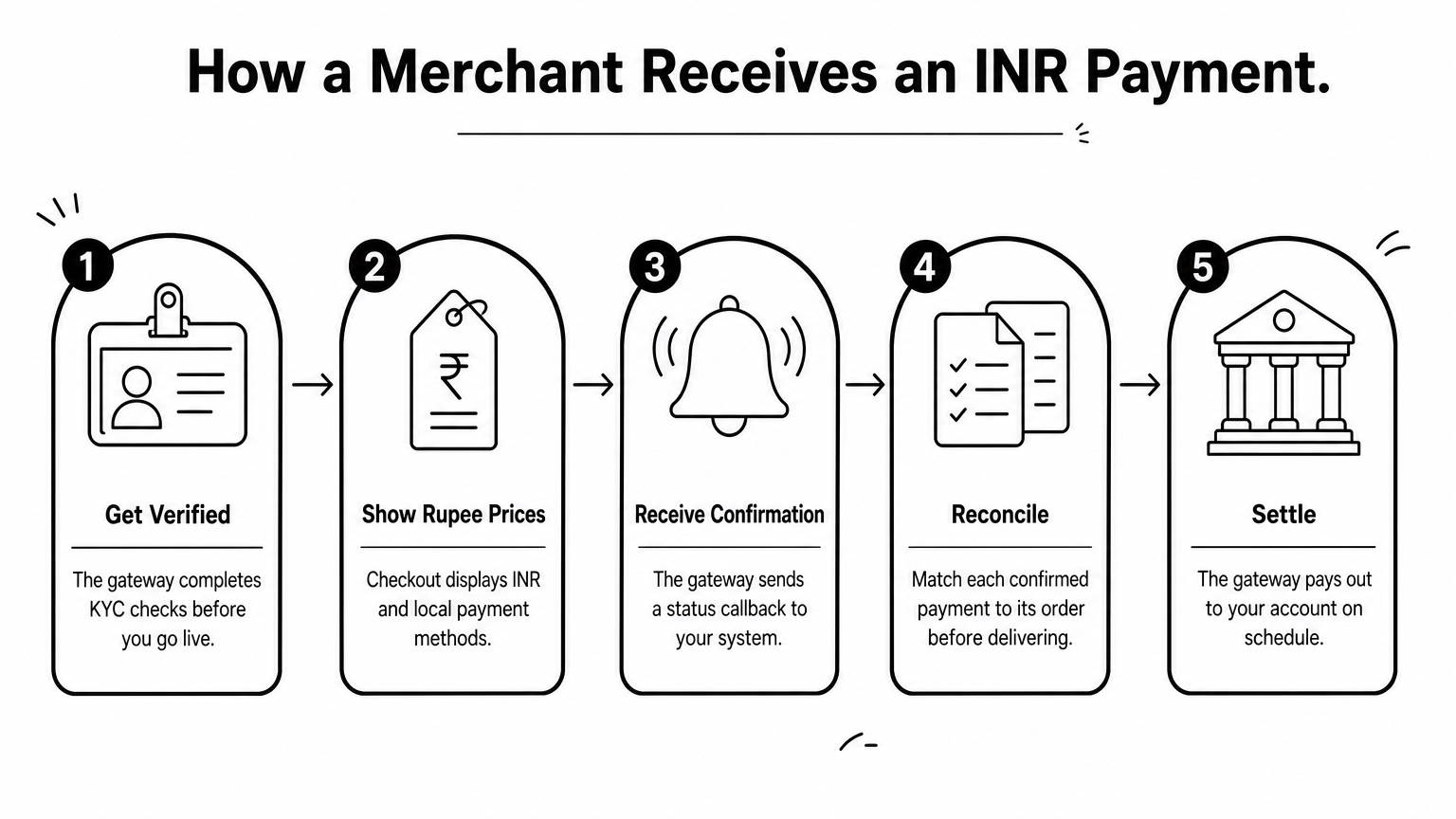
- Get verified. The gateway reviews your business and completes KYC checks before you go live.
- Show rupee prices. Integrate the gateway so checkout displays INR and the methods above.
- Receive confirmation. When the customer pays, the gateway sends a status callback to your system.
- Reconcile. Match each confirmed payment to its order before you deliver or credit the account.
- Settle. The gateway pays out to your account on the agreed schedule.
An INR payment is only complete for you once it is confirmed, reconciled, and settled.
Skipping reconciliation is the mistake we see most often. Orders marked paid without a confirmed callback create disputes that are slow to untangle.
INR vs. USD: which currency should you pay in?
Side-by-side comparison
The difference between an INR payment and a USD payment comes down to who handles the conversion. The currency you price in decides who absorbs the exchange cost, and that shapes fees, speed, and approval rates.
| Factor | INR payment | USD payment |
|---|---|---|
| Customer's price | Fixed in rupees | Converted at the bank's rate |
| Customer's extra cost | None | Exchange margin, often a cross-border card fee |
| Common methods | UPI, net banking, domestic cards | International cards, wire transfers |
| Confirmation | Seconds | Seconds for cards, days for wires |
| Decline risk | Low | Higher, since many banks restrict international use |
| Exchange risk for you | Yes, until you convert | Lower if you hold dollars |
When each currency makes sense
Choose INR when you sell to Indian consumers or small businesses, especially for low-ticket, repeat purchases such as game top-ups, subscriptions, and wallet deposits. These buyers expect UPI, and they compare your price against local competitors in rupees.
Price in the currency your customer actually spends.
USD still works for large B2B invoices and for buyers with corporate cards or treasury teams that already hold dollars. A wire for a five-figure contract does not need a QR code.
Many merchants run both. Show rupee prices and local methods by default to visitors in India, and keep USD for everyone else. The trade-off is that you carry the rupee exchange risk between collection and conversion to your home currency. Settle often, or agree a clear conversion schedule with your gateway, so a weak rupee week does not quietly shrink your margin.
How to handle INR settlement, fees, and compliance
Settlement: when and how you get paid
Settlement is where an INR payment becomes money you can actually use. Most gateways pay out on a fixed schedule, such as daily or weekly. Before you sign, ask whether payouts arrive in rupees or in another currency, and whether conversion uses a stated rate or whatever the market offers that day.
Fees to expect
Fees vary by payment method and provider, so compare the total cost of a payment gateway in India, not the headline rate. Ask for each of these in writing:
- Processing fee per transaction, which can differ for UPI, net banking, and cards.
- Currency conversion margin, if you settle outside India.
- Payout fees per transfer to your account.
- Taxes on fees, such as GST on service charges.
- Refund and dispute costs.
In our experience, surprises rarely sit in the processing rate. They hide in conversion and payout terms, so request a full fee schedule before integration.
Compliance you cannot skip
India regulates payments closely, and reputable gateways screen every merchant. Expect KYC and business due diligence, including company registration, ownership details, your website, and a clear description of your business model. Providers should reject scams, money games, and deceptive schemes, so a transparent, legitimate model is your best asset. Cross-border receipts also fall under foreign exchange rules, so confirm your structure with a local accountant or counsel.
Compliance is not a hurdle after launch. It decides whether you launch at all.
Finally, keep your own records. Matched payment logs, settlement reports, and fee statements make audits, tax filing, and dispute handling far easier.
Other meanings of INR you may come across
INR as a blood-clotting test
In medicine, INR stands for International Normalized Ratio. It comes from the prothrombin time test, which measures how long your blood takes to clot. Labs standardize the result so numbers compare across hospitals. People with no clotting problems usually score close to 1.0.

Doctors rely on it most for patients taking warfarin, a blood thinner. A common target range is 2.0 to 3.0, though some conditions call for a different one. Your care team sets your range, so ask them instead of relying on a general article.
How to tell which meaning you need
Context settles it fast. If INR sits next to an amount, a ₹ symbol, or a currency pair such as USD/INR, it means money. If it appears on a lab report beside a number between 1 and 3, it is a clotting ratio. Anyone asking what is INR payment in a business setting is dealing with the Indian Rupee.
| Where you see it | Meaning | Example |
|---|---|---|
| Invoice, checkout, bank statement | Indian Rupee | INR 1,500 |
| Exchange rate quote | Indian Rupee | USD/INR |
| Lab report or clinic note | International Normalized Ratio | INR 2.5 |
An INR on an invoice is rupees, and an INR on a lab report is a clotting ratio.
Only the first meaning affects your checkout. If you run an online business, you can ignore the medical sense and focus on the practical side: pricing in rupees, choosing local methods, and planning settlement so the money reaches you intact.
Key takeaways on INR payments
So, what is an INR payment? It is a transaction settled in Indian Rupees, usually over UPI, net banking, or domestic cards. For Indian customers, it removes conversion at checkout, which means fewer declines and more completed orders than a USD-only price.
Pricing in rupees suits consumer and low-ticket repeat sales, while USD still fits large B2B invoices. Whichever you choose, plan settlement, fees, and compliance before you launch, and get the full fee schedule in writing. The only other INR you are likely to meet is the clotting ratio on a lab report, which has nothing to do with your checkout.
If you want a partner that handles verification, local payment methods, and support after integration, book a free demo with CoinPay and talk through your India setup with our team.